

If you’ve ever wondered why a U.S. citizen working in Tokyo still contributes to America’s economic output, the GNP formula holds the answer. Gross National Product measures what a country’s residents produce and earn, regardless of where they live. Unlike GDP, it follows people—not borders. In this guide, you’ll get a plain-English breakdown of the formula, a step-by-step calculation, a definitive GNP vs. GDP vs. GNI comparison, and 2024 World Bank data across major economies.
What Is Gross National Product (GNP)?
GNP is the total market value of all goods and services produced by a country’s residents and businesses—anywhere in the world—over a set period, typically one year.
The key word is residents. GNP doesn’t care where production happens. It cares about who owns it.
official BEA definition of Gross National Product
The U.S. used GNP as its primary economic indicator until 1991, when the Bureau of Economic Analysis switched to GDP to align with international standards. GNP didn’t disappear—it just became a supporting metric, especially useful for tracking cross-border income flows.
The GNP Formula — Every Component Decoded
The Standard Formula
The official GNP formula is:
GNP = C + I + G + X + Z
| Variable | Stands For | Real-Life Example |
|---|---|---|
| C | Personal Consumption | Grocery bills, Netflix subscriptions, car payments |
| I | Private Investment | A startup buying servers; a developer building condos |
| G | Government Expenditure | Federal highway projects, military spending |
| X | Net Exports | U.S. exports minus U.S. imports |
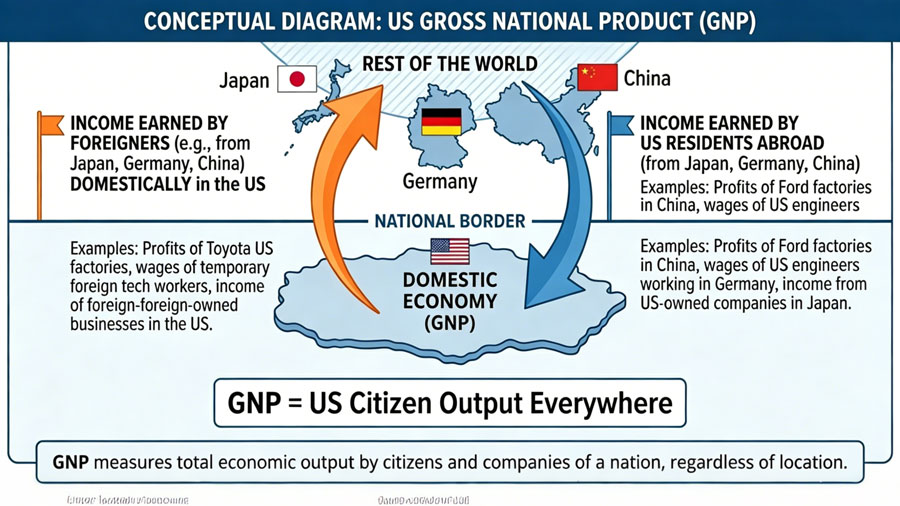
| Z | Net Foreign Income | Income U.S. residents earn abroad, minus income foreign residents earn in the U.S. |
The Z variable is what separates GNP from GDP. Everything else is identical.
The GDP-Based Alternative Formula
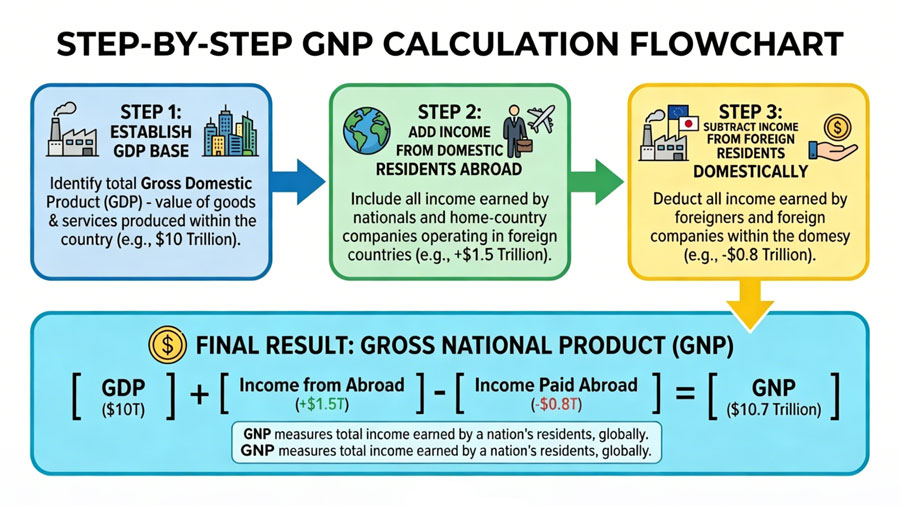
If you already have a country’s GDP figure, there’s a faster route:
GNP = GDP + Net Income from Abroad
Where Net Income from Abroad = income earned by domestic residents overseas minus income earned by foreign residents domestically.
This version is useful when working with published economic data, since GDP figures are widely available from sources like the World Bank and IMF.
how GDP is calculated and what it measures
Nominal GNP vs. Real GNP
Nominal GNP uses current prices. Real GNP adjusts for inflation using a GDP deflator—making it the right tool for year-over-year comparisons.
Real GNP = (Nominal GNP ÷ GDP Deflator) × 100
Between 2008 and 2010, U.S. nominal GNP figures looked relatively stable on the surface. Real GNP told a different story—inflation-adjusted output had contracted sharply. Always use real GNP when comparing across time periods.
How to Calculate GNP: A Step-by-Step Example
Let’s walk through a simplified calculation using a hypothetical economy—call it Country A.
Given data (in billions USD):
- Personal Consumption (C): $800
- Private Investment (I): $200
- Government Spending (G): $150
- Exports: $120, Imports: $90 → Net Exports (X): +$30
- Income earned by Country A residents abroad: $60
- Income earned by foreign residents in Country A: $25
- Net Foreign Income (Z): +$35
Step 1: Calculate GDP
GDP = C + I + G + X = 800 + 200 + 150 + 30 = $1,180B
Step 2: Add Net Foreign Income
GNP = GDP + Z = 1,180 + 35 = $1,215B
Step 3: Adjust for inflation if comparing across years
Real GNP = (1,215 ÷ Deflator) × 100
One thing to watch: exchange rates. If Country A’s currency weakens against the dollar, the foreign income component (Z) inflates in local currency terms—even if no real economic growth occurred. That’s a distortion, not a signal.
GNP vs. GDP vs. GNI — The Definitive Comparison
This is where most articles leave readers confused. Here’s the full picture in one place.
| Dimension | GNP | GDP | GNI |
|---|---|---|---|
| Measures | Output by residents | Output within borders | Income received by residents |
| Includes overseas income? | ✅ Yes | ❌ No | ✅ Yes |
| Includes net taxes from abroad? | ❌ No | ❌ No | ✅ Yes |
| Primary users | Historical U.S. standard | Global standard | World Bank, EU, HDI |
| Best for | Cross-border income tracking | Domestic economic health | International income comparison |
When GNP Exceeds GDP — And What It Signals
When domestic residents earn more abroad than foreigners earn domestically, GNP > GDP. This typically signals a nation with significant overseas investment or a large diaspora sending remittances home.
Norway is a textbook example. Its sovereign wealth fund generates substantial foreign investment returns, pushing GNP well above GDP—$102,460 vs. $87,962 per capita in 2023.
Ireland is the counterexample. Dozens of multinational corporations are headquartered there for tax purposes, generating enormous GDP figures. But most of those profits flow back to parent companies overseas—so Irish GNP runs significantly below GDP.
Why the World Bank Replaced GNP with GNI
GNI adds one layer GNP misses: net taxes and subsidies receivable from abroad. For cross-country comparisons—especially between developed and developing nations—this makes GNI more precise.
World Bank methodology for GNI per capita calculation
The World Bank now uses GNI per capita (PPP-adjusted) as its benchmark for classifying economies. GNP still appears in academic research and historical data sets, but GNI is the current institutional standard.
2024 GNP Data: How Major Economies Compare
Source: World Bank, 2023 figures (most recent available), presented per capita in USD.
| Country | GNP Per Capita | GDP Per Capita | GNP vs. GDP | Key Driver |
|---|---|---|---|---|
| Norway | $102,460 | $87,962 | GNP higher | Sovereign wealth fund returns |
| Switzerland | $95,160 | $99,995 | GNP lower | High foreign corporate activity |
| United States | $80,300 | $81,695 | Near parity | Balanced in/outflows |
| Japan | $39,030 | $33,834 | GNP higher | Extensive overseas manufacturing |
| South Korea | $35,490 | $33,121 | GNP higher | Overseas conglomerate earnings |
| Mexico | ~$11,000* | $10,800* | GNP higher | Remittances from U.S. diaspora |
| India | ~$2,600* | $2,400* | GNP higher | Overseas IT & professional income |
*Approximate estimates based on World Bank GNI proxy data.
The Mexico and India rows deserve attention. In both countries, remittances from citizens working abroad represent a meaningful share of national income—income that GDP entirely ignores. For these economies, GNP (or GNI) gives a materially more accurate picture of household financial resources.
Common Mistakes When Applying the GNP Formula
Mistake 1: Treating GNP and GDP as interchangeable. They’re related, but not the same. Swapping them in policy analysis can misrepresent where income actually originates.
Mistake 2: Comparing nominal GNP figures across years. Inflation makes raw numbers misleading. Always convert to real GNP before drawing time-series conclusions.
Mistake 3: Ignoring the exchange rate effect on Z. A weakening dollar makes foreign holdings of U.S. residents worth more in dollar terms—which inflates GNP without reflecting genuine economic gains.
Mistake 4: Double-counting dual citizens. If a producer holds citizenship in two countries, both nations may count their output. There’s no universal standard fix—just a known limitation to flag when reading GNP data.
Frequently Asked Questions
Q: What is the GNP formula in simple terms?
GNP = C + I + G + X + Z. The Z term—net income earned by domestic residents abroad—is what makes GNP different from GDP.
Q: How is real GNP different from nominal GNP?
Nominal GNP uses today’s prices. Real GNP adjusts for inflation using a GDP deflator, making it accurate for year-over-year comparisons.
Q: Which is a better economic indicator—GNP or GDP?
Depends on what you’re measuring. GDP is better for assessing domestic economic activity. GNP is better for understanding the total income of a country’s residents, wherever they are.
Q: Why did the U.S. stop using GNP in 1991?
The Bureau of Economic Analysis switched to GDP to align with global reporting standards and because GDP more accurately reflected domestic production activity.
Q: Is GNP the same as GNI?
Nearly, but not exactly. GNI adds net taxes and subsidies receivable from abroad—a distinction that matters for international institutional comparisons. The World Bank uses GNI; GNP appears more in older academic literature.
Q: How does currency depreciation affect GNP?
A weaker domestic currency increases the local-currency value of foreign holdings, boosting nominal GNP—even without any real economic change. This is why real, inflation-adjusted figures matter.
The Bottom Line
The GNP formula—GNP = C + I + G + X + Z—captures something GDP doesn’t: the economic output of people, not just places. For countries with large diasporas, significant overseas investment portfolios, or multinational corporations operating abroad, GNP tells a meaningfully different story than GDP.
It’s not a perfect metric. Exchange rates distort it. Dual citizens complicate it. And for most day-to-day economic analysis, GDP remains the global standard. But dismissing GNP entirely means missing the full picture of where a nation’s income actually comes from.
Disclaimer: This article is for informational and educational purposes only. It does not constitute financial, investment, economic, or legal advice. Economic data cited is sourced from publicly available databases including the World Bank and BEA; figures may be subject to revision. Always consult a licensed financial advisor or qualified economist before making decisions based on economic indicators.