

Most people spend decades chasing money — and never build real wealth. Understanding the wealth vs money difference is the single most important financial concept you’re probably not applying. This article breaks down exactly what separates the two, why high earners often end up broke, and a practical four-step roadmap to start building genuine, lasting wealth — not just a bigger paycheck.

What “Money” Actually Means — And Why Most People Get It Wrong
Money is a tool. That’s it.
It measures value, stores purchasing power, and moves through economies. But it is not wealth. It never was.
The confusion starts early. You get a raise. You feel richer. You spend more. The cycle repeats. What you’re really experiencing is income growth without net worth growth — and for millions of American households, that gap is enormous.
According to the Federal Reserve’s Survey of Consumer Finances, the median net worth of families in the top income quintile sits around $800,000 — but a significant portion of high earners carry net worths well below that figure due to debt, spending habits, and zero investment strategy.
The Psychological Pull of “Looking Rich”
Lifestyle inflation is quiet. It scales with your income almost automatically.
Promotion → nicer car. Bonus → bigger apartment. Six-figure salary → private school, business class, renovation loans.
None of these are wrong choices on their own. But when your spending rises in lockstep with your earning, your net worth flatlines — regardless of how impressive your salary looks on paper. That’s the trap. You look rich. You feel rich. Your balance sheet tells a different story.
What Real Wealth Actually Is: A Three-Part Definition
Wealth is not a number. It’s a condition.
Here’s the framework worth building around:
Wealth = Net Worth + Financial Resilience + Freedom of Choice
- Net Worth is the foundation: total assets minus total liabilities
- Financial Resilience means a job loss is an inconvenience, not a catastrophe
- Freedom of Choice means money no longer dictates your major life decisions
This is why a teacher who owns her home outright, maxes her 403(b) annually, and carries zero consumer debt may be wealthier than a $300K-a-year consultant who leases two cars and has three months of runway in savings.
Financial Freedom vs. Being Rich — Where’s the Real Line?
Being rich is about cash flow. Being wealthy is about options.
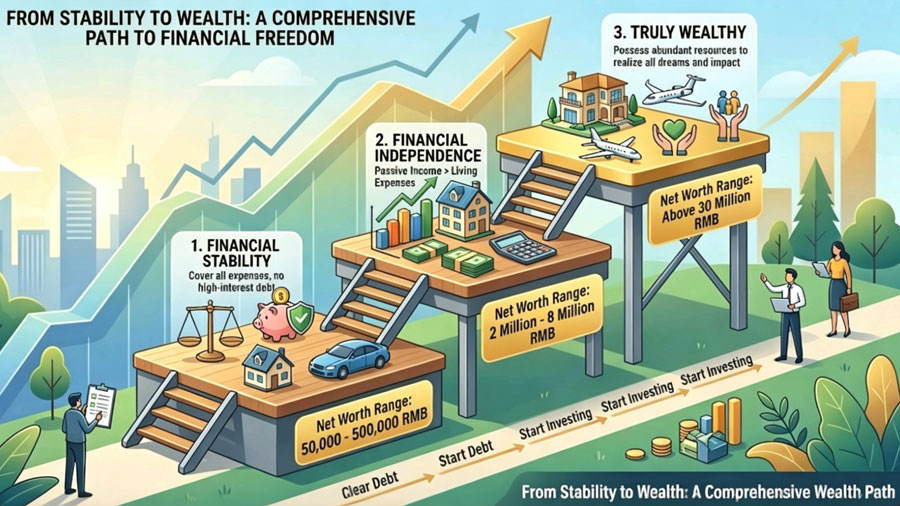
There are three meaningful levels on the path:
- Financially Stable — expenses covered, no high-interest debt, 3–6 months emergency fund
- Financially Independent — passive income covers monthly expenses without active work
- Truly Wealthy — assets generate compounding growth; money is no longer a constraint on time or choices
Most personal finance content stops at level one. Real wealth lives at levels two and three.
The 2024 Charles Schwab Modern Wealth Survey found that Americans now consider $2.5 million in net worth the threshold for being “wealthy” — up from previous years, reflecting both inflation and rising financial awareness.
Wealth vs Money: A Side-by-Side Breakdown
| Dimension | Money (Income-Focused) | Wealth (Net Worth-Focused) |
|---|---|---|
| Primary metric | Monthly income | Net worth & asset base |
| Time horizon | Short-term | Long-term |
| Lifestyle driver | Consumption | Investment & compounding |
| Risk exposure | High — income-dependent | Resilient — diversified assets |
| Freedom level | Conditional on employment | Unconditional |
| Job loss impact | Crisis | Manageable setback |
The difference isn’t just mathematical. It’s behavioral.
The Mindset Shift: From Earning to Owning
People focused on money ask: How much am I making this month? People building wealth ask: What do I own that will be worth more next year?
Thomas Stanley’s research in The Millionaire Next Door found that the majority of U.S. millionaires live in middle-class neighborhoods, drive used cars, and avoid conspicuous consumption entirely. Their secret wasn’t a high income — it was a gap between what they earned and what they spent, deployed consistently into appreciating assets.
how to calculate your net worth
Why High Earners Fail to Build Wealth: 4 Specific Patterns
1. Lifestyle Inflation That Never Stops
Every income increase gets absorbed by a new spending category. The savings rate stays flat. The net worth barely moves. This is the most common and least discussed wealth killer in the $100K–$250K income bracket.
2. Ignoring Tax-Advantaged Accounts
The 2025 IRS contribution limits are $23,500 for 401(k) plans and $7,000 for IRAs. Compounded over 30 years at a 7% average annual return, maxing a 401(k) alone can generate over $2 million.
Most people leave this on the table.
Compliance note: Contribution limits adjust annually. For retirement planning specific to your situation, consult a Certified Financial Planner (CFP®).
IRS retirement plan contribution limits 2025
3. Treating Home Equity as a Full Investment Strategy
A home is not a portfolio. It’s illiquid, expensive to maintain, and concentrated in a single asset class. Building wealth requires a diversified base — equity, bonds, real estate, and cash equivalents.
4. No Written Financial Plan
A 2023 CFP Board study found that Americans with a written financial plan are significantly more confident about retirement — and consistently accumulate more assets than those without one. Yet fewer than one-third of Americans have a formal plan in place.
How to Build Wealth, Not Just Income: A 4-Step Roadmap
This is where most personal finance content stops talking and starts waving its hands. Here’s what actually works.
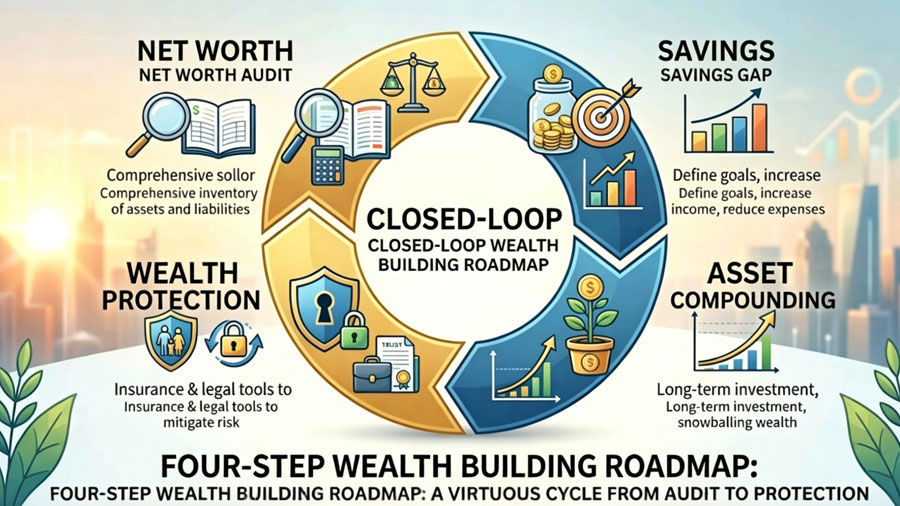
Step 1: Run a Net Worth Audit
List every asset (savings, investments, property, retirement accounts) and every liability (mortgage, student loans, car loans, credit cards). Subtract. That number is your real financial starting point — not your salary.
Free tools: Empower (formerly Personal Capital), YNAB.
Step 2: Close the Gap Between Earning and Keeping
Target a savings rate of at least 20% of gross income. If you’re starting from zero, the 50/30/20 framework — 50% needs, 30% wants, 20% savings/investing — gives you a workable structure.
The goal isn’t deprivation. It’s the intentional gap between income and spending that becomes your compounding engine.
Step 3: Let Assets Work While You Sleep
$500 per month invested in a low-cost index fund at a 7% average annual return grows to approximately $566,000 over 30 years. That’s not a trick. That’s compounding.
Dividend reinvestment, index funds, rental income — these are the mechanisms that convert income into lasting wealth. You don’t need to pick stocks. You need to start, and stay consistent.
Step 4: Protect What You Build
Wealth without protection is fragile. This means:
- Term life insurance if others depend on your income
- An umbrella liability policy once your net worth exceeds $500K
- A basic will and updated beneficiary designations on every account
Compliance note: Insurance and estate planning needs vary significantly by individual circumstance. This article is for educational purposes only. Consult a licensed financial advisor or estate attorney for personalized guidance.
Wealthy Habits vs. Rich Habits: What the Research Shows
Dave Ramsey’s Millionaire Study — which surveyed over 10,000 U.S. millionaires — found that 79% did not receive any inheritance. They built wealth through consistent behavior, not windfalls.
The behavioral gap between rich and wealthy breaks down like this:
Rich habits (income-focused):
- Upgrade lifestyle with every raise
- Prioritize status purchases
- Treat investment as something to do “later”
Wealthy habits (net worth-focused):
- Automate savings before spending
- Buy assets, not liabilities
- Invest consistently through market cycles, not just bull markets
The pattern isn’t about sacrifice. It’s about direction.
FAQ: Wealth vs Money — Your Most Common Questions
Q: Can you be wealthy without being rich?
Yes. Wealth is about net worth and financial freedom, not income. A person with modest income, no debt, and significant invested assets is wealthier than a high earner with no savings and $200K in consumer debt.
Q: What net worth is considered wealthy in the U.S. in 2025?
According to the Charles Schwab Modern Wealth Survey, Americans define “wealthy” as having approximately $2.5 million in net worth. “Financially comfortable” starts around $780,000.
Q: Is a high salary enough to build wealth?
No. Salary creates the opportunity to build wealth. Whether it does depends entirely on your savings rate, investment behavior, and debt management — not the income number itself.
Q: What’s the fastest way to shift from an income mindset to a wealth mindset?
Start with a net worth audit. When you see your actual balance sheet — not your salary — your financial decisions shift immediately. Most people have never calculated their real net worth.
Q: How does financial freedom differ from simply being rich?
Being rich means having high income or visible assets. Financial freedom means your passive income covers your living expenses — you work because you want to, not because you have to.
The Only Financial Goal Worth Chasing
Money is a tool. Wealth is what you build with it.
The gap between the two isn’t income — it’s intention. The high earner who never builds wealth and the modest earner who retires early made different choices about what to do with the gap between what they earned and what they spent.
That gap, invested consistently over time, is the only financial engine that matters.
Disclaimer: The content in this article is for educational and informational purposes only. It does not constitute financial, investment, tax, or legal advice. Individual financial circumstances vary. Always consult a licensed financial advisor, CFP®, or other qualified professional before making financial decisions.