

Here’s a number most homebuyers never run: after factoring in property taxes, maintenance, insurance, and transaction costs, the real net return on U.S. residential real estate averages just 1–2% annually — barely above zero in real terms. Yet millions of Americans treat a home purchase as the cornerstone of their financial plan. This article breaks down why real estate is a bad investment for most middle-class households, what the data actually shows, and what smarter alternatives exist. No cheerleading. Just math.
Disclaimer: This article is for informational purposes only and does not constitute financial, tax, or legal advice. Consult a licensed financial advisor or tax professional before making any investment decisions.
1. The Returns Look Great — Until You Do the Real Math
The headline number sounds compelling: U.S. home prices have risen significantly over the past two decades. But gross appreciation is not your return. Your return is what’s left after every dollar you spent owning that property.
The Hidden Cost Stack Nobody Shows You at Closing
Here’s what eats into your gain every single year:
- Property taxes: The average effective rate in the U.S. is 1.1% of home value annually [U.S. property tax rate data]
- Maintenance: The widely cited “1% rule” means a $400,000 home costs $4,000/year minimum — and that’s optimistic
- Homeowners insurance: National average is approximately $1,400–$2,000/year and rising fast in high-risk states
- HOA fees: Median cost is roughly $170/month nationally, per Bankrate data
- Transaction costs on entry and exit: Buying and selling together typically consumes 8–10% of the home’s value
Run those numbers over 10 years on a $400,000 home and you’ve spent $80,000–$120,000 in carrying costs before a single mortgage interest payment.
What Shiller’s Research Actually Found
Nobel Prize-winning economist Robert Shiller analyzed U.S. home prices from 1890 to 2012. His conclusion: after adjusting for inflation, real home prices appreciated at roughly 0.6% per year. That’s not a typo.
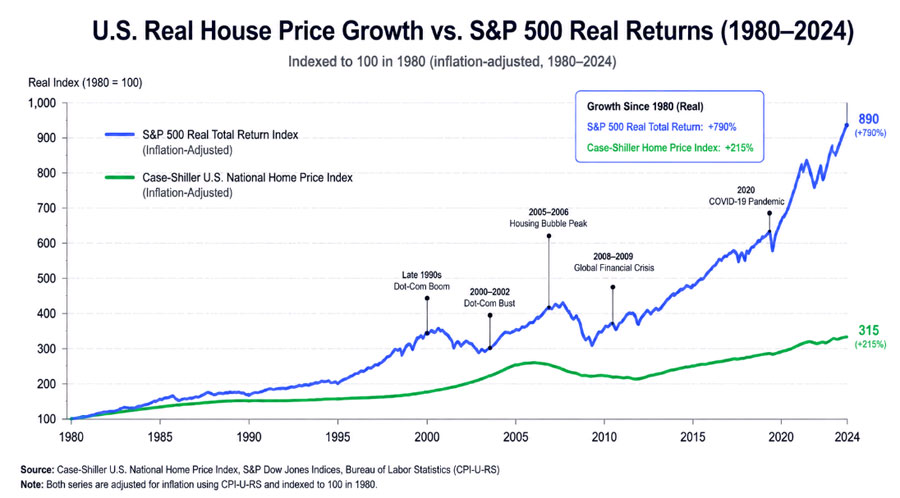
Over the same long horizon, U.S. equities returned approximately 6.8% annually in real terms (Siegel, Stocks for the Long Run). That gap compounds into a chasm over 20–30 years.
2. Illiquidity: Your Money Is Locked Up Exactly When You Need It
Stocks can be sold in seconds. Real estate cannot. This isn’t a minor inconvenience — it’s a structural flaw that becomes catastrophic during life’s worst moments.
The Three Scenarios That Expose the Problem
Consider three events that hit Americans every year: job loss, a medical emergency, or divorce. Each creates an urgent need for cash. Each is incompatible with owning an asset that takes 30 to 90 days to sell in a healthy market — and far longer when conditions deteriorate.
If you’re forced to sell quickly, you accept a discount. Researchers estimate distressed property sales close at 10–15% below fair market value. Add the 5–6% seller’s agent commission, and you’re potentially losing 20% of the asset’s value just to access your own money.
The 2008 Lesson People Already Forgot
When the housing market froze in 2008, homeowners couldn’t sell — not at any price that covered their mortgage balance. Illiquidity didn’t just create inconvenience. It created foreclosure. Over 3.8 million foreclosure filings were recorded in 2010 alone (RealtyTrac data). The problem wasn’t just falling prices. It was being unable to exit.
3. Transaction Costs Make Real Estate Economically Sticky
One of the most overlooked risks of investing in real estate is how expensive it is to get in and out.
A typical U.S. real estate transaction burns through:
- Buyer’s closing costs: 2–5% of purchase price (loan origination, appraisal, title insurance, prepaid taxes)
- Seller’s costs: 5–6% agent commission + transfer taxes + attorney fees
- Total round-trip friction: Often 8–10% of the home’s value
On a $500,000 home, that’s $40,000–$50,000 lost before price movement even enters the equation. By contrast, buying a broad-market ETF costs 0.03–0.20% in expense ratios annually with zero transaction friction.
This is why real estate vs. stock market returns comparisons that ignore transaction costs are misleading. Stocks win by an even wider margin on a net basis.
4. Geographic Lock-In Kills Career Flexibility
Why millennials are not buying homes at the same rates as prior generations isn’t just a cultural shift — it’s a rational response to labor market realities.
The average American changes jobs every 4.1 years (Bureau of Labor Statistics). The average homeowner stays in their home for 13 years (National Association of Realtors, 2023). That mismatch isn’t accidental. High transaction costs make it financially painful to sell within the first 5–7 years of ownership.
The Opportunity Cost of Staying Put
In knowledge-economy careers — tech, finance, consulting, healthcare — the salary gap between staying in one market and relocating to a higher-opportunity city can easily be $20,000–$40,000 per year. A mortgage that traps you in Cleveland when your industry is paying premiums in Austin or Seattle isn’t just an inconvenience. It’s a compounding career cost.
rent vs. buy decision framework for young professionals
5. Leverage Amplifies Losses Just as Readily as Gains
Leverage is the feature most real estate advocates celebrate. It’s also the mechanism that wipes people out.
How the Math Works Against You
Say you buy a $500,000 home with $100,000 down and a $400,000 mortgage. The home drops 20% in value to $400,000. Your loss: 100% of your equity. The lender still owns $400,000. You own nothing — and still owe the mortgage payment.
Meanwhile, the interest you paid over those years? Gone. The transaction costs to enter? Gone. The maintenance costs? Gone.
A 20% price drop — entirely plausible in any local market downturn — doesn’t just cost you 20% of your investment. With typical leverage, it costs you everything you put in. As Howard Marks, co-founder of Oaktree Capital Management, put it: leverage “carries an extra risk on the downside that isn’t offset by accompanying upside: the risk of ruin.”
Rising interest rates compound this. At 7%+ mortgage rates (the environment of 2023–2024), the carrying cost of a leveraged property purchase increases dramatically, compressing the margin for error to near zero.
6. Concentration Risk: All Your Eggs, One Very Expensive Basket
Most American homeowners have 70–80% of their net worth tied to a single property in a single zip code. No financial advisor would construct a portfolio this way on purpose.
Location Risk Is Real and Uncontrollable
Detroit. Parts of the Rust Belt. Certain Sun Belt markets that boomed and collapsed within a decade. Local economic shifts — a major employer leaving, a highway rerouted, a school district declining — can devastate property values in ways no homeowner can hedge against.
Climate Risk Is the Emerging Wildcard
Homeowners insurance in Florida, California, and parts of the Gulf Coast has spiked 40–80% since 2020, with several major insurers exiting those markets entirely. Some properties in high-risk zones are becoming effectively uninsurable — and therefore unmortgageable and unsellable.
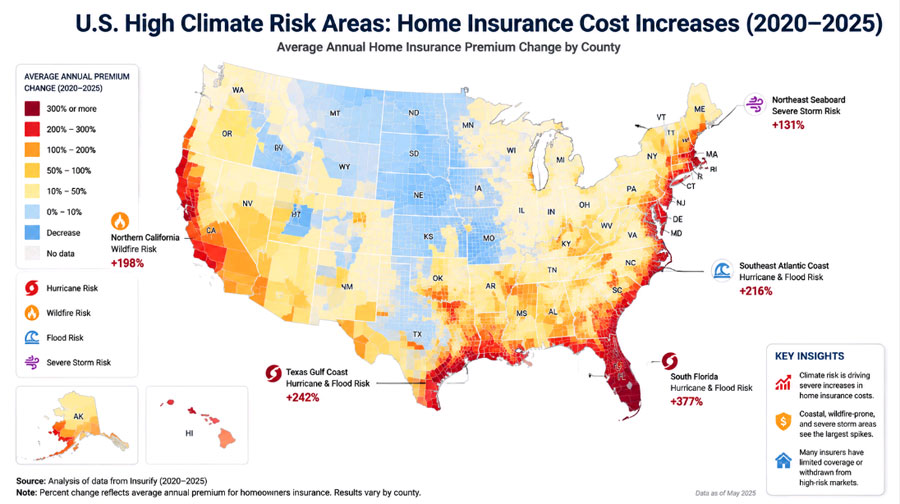
climate risk impact on home values and insurance costs
7. Rental Property Is a Part-Time Job, Not Passive Income
The appeal of rental income is real. The reality is less glamorous.
Self-managing a rental property typically requires 8–15 hours per month — tenant screening, lease renewals, maintenance coordination, rent collection, and the occasional 2 a.m. emergency call. Outsource it to a property manager and pay 8–12% of monthly rent, which on a $2,000/month rental is $2,400/year off the top.
Stack that with vacancy periods (industry standard is 5–8% annual vacancy), property taxes, insurance, maintenance, and mortgage interest — and many landlords discover their “passive” income is functionally zero or negative on a cash flow basis for the first several years.
8. Better Alternatives for Building Wealth in 2026
None of this means real estate exposure is worthless in a portfolio. It means physical real estate ownership is a poor vehicle for most middle-class investors.
REITs vs. Physical Real Estate: The Core Comparison
| Factor | Physical Real Estate | REITs |
|---|---|---|
| Minimum investment | $80K–$200K+ (down payment) | $1–$50 per share |
| Transaction costs | 8–10% round trip | ~0.25% brokerage fee |
| Liquidity | 30–180 days to sell | Seconds on exchange |
| Diversification | Single property, single market | Hundreds of properties, multiple sectors |
| Management required | Active (or 8–12% fee) | None |
| Annual gross returns (20-yr avg, U.S.) | ~4–5% | ~8–10% (NAREIT data) |
| Transparency | Opaque, private market | Public, real-time pricing |
REITs — publicly traded real estate investment trusts — give you exposure to commercial real estate, apartment complexes, data centers, and healthcare facilities without the illiquidity, management burden, or geographic concentration.
The Three-Fund Portfolio Case
For most 28–45-year-old middle-class investors, a simple index fund portfolio — U.S. total market, international, bond fund — combined with a REIT ETF allocation (such as VNQ or SCHH) provides real estate exposure at a fraction of the cost and complexity of property ownership.
When Buying a Home Does Make Financial Sense
This article argues against real estate as an investment. Buying a home as a place to live long-term is a different calculation.
Purchasing likely makes sense if:
- You plan to stay in the same city for 10+ years
- The local price-to-rent ratio favors buying (generally below 20:1)
- You have a stable emergency fund separate from the down payment
- You’re not sacrificing retirement contributions to afford the mortgage
If those conditions don’t all apply, renting and investing the difference is often the stronger financial outcome.
FAQ: Why Real Estate Is a Bad Investment
Q: Is real estate a bad investment in 2026?
For most middle-class investors seeking wealth-building returns, yes — when factoring in net returns after all costs, illiquidity, and concentration risk. It can make sense as a long-term primary residence but performs poorly as a pure investment vehicle compared to equities.
Q: Why do financial advisors still recommend buying a home?
Many do for lifestyle and forced-savings reasons, not pure investment return. A mortgage functions as a savings mechanism for people unlikely to invest disciplined monthly contributions otherwise. That’s a valid reason — just different from claiming real estate is the best investment.
Q: What percentage of net worth should be in real estate?
Most financial planning guidelines suggest keeping primary residence equity below 30–40% of total net worth. Concentration above that level exposes the household to significant single-asset risk.
Q: Is renting really “throwing money away”?
No. Rent buys you housing, flexibility, and liquidity. A mortgage buys you those same things plus ownership — but the interest, taxes, insurance, and maintenance you pay in the early years often exceeds equivalent rent. Run the NYT Rent vs. Buy calculator with your local numbers before deciding.
Q: Are REITs safer than buying property directly?
REITs carry their own risks, including market volatility and sector concentration. But for most investors, the liquidity, diversification, and low entry costs of REITs make them a lower-risk way to access real estate returns than owning physical property.