

Buying a home that doesn’t exist yet takes nerve — and a clear process. Understanding how to buy off the plan the right way can save you tens of thousands of dollars; getting it wrong can cost you your deposit. This guide walks you through every step: from researching the developer to protecting yourself if property values drop before settlement. No fluff, no vague advice — just a practical framework you can use right now.

What Does Buying Off the Plan Actually Mean?
When you buy off the plan, you’re agreeing to purchase a property before construction is complete — sometimes before a single brick has been laid. Your decision is based on floor plans, renders, and a contract of sale, not a finished home you can walk through.
This isn’t inherently risky. Millions of buyers do it successfully every year. But it’s structurally different from buying an existing property, and those differences create specific risks that standard homebuying advice won’t prepare you for.
Who Buys Off the Plan — and Why
- First-time buyers use it to enter the market at today’s prices while spreading upfront costs over the construction period.
- Investors target capital growth during the build phase and may benefit from depreciation allowances on new properties.
- Owner-occupiers value the ability to customize finishes and layouts before handover.
Each group faces different risk profiles. An investor who can absorb a delayed settlement has more flexibility than a first-time buyer who has already given notice on their rental.
The Real Pros and Cons — With Honest Conditions Attached
Most pros-and-cons lists tell you the upside without the asterisk. Here’s what the fine print actually says.
| Advantage | When It Actually Works |
|---|---|
| Price locked at today’s rate | Only benefits you if the market rises during construction |
| Stamp duty concessions | Varies by state/province — verify your eligibility before assuming |
| Time to save more money | Requires the build timeline to stay on schedule |
| Customization of finishes | Usually only available to early-stage buyers, before options close |
| New-build warranty coverage | Only as good as the warranty terms — read them carefully |
| Risk | How Often It Actually Happens |
|---|---|
| Developer insolvency | Low but catastrophic if your deposit isn’t in a trust account |
| Property value drops before settlement | More common than most buyers expect in cooling markets |
| Mortgage offer expires before completion | Frequent on projects that run 12–24 months |
| Finished product doesn’t match the renders | One of the most common complaints from off-plan buyers |
| Construction delays | Common enough that your contract must include a long-stop date |
off-plan buyer complaint data and construction delay statistics
The Full Cost of Buying Off the Plan
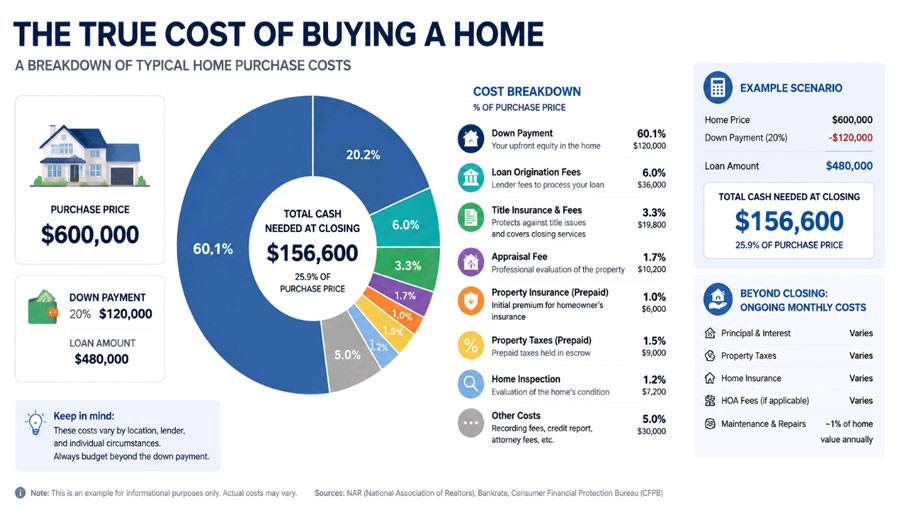
Competitors quote you a purchase price. Here’s the actual bill.
| Cost Item | Typical Range | Notes |
|---|---|---|
| Deposit | 5%–10% of purchase price | Paid at contract exchange |
| Stamp duty / transfer tax | Varies by jurisdiction | First-time buyers may qualify for exemptions |
| Independent conveyancer fees | $1,500–$3,500 | Do not use the developer’s solicitor |
| Mortgage application fees | $300–$600 | Some lenders waive these |
| Pre-completion snagging inspection | $300–$800 | Non-negotiable — budget for this |
| Strata / HOA management fees | $1,000–$5,000+/year | Many new developments carry ongoing charges |
| Temporary housing during delays | Varies | Easily overlooked; budget a contingency |
The deposit alone on a $600,000 property at 10% is $60,000. Factor in all of the above before you sign anything.
How to Buy Off the Plan: A 9-Step Process
Step 1: Know Your Borrowing Limit Before You Visit a Showroom
Get a mortgage in principle before you fall for a floor plan. Not all lenders will finance off-plan purchases, and those that do may apply stricter loan-to-value ratios (LVRs) than on existing properties. Speak to a broker who specializes in new-build financing — their knowledge of which lenders have longer offer validity periods (more on that in Step 5) will save you significant stress later.
how to get mortgage pre-approval for a new build property
Step 2: Research the Developer — Specifically, Not Generally
A Google search isn’t enough. You need to know:
- How many projects have they completed on time? Ask for a reference list of completed developments and visit them.
- Are they financially solvent? Check public company filings or business credit reports.
- Do they have active legal disputes? Court record searches are public in most jurisdictions.
- What do previous buyers say? Search the development name plus “reviews” or “problems” — not just the developer’s brand name.
A developer with a polished website and a history of delayed completions is a developer to avoid.
Step 3: Read the Plans and Specifications — Line by Line
You’re buying a document, not a building. The glossy brochure is marketing material. The contract specifications are what the developer is legally obligated to deliver.
Watch for these specific phrases:
- “Or equivalent” — this lets the developer substitute materials
- “Subject to change” — this applies to layouts and finishes
- Approximate floor areas — actual delivered size may be smaller
Ask your conveyancer to ensure every finish, fitting, and dimension you care about is listed in writing in the contract itself.
Step 4: Hire Your Own Conveyancer — Not the Developer’s
This is where buyers lose their protection. Developers often recommend or pressure buyers to use their preferred solicitor. That solicitor receives ongoing business from the developer. Their loyalty is divided at best.
Your conveyancer should independently review:
- Sunset clause / long-stop completion date (see Step 5)
- Deposit protection mechanism (trust account confirmation)
- Whether the contract price is locked at exchange
- Dispute resolution and defect remedy clauses
- Strata and estate management fee obligations
Step 5: Understand the Mortgage Expiry Problem — and Solve It in Advance
Standard mortgage offers are valid for six months. Most off-plan builds take 12–24 months. That gap is a serious problem.
Here’s what can go wrong: your offer expires, you reapply, and by then the property’s value has dropped. The lender’s new valuation comes in lower, your LVR increases, and suddenly you need a larger deposit — or you can’t get a loan at all.
Three ways to protect yourself:
- Ask your broker specifically about lenders offering extended validity periods (some go to 9–12 months for new builds)
- Have your conveyancer insert a long-stop completion date in the contract — if the developer misses this date, you can exit and recover your deposit
- Make sure the long-stop date falls before your mortgage offer expires
Step 6: Pay Your Deposit — and Verify It’s Protected
At contract exchange, you’ll typically pay 5%–10% as a deposit. Before you hand over that money, confirm in writing:
- The deposit is held in a statutory trust account (not the developer’s operating account)
- The developer carries developer insurance covering buyer deposits
- Your contract specifies what happens to the deposit if the developer becomes insolvent
If a developer is evasive about any of these points, that’s a clear signal.
Step 7: Monitor the Build — Stay Engaged
Don’t disappear after signing. Request written progress updates every 90 days. Visit the site if permitted. Keep a record of every communication.
If the developer signals delays, engage your conveyancer immediately. A delay that pushes past your mortgage offer expiry or long-stop date needs to be addressed in writing before it becomes a crisis.
Step 8: Pre-Completion Inspection — Never Skip It
Before you accept the keys, have a professional snagging inspector assess the property independently. This inspection catches everything from cosmetic issues (uneven paint, misaligned tiles) to structural defects (broken roof trusses, faulty waterproofing).
The inspection report goes to your conveyancer and to the developer. The developer is legally responsible for rectifying listed defects before handover. Once you accept the property without a documented snag list, your leverage disappears.
Step 9: Settlement — Your Final Checklist
When the developer issues a “notice to complete,” you typically have 10 working days to settle. In that window:
- Confirm your final mortgage approval is in place
- Do a final walkthrough and verify all snags have been addressed
- Review the final settlement statement for any unexpected charges
- Confirm strata levies, utility connections, and title transfer are in order
what to check at property settlement — step-by-step settlement checklist
What Happens If Property Value Drops Before Settlement?
This is the question every off-plan buyer should ask — and almost no one does until it’s too late.
Here’s the scenario: you agreed to buy at $550,000. Two years later, at settlement, the bank values the property at $490,000. You still owe the agreed price, but the bank will only lend against $490,000. The $60,000 gap is your problem.
Your three options:
- Top up your deposit to cover the shortfall — requires cash reserves you may not have planned for
- Renegotiate the purchase price with the developer — possible in a buyer’s market, unlikely in a rising one
- Exit via a contractual clause — only available if your conveyancer inserted a valuation condition into the contract before you signed
The clause you need reads something like: “Subject to the property being valued by the purchaser’s lender at no less than the purchase price.” Most developers resist this. Push for it anyway.
Key Questions to Ask the Developer Before You Sign
Don’t treat these as a casual checklist. Listen carefully to the answers — and note the red flags.
| Question | Red Flag Answer |
|---|---|
| Is my deposit held in a statutory trust account? | “Yes, it’s all handled by our team” (vague non-answer) |
| What is the long-stop completion date? | “We expect to be done well before that” (no specific date) |
| Is the contract price locked at exchange? | “Prices are subject to market review” |
| Can I commission an independent pre-completion inspection? | “That’s not how we operate” |
| What new-build warranty is provided? | “We stand behind our work” (no specifics) |
| Are there strata or HOA fees — what’s the projected annual cost? | “Fees are still being determined” |
FAQ: Buying Off the Plan
What deposit do I need to buy off the plan?
Most developers require 5%–10% of the purchase price at contract exchange. On a $600,000 property, that’s $30,000–$60,000 in cash. Some developers accept deposit bonds as an alternative to cash, which can preserve your liquidity during the build.
Can I get a mortgage for an off-plan property?
Yes, but not all lenders offer them, and those that do may apply tighter LVR limits. Getting a mortgage in principle from a new-build specialist broker before you sign any contract is essential. Standard mortgage offers last six months — shorter than most build timelines — so extended-validity products are worth seeking out.
What are the biggest risks of buying off the plan?
Developer insolvency (losing your deposit), property value dropping before settlement (creating a financing gap), mortgage offer expiry during a long build, and the finished property not matching specifications. All four are manageable with the right contract clauses and professional advice.
Can I back out of an off-plan purchase?
After exchanging contracts, exit is difficult and typically costly. Your ability to withdraw without penalty depends on specific clauses in your contract — such as a valuation condition or long-stop date trigger. Without those clauses, walking away usually means forfeiting your deposit and potentially facing legal action from the developer. This is why independent legal review before signing is not optional.
How long does an off-plan purchase typically take?
From contract exchange to settlement, timelines vary widely — anywhere from 12 months for a smaller development to 3+ years for large mixed-use projects. Always ask the developer for a specific anticipated completion date and a contractual long-stop date.
Disclaimer
The information in this article is provided for general educational purposes only and does not constitute financial, legal, or investment advice. Property markets, regulations, and lending policies vary significantly by location and change over time. Before making any property purchasing decision, consult a licensed financial adviser, a qualified conveyancing solicitor, and a registered mortgage broker who can assess your individual circumstances.