

Introduction
Retirement how much do I need? Most calculators give you one number and call it done. That’s the problem. Your retirement number depends on your spending, your health, your Social Security timing, and how long you live. This guide walks through the real math, with actual figures, so you can stop guessing.
Why the “70% of Income” Rule Doesn’t Work for Everyone
Financial media loves the 70% rule. Spend less than you earned, retire happy. It’s a decent starting point, nothing more.
Here’s where it breaks down: two people earning $90,000 a year can have completely different retirement costs. One rents, one owns outright. One has a chronic health condition, one doesn’t. One wants to travel four months a year, one wants to garden.
The Variables That Actually Move Your Number
- Your expected retirement age and life expectancy
- Housing status (mortgage-free vs. still paying)
- Healthcare needs before Medicare eligibility
- Whether you’ll relocate to a lower cost-of-living area
- Your Social Security claiming strategy
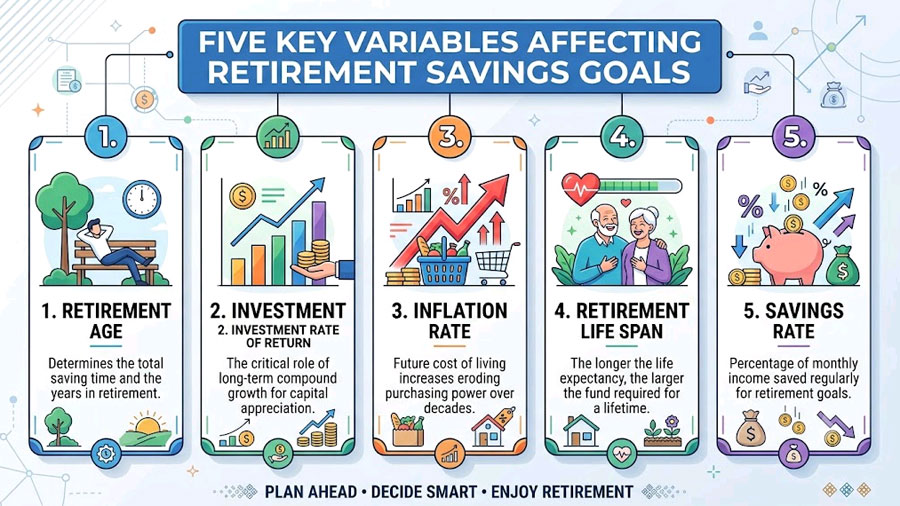
How Much Money Do You Need to Retire? Three Ways to Calculate It
The 25x Rule
Take your expected annual retirement spending and multiply by 25. Spend $60,000 a year, you’d need $1.5 million invested. Simple. But it assumes a static withdrawal rate and ignores Social Security income entirely.
The 4% Rule, Explained Properly
Financial planner Bill Bengen introduced this in 1994: withdraw 4% of your portfolio in year one, then adjust for inflation each year after, and your money should last 30 years based on historical market data. It’s not a guarantee. Sequence-of-returns risk (a market crash early in retirement) can break the math even when the average return looks fine over decades.
Recent research, including work from Morningstar, suggests a more conservative starting withdrawal rate closer to 3.7% for portfolios that need to last longer than 30 years. [Latest research data on sustainable withdrawal rates] The takeaway: build in a buffer, don’t plan to the exact percentage.
The Expense-Replacement Method
This one starts from your actual budget, not a rule of thumb.
Example: A dual-income couple spending $70,000 a year today expects $55,000 in retirement after the mortgage is paid off. Subtract $30,000 in expected Social Security, and they need their portfolio to generate $25,000 a year. At a 4% withdrawal rate, that’s a target of $625,000.
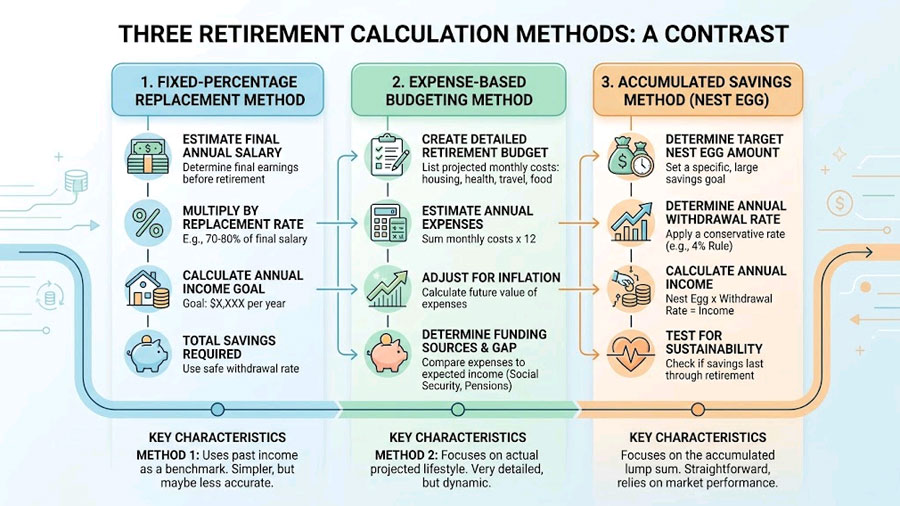
Average Retirement Savings by Age — Where Do You Stand?
| Age | General Savings Target | Common Reality |
|---|---|---|
| 30 | 1x annual salary | Often below target |
| 40 | 3x annual salary | Gap widens for late starters |
| 50 | 6x annual salary | Catch-up contributions become critical |
| 60 | 8x annual salary | Final stretch before withdrawal phase |
| 67 | 10x annual salary | Full retirement age target |
View the complete comparison of savings benchmarks across all age groups
What If You’re Starting Late?
Catch-up contributions exist for exactly this reason. For 2026, the IRS raised 401(k) limits to $24,500, with an additional $8,000 catch-up for savers 50 and older, bringing the total to $32,500. Workers aged 60 to 63 get an even higher catch-up of $11,250, for a total of $35,750. IRA limits rose to $7,500, with a $1,100 catch-up for those 50 and older. [Official Announcement on 2026 IRS Retirement Account Contribution Limits]
If you’re 52 with modest savings, maxing out both a 401(k) and a spousal IRA can add over $60,000 a year between two earners. That’s not a small correction. That’s a real strategy.
The Building Blocks — Where Retirement Income Actually Comes From
| Account Type | Tax Treatment | 2026 Limit | Best For |
|---|---|---|---|
| Traditional 401(k) | Pre-tax now, taxed later | $24,500 | High earners lowering current tax bill |
| Roth IRA | After-tax now, tax-free later | $7,500 | Younger savers expecting higher future tax rates |
| SEP IRA | Pre-tax, employer-funded | Up to $72,000 | Self-employed and small business owners |
| SIMPLE IRA | Pre-tax | $17,000 | Small businesses without a 401(k) |
Social Security — How Much Will It Really Cover?
Claiming at 62 locks in a permanently reduced benefit. Waiting until 70 increases it by roughly 8% per year past full retirement age. For most people, delaying even a few years meaningfully changes the retirement number needed from personal savings.
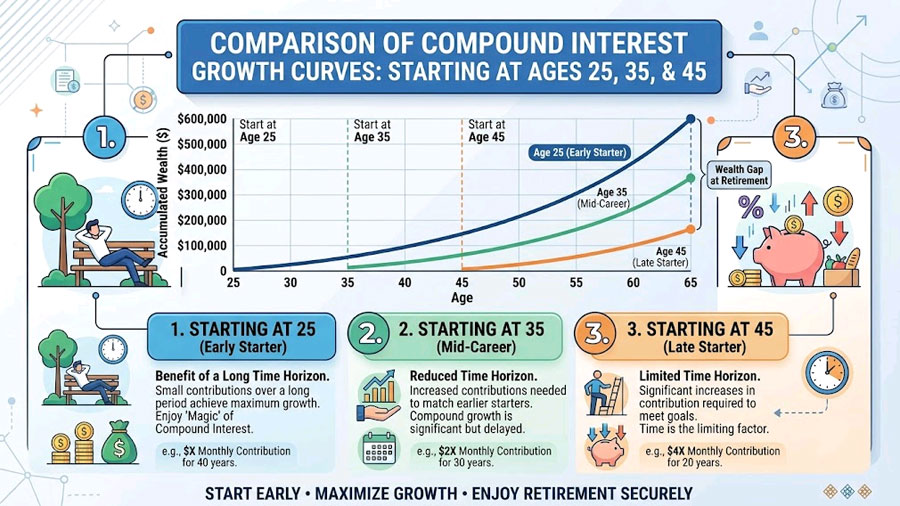
Compounding — Why Ten Years Matters More Than You Think
Someone who saves $500 a month starting at 25 ends up with far more at 65 than someone saving $1,000 a month starting at 45, assuming the same average return. Time in the market does more work than the size of your contribution.
Retirement Costs People Consistently Underestimate
Healthcare Before Medicare
If you retire before 65, you’re paying for private insurance out of pocket. This gap is one of the most common budget-busters in early retirement planning.
Taxes on Withdrawals
Money coming out of a traditional 401(k) or IRA is taxed as ordinary income. A $60,000 withdrawal isn’t $60,000 in your pocket. Roth accounts sidestep this, which is why tax diversification across account types matters.
Inflation’s Slow Bite
At 3% average inflation, prices double roughly every 24 years. A retirement that starts at 65 and lasts to 90 will see costs more than double along the way. Your number needs to account for that, not just today’s cost of living.
Real-World Scenarios — What “Enough” Actually Looks Like
Scenario A — Couple, age 35, retiring at 65: Targeting $1.4 million with 30 years to save. Consistent contributions and market growth carry most of the weight here.
Scenario B — Single professional, age 45, starting late: Needs an aggressive savings rate, likely 25-30% of income, plus full use of catch-up contributions after 50.
Scenario C — Early retiree (FIRE), age 30: Targeting retirement by 45 requires a much higher savings rate today, often 50% or more of income, since the withdrawal period stretches far longer.
Building and Stress-Testing Your Personal Number
- List your current annual expenses
- Subtract costs that disappear in retirement (mortgage, commuting, retirement contributions themselves)
- Add costs that increase (healthcare, travel, hobbies)
- Subtract expected Social Security and pension income
- Apply a 3.5-4% withdrawal rate to find your portfolio target
- Stress-test against a market downturn in your first five retirement years
A plan that only works in average market conditions isn’t a plan. Run the numbers assuming a recession hits right when you retire.
When to Talk to a Financial Advisor
Calculators handle the math. They don’t handle your specific tax situation, estate planning needs, or the emotional side of a major life transition.
Before hiring an advisor, ask:
- Are you a fee-only fiduciary, or do you earn commissions on products you recommend?
- Do you hold a CFP or similar credential?
- How do you charge, and what’s included?
Frequently Asked Questions
How much do I need to retire at 65?
It depends on your spending, but a common target is 10-12 times your final annual salary, adjusted by expected Social Security income.
Is $1 million enough to retire comfortably?
For many people spending $40,000-$50,000 a year with Social Security supplementing income, yes. For higher spenders or those retiring early, likely not.
Does the 4% rule still work in 2026?
It’s a reasonable starting point, but many planners now recommend 3.5-3.7% for portfolios expected to last more than 30 years.
How much should I have saved by age 40?
A common benchmark is three times your annual salary, though this varies with income, debt, and family circumstances.
Can I retire early without Social Security?
Yes, but you’ll need a larger portfolio since you can’t claim benefits before age 62, and your savings alone must cover the gap years.
Disclaimer
This article is for informational purposes only and does not constitute financial, investment, tax, or legal advice. Retirement planning involves personal circumstances that vary widely. Consult a licensed financial advisor, CPA, or attorney before making decisions based on this content.