

Wondering how long does credit recovery take before your score actually moves? The honest answer: it depends less on luck and more on three specific factors — your starting score, the type of damage on your report, and how fast you act. This guide breaks down exact timelines by score range and by issue, so you know what to expect instead of guessing.

What Credit Recovery Actually Means (And What It Doesn’t)
People throw around “credit repair,” “credit rebuilding,” and “credit building” like they’re the same thing. They’re not.
- Credit repair means fixing errors or disputing inaccurate items on your report.
- Credit recovery (or rebuilding) means recovering from real, legitimate negative marks — late payments, collections, bankruptcy.
- Credit building means starting from a thin file with little to no history at all.
Mixing these up leads to wasted effort. Someone with a genuine 90-day-late payment doesn’t need a dispute letter. They need time and consistent behavior.
How Credit Scores Are Calculated
Five factors drive your FICO score:
| Factor | Weight |
|---|---|
| Payment history | 35% |
| Credit utilization | 30% |
| Length of credit history | 15% |
| Credit mix | 10% |
| New credit inquiries | 10% |
according to myFICO’s official scoring breakdown
Payment history and utilization make up two-thirds of your score. That’s why recovery plans should target those two levers first.
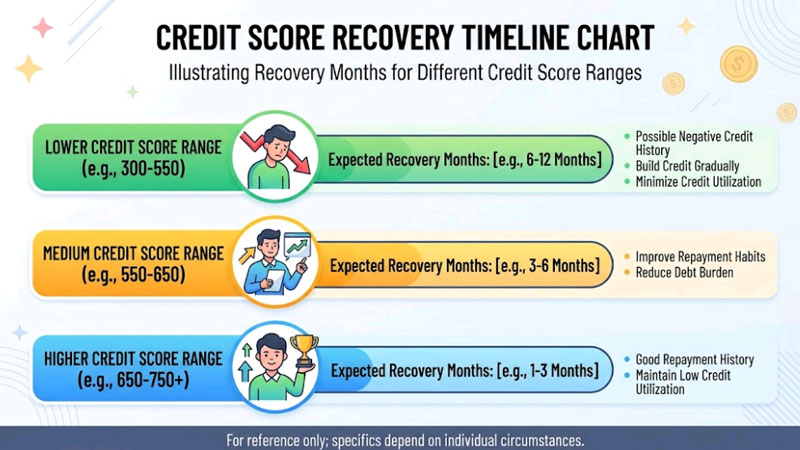
How Long Does Credit Recovery Take, By Starting Score?
Recovery speed isn’t linear. Climbing from 500 to 600 moves faster than climbing from 750 to 800, because scoring models reward correcting big mistakes more than polishing an already-decent file.
Recovering from 500–579 (Poor)
Expect 12 to 18 months of consistent on-time payments and utilization under 30% before you cross into “Fair” territory. Early wins come fast — usually within 60 days — but the leap out of “Poor” takes sustained behavior, not a single fix.
Recovering from 580–669 (Fair)
This range moves quicker. Six to nine months of clean payment history, paired with utilization under 10%, typically pushes a score into “Good.” Dispute any inaccurate items here first — errors are more common than people assume.
Recovering from 670–739 (Good) — Closing the Gap to “Very Good”
This is the slowest stretch per point gained. Lenders already see you as low-risk, so the model rewards patience over action. Expect 9 to 12 months, driven mostly by aging accounts and a diversified credit mix rather than any single move.
How Long Different Credit Problems Take to Recover From
This is where most advice gets vague. Here’s the actual breakdown, matched to how long each item legally stays on your report versus how long its damage actually lingers.
Late or Missed Payments
Stays on report: 7 years. Score impact fades significantly after 12–24 months of on-time payments following the incident.
Collections Accounts
Stays on report: 7 years from the original delinquency date. Impact softens noticeably after 6–12 months, faster if you negotiate a “pay for delete” or settlement.
Charge-Offs
Stays on report: 7 years. These hurt more than standard late payments and typically need 18–24 months of clean behavior to fully offset.
Bankruptcy — Chapter 7 vs. Chapter 13
Chapter 7 stays 10 years; Chapter 13 stays 7 years. Score recovery to “Fair” range is possible within 12–24 months post-discharge if you rebuild actively with secured credit and on-time payments.
Foreclosure or Repossession
Stays on report: 7 years. Mortgage lenders often require a 2–7 year waiting period depending on loan type, separate from score recovery itself.
Hard Inquiries
Stays on report: 2 years, but impact on your score fades within 3–6 months.
| Issue Type | Time on Report | Score Impact Fades | Realistic Action Window |
|---|---|---|---|
| Late payment | 7 years | 12–24 months | Immediate |
| Collections | 7 years | 6–12 months | Immediate |
| Charge-off | 7 years | 18–24 months | 1–3 months |
| Chapter 7 bankruptcy | 10 years | 12–24 months (post-discharge) | Post-discharge |
| Chapter 13 bankruptcy | 7 years | 12–24 months (post-discharge) | Post-discharge |
| Foreclosure | 7 years | 24–36 months | 6 months |
| Hard inquiry | 2 years | 3–6 months | N/A |
What Actually Speeds Up Recovery
Not every action moves the needle equally. Rank your effort by impact.
High-impact, fast results (30–60 days):
- Dispute verifiable errors on your report
- Pay utilization down below 30%, then below 10%
Medium-impact (3–6 months):
- Open a secured credit card and use it lightly
- Take out a credit-builder loan
- Become an authorized user on a well-managed account
Long-horizon (6+ months):
- Diversify your credit mix with an installment loan
- Let hard inquiries age off naturally
“The biggest mistake I see is people chasing ten small fixes at once instead of nailing utilization first,” says a credit counselor certified through the National Foundation for Credit Counseling. “Utilization is the fastest lever you control directly. Payment history takes time no matter what you do.”
A word of caution: becoming an authorized user only helps if the primary cardholder has a strong, consistent payment history. If their account goes delinquent, yours takes the hit too. Vet this arrangement carefully before agreeing to it.
Should You DIY Your Credit Recovery, or Hire Professional Help?
This decision matters more than most guides admit.
DIY makes sense when: your issues are limited to one or two items, you understand the dispute process, and you have time to track progress monthly.
Professional help makes sense when: you’re facing multiple collections, a recent bankruptcy, or you simply don’t have bandwidth to manage the process yourself.
| Option | Cost | Typical Timeline | Legal Limits |
|---|---|---|---|
| DIY | Free | 6–24 months | None — full control |
| Nonprofit credit counseling | Free–low cost | 6–24 months | Can negotiate payment plans, no dispute filing on your behalf |
| Paid credit repair company | $50–150/month | 3–6 months (limited scope) | Cannot remove accurate negative items — regulated activity |
as outlined in the Credit Repair Organizations Act
Any company promising to erase accurate negative marks is breaking federal law. That’s not a gray area — it’s the core protection under CROA.
Frequently Asked Questions
How long does it take to go from a 500 to a 700 credit score?
Typically 18–24 months with consistent on-time payments and utilization kept under 10%. Faster if you’re disputing genuine errors along the way.
Can you recover credit in 30 days?
Only marginally. Correcting a reporting error can move your score within weeks, but rebuilding from real derogatory marks takes months, not days.
Does paying off collections improve your score immediately?
Not always. Older scoring models still count the account even after payoff. Negotiating removal (“pay for delete”) before paying gets better results than paying first.
How long after bankruptcy can you get a mortgage or car loan?
Auto loans are often possible within 12–18 months post-discharge. Conventional mortgages typically require 2–4 years, though FHA loans may allow qualification sooner.
Is credit recovery guaranteed to work?
No. Results depend on your specific credit profile, the accuracy of your report, and consistency of your actions. This isn’t a guaranteed outcome for everyone.
The Bottom Line
Credit recovery isn’t about finding one trick. It’s about knowing which lever moves your score fastest for your specific situation, then staying consistent long enough for the math to catch up. Fix utilization first. Let payment history compound. Be patient with the slow stretches — they’re normal, not a sign you’re doing something wrong.
Disclaimer: This article is for informational purposes only and does not constitute financial, legal, or credit counseling advice. Credit recovery timelines vary by individual circumstances. Consult a licensed financial advisor or NFCC-certified credit counselor before making decisions about your credit or debt.