

Employee benefits prioritization isn’t about adding more perks. It’s about spending less and retaining more. Most HR teams guess at what employees want, then wonder why turnover doesn’t budge. This guide gives you a five-step framework, real 2025-2026 benchmark data, and a compliance checklist most articles skip entirely.
Why Employee Benefits Prioritization Has Become Non-Negotiable
Budgets are flat. Healthcare costs aren’t. That gap is forcing HR teams to make sharper calls about where every dollar goes.
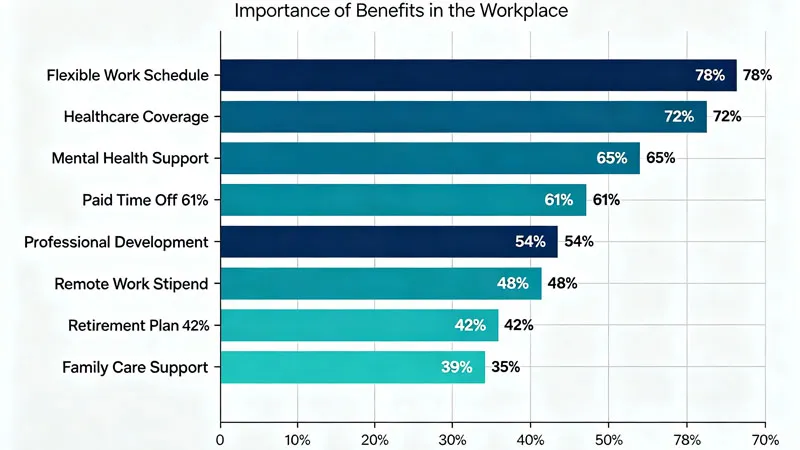
According to SHRM’s 2025 Employee Benefits Survey — one of the largest annual benchmarks in the industry, drawing on responses from nearly 4,000 HR professionals — health care remains the top priority for 88% of employers, with leave benefits and retirement savings tied for second place at 81% for the fourth year running. Flexible work still matters, but it’s slipping: flexible working benefits fell two percentage points in 2025 to 68%.
Here’s the part most companies miss. Structured wellness programs dropped to just 39% of employers in 2025, down from 53% in 2021 — even as employees report higher stress. That’s a prioritization failure, not a budget one. Wellness programs are often cheap to run and expensive to cut.
The Five-Generation Workforce Problem
A 24-year-old and a 58-year-old sitting three desks apart have almost nothing in common when it comes to benefit priorities. One wants student loan help. The other wants retirement contribution matching. Treat them the same, and you underserve both.
Generational workforce trends guide
What Employers Assume vs. What Employees Actually Rank First
Employers consistently overweight flashy perks — unlimited PTO, wellness apps, snack bars — while underweighting the boring stuff that actually drives retention: predictable schedules, dependable healthcare, and clear paid leave policies.
| Generation | What Employers Assume Matters Most | What Employees Actually Prioritize |
|---|---|---|
| Gen Z | Mental health apps, unlimited PTO | Student loan support, career growth clarity |
| Millennials | Remote flexibility | Affordable childcare, healthcare cost predictability |
| Gen X | Wellness perks | Elder care support, retirement catch-up options |
| Boomers | Flexible scheduling | Retirement contribution matching, healthcare stability |
A Step-by-Step Framework for Prioritizing Employee Benefits
Stop picking benefits off a trend list. Use a process instead.
Step 1: Audit What You Already Offer
Pull enrollment rates, opt-out rates, and claims data for every benefit on your books. Anything under 20% utilization needs a hard conversation — either employees don’t know it exists, or they don’t want it.
Step 2: Run a Structured Employee Needs Survey
Skip vague questions like “what benefits do you want?” Ask specific, forced-choice questions instead:
- If you had $100 in extra monthly benefit budget, where would you put it?
- Rank these five benefits by personal importance: healthcare, PTO, retirement match, childcare support, professional development.
- What benefit have you never used but assumed you would?
- What’s the one benefit that would make you turn down a competing job offer?
Forced ranking beats open-ended wishlists. It forces trade-offs, which is exactly the decision you’re trying to make.
Step 3: Segment by Life Stage, Not Just Age
Age is a lazy proxy. Life stage is sharper. A 35-year-old with no kids and a 35-year-old caring for aging parents need completely different support. Segment your survey data by caregiving status, homeownership, and income band — not just birth year.
Step 4: Build a Weighted Priority Matrix
Plot every benefit on two axes: cost to implement and employee-perceived value. This turns a messy list into four clear buckets.
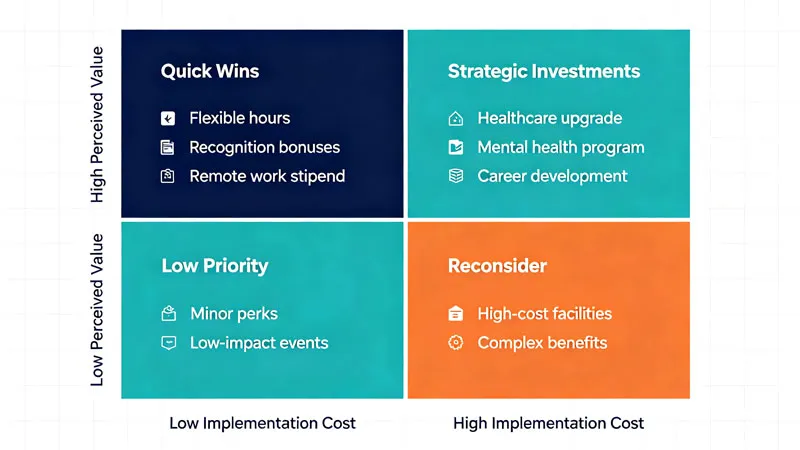
- Quick Wins (low cost, high value): flexible scheduling, EAP basics, remote work policy
- Strategic Investments (high cost, high value): healthcare upgrades, retirement match increases
- Reconsider (high cost, low value): underused perks, legacy vendor contracts
- Low Priority (low cost, low value): novelty perks nobody asked for
Step 5: Pilot Before You Commit
Roll out changes to one department or location first. Measure enrollment and sentiment for one quarter before scaling company-wide. This limits the downside if a benefit flops.
How to Prioritize Employee Benefits on a Limited Budget
Budget size changes the playbook. Here’s what actually fits at each tier.
Under $50 Per Employee, Per Month
Flexible scheduling, a basic Employee Assistance Program, and manager-led recognition programs cost almost nothing and move retention numbers.
$50–$200 Per Employee, Per Month
Financial wellness tools, voluntary supplemental insurance, and expanded PTO policies fit comfortably here. Many payroll and 401(k) providers bundle these in at low or no added cost — ask before you buy something new.
$200+ Per Employee, Per Month
This tier supports meaningful healthcare upgrades, richer retirement matching, and dependent care subsidies — the benefits SHRM data shows employees rank highest but employers underfund most.
Low-cost employee retention strategies
Calculating the ROI of Your Benefits Strategy
Nobody tracks this well, so nobody defends their benefits budget well either.
Track four numbers before and after any benefits change: turnover rate, time-to-fill for open roles, healthcare cost trend, and employee sentiment score. A simple formula works: take your average cost to replace an employee (commonly cited at 30-50% of annual salary for mid-level roles, higher for specialized talent), multiply by the number of retained employees you can reasonably attribute to a benefits change, and compare that to the benefit’s annual cost.
Cost of employee turnover research
If retaining ten employees saves $400,000 in replacement costs, and the benefit driving that retention costs $60,000 a year, the math defends itself in any budget meeting.
Compliance Considerations Before You Prioritize
This is where most benefits guides stop short — and where mistakes get expensive.
ACA Requirements
Applicable large employers (generally 50+ full-time equivalent employees) must offer affordable, minimum-value health coverage or face penalties. Any benefits restructuring needs a compliance check against current ACA thresholds before rollout.
State-Specific Paid Leave Laws
California, New York, and a growing list of states mandate specific paid sick leave accrual and, in some cases, payout rules for unused time. A “flexible PTO” policy that looks generous can accidentally violate state accrual-and-payout requirements if it’s not structured correctly.
ERISA Obligations
Any change to a formal benefit plan — not just perks — typically triggers ERISA disclosure and plan document requirements. Loop in benefits counsel before communicating major changes to employees.
Real-World Example: Rebuilding Priorities at a 120-Person Company
A mid-sized services firm ran this exact framework. Their audit showed a wellness stipend at 12% utilization and a legacy gym discount nobody used. Their survey revealed the real ask: predictable schedules and better dependent care support.
They cut the gym benefit, redirected the funds into a dependent care FSA match and two flexible scheduling days per month. Six months later, voluntary turnover dropped from 22% to 15%, and their employee survey scores on “my employer understands my needs” rose sharply. Total cost: roughly the same as before. Only the allocation changed.
FAQ: Employee Benefits Prioritization
How often should companies reprioritize employee benefits?
Review utilization data every quarter, but run a full priority reassessment annually — ideally before open enrollment planning begins.
What are the most cost-effective employee benefits right now?
Flexible scheduling, EAP access, and financial wellness tools consistently deliver strong retention impact relative to their low implementation cost.
How do you measure employee satisfaction with benefits?
Use a short pulse survey with forced-ranking questions rather than open-ended feedback, paired with actual enrollment and utilization data.
Should small businesses offer the same benefits as large companies?
No. Match benefits to your budget tier and workforce composition — a 15-person company doesn’t need the same benefits stack as a 1,500-person enterprise, and copying one rarely works.
Do employees really value retirement matching over flexible work?
It depends heavily on age and life stage — older employees and higher earners tend to rank retirement contributions higher, while younger and caregiving employees often prioritize flexibility and direct financial support.
Disclaimer: This article is for general informational purposes only and does not constitute legal, tax, financial, or HR compliance advice. Benefits and employment laws vary by state and change frequently. Consult a licensed HR compliance professional, benefits broker, or employment attorney before making changes to your organization’s benefits program.