

Is getting into real estate hard? Not really — the license is the easy part. What’s hard is what happens after: most new agents earn under $10,000 in their first two years, and a large share don’t renew their license at all. This guide breaks down exactly where the difficulty hides, with real cost and income data.
The Short Answer: Easy to Start, Brutal to Survive
Getting licensed takes a few months and a few hundred dollars. Staying in business takes years and thousands of dollars you won’t see back right away.
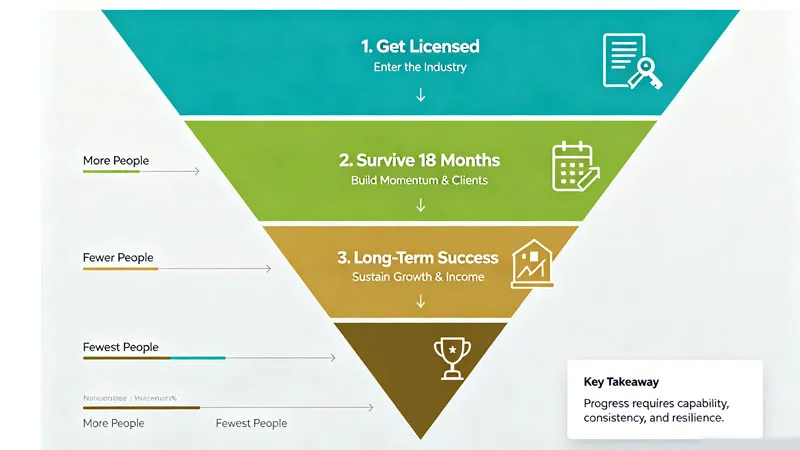
Three separate difficulty levels exist here, and most articles blend them together:
- Licensing difficulty — low. Anyone who studies can pass.
- First 18-month survival difficulty — high. This is where most people quit.
- Long-term career difficulty — moderate, but it rewards consistency over talent.
Is It Hard to Get a Real Estate License?
No. This part is genuinely accessible, which is exactly why so many people walk in without a plan.
Pre-Licensing Hours Vary More Than You’d Think
Course length isn’t uniform. Florida requires 63 hours. Texas requires 180. California splits its 135 hours between principles, practice, and an elective. If you’re comparing states before you commit, don’t assume “a few months” applies everywhere.
| State | Pre-License Hours | Exam Format |
|---|---|---|
| California | 135 | 150 questions, 3 hrs |
| Texas | 180 | 110 questions, national + state |
| Florida | 63 | 100 questions |
| New York | 77 | 75 questions |
| Illinois | 75 | 140 questions |
State real estate license requirements guide
Exam Pass Rates: The Number Most Sites Skip
First-time pass rates typically sit in the 55-65% range depending on the state, and drop sharply for repeat test-takers. That gap tells you something: most failures come from under-preparing, not from the material being unreasonably hard.
How Much Does It Actually Cost to Get Into Real Estate?
This is the question competitors barely answer, and it’s where “hard” starts to mean something concrete.
Upfront Costs
- Pre-licensing course: $150–$700
- Exam fee: $60–$100 (per attempt)
- Background check and fingerprinting: $40–$100
- License application: $50–$250
Total to get licensed: roughly $300–$1,000, before you’ve earned a dollar.
The Ongoing Costs Nobody Warns You About
Once licensed, the real bill starts. NAR national dues run $201 a year, but that’s just one line item. Add your state association, your local board, and MLS access, and the total swings hard depending on where you practice.
| Cost Category | Low End (Annual) | High End (Annual) |
|---|---|---|
| NAR national dues | $201 | $201 |
| State + local association dues | $150 | $650 |
| MLS access | $100 | $500 |
| E&O insurance | $150 | $500 |
| Marketing & lead gen | $500 | $5,000+ |
| Continuing education | $50 | $300 |
Put it together and a new agent’s realistic year-one bill lands somewhere between $1,000 and $8,000 — before any of it produces a closed deal. [NAR membership dues structure]
The Part Nobody Talks About: Failure and Attrition Rates
You’ll see the claim that “87% of agents fail within five years” repeated everywhere. Here’s the honest version: NAR has never published a verified attrition study behind that exact number, and measuring “failure” is genuinely messy — some agents leave a brokerage but stay licensed elsewhere.
What NAR’s 2025 Member Profile does confirm is harder to argue with. REALTORS® with two years of experience or less earned a median of $8,100 in the prior year, and 62% of that group earned less than $10,000. Median income across all REALTORS® was $58,100 — meaning the gap between year one and an established career is enormous, not gradual.
NAR membership has also been shrinking: from roughly 1.53 million members in late 2024 to about 1.45 million by mid-2025, with projections pointing toward 1.2 million by the end of 2026. The median member age has climbed to 57. New agents aren’t being replaced as fast as they’re leaving. [NAR Member Profile income statistics]
That’s the real difficulty. It’s not the exam. It’s surviving on close to nothing for a year or two while building a pipeline.
Is the Job Itself Hard? What Day-to-Day Work Looks Like
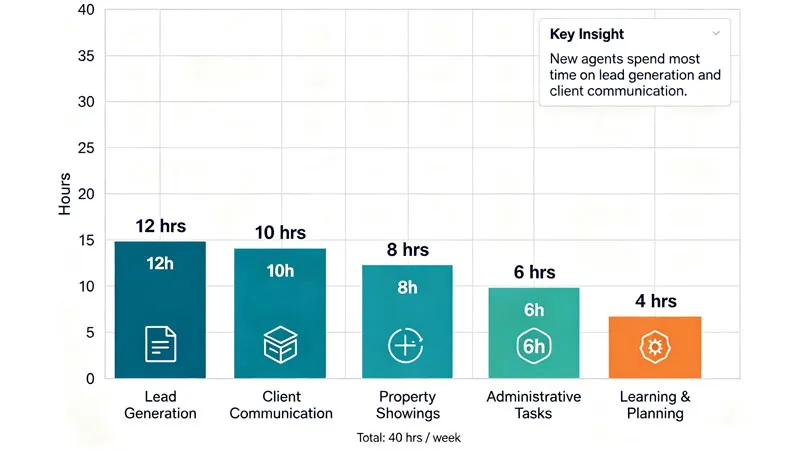
You’re not hired into a job. You’re started as a one-person business, and you’ll do every role in it — prospecting, admin, marketing, negotiation, and bookkeeping — until you can afford to outsource pieces of it.
A broker I’ve worked with who’s spent over a decade training new agents puts it plainly: most people don’t quit because the contracts are too hard. They quit because they run out of money before their pipeline produces income.
A Realistic First-Year Weekly Split
- Prospecting and lead follow-up: 12–15 hours
- Showings and client meetings: 8–10 hours
- Admin, paperwork, CRM: 6–8 hours
- Training and skill-building: 4–5 hours
How Much Can You Realistically Earn?
Take a $400,000 home sale with a 5% total commission — $20,000 split between listing and buyer’s side, or $10,000 each. Your broker split (commonly 70/30 for newer agents) leaves you with $7,000 before taxes. Since you’re a 1099 contractor, self-employment tax applies on top of income tax — a detail almost every beginner underestimates until their first tax season.
One or two closings a year, which is common for new agents, explains that $8,100 median figure directly.
Real Estate vs. Other Commission Careers
| Real Estate | Insurance Sales | Financial Advising | |
|---|---|---|---|
| Entry cost | $300–$1,000 | $100–$500 | Varies (often employer-covered) |
| Time to first income | 2–6 months | 1–3 months | 6–12 months |
| Year-1 median income | ~$8,100 | Varies widely | Often salaried early on |
| Ongoing licensing cost | High | Moderate | Moderate–High |
Real estate has a low door to walk through and a steep hill right behind it — that combination is what makes the honest answer to “is it hard” so situational.
FAQ: What People Also Ask
Is it hard to pass the real estate exam?
Not if you study consistently. First-time pass rates average around 55–65%, and most failures come from insufficient prep, not exam difficulty.
How long does it take to become a real estate agent?
Typically 2–6 months, depending on your state’s required course hours and how quickly you schedule your exam and background check.
Do most real estate agents actually fail?
The widely cited “87%” figure isn’t independently verified, but NAR data confirms new agents earn far less than established ones — a median of $8,100 in the first two years.
Is real estate a good career in 2026?
It can be, especially post-NAR-settlement, for agents who treat it as a business with a financial runway — not as a quick side income.
Can you do real estate part-time while working another job?
Yes, but expect a slower ramp-up. Most brokerages and clients expect responsiveness that’s harder to deliver part-time.
Disclaimer: This article is for informational purposes only and does not constitute financial, tax, or legal advice. Licensing requirements, fees, and income data vary by state and change over time. Consult a licensed real estate professional, broker, or CPA before making career or financial decisions.