

Picture this: you hold a single stock, the company gets hit with a product recall, and the price drops 30% overnight while the S&P 500 barely moves. That’s unsystematic risk — the risk tied to one company, not the whole market. This guide breaks down exactly what it is, where it hides in your portfolio, and the specific steps that shrink it.
What Is Unsystematic Risk?
Unsystematic risk is the risk that comes from a single company, industry, or sector — not the broader market. Unlike market-wide forces, this type of risk can be reduced, sometimes almost entirely, through smart portfolio construction.
You’ll also see it called specific risk, diversifiable risk, residual risk, or idiosyncratic risk. Different name, same idea: something goes wrong at one business, and that business’s investors feel it directly.
[SEC investor education glossary]confirms this same core definition, distinguishing it from risks that hit entire markets at once.
Unsystematic Risk vs. Systematic Risk — Why the Distinction Matters
Systematic risk comes from macro forces — inflation, interest rate hikes, recessions. Nobody escapes it. Unsystematic risk comes from decisions and events inside a single company. That difference determines whether you can actually do something about it.
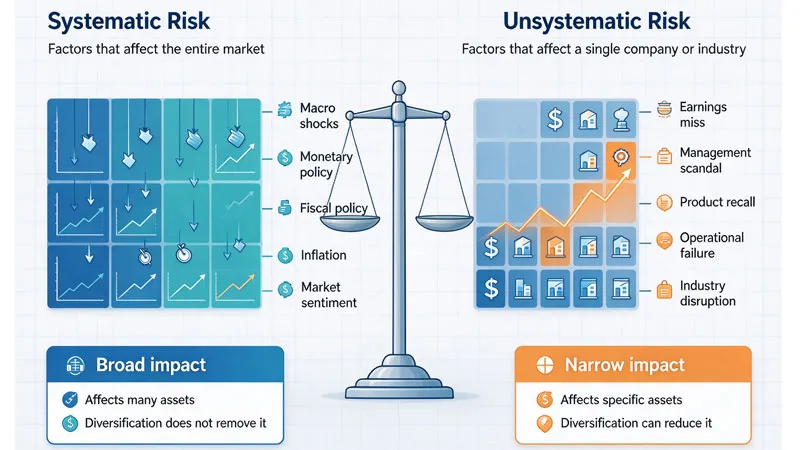
Comparison Table: Systematic vs. Unsystematic Risk
| Systematic Risk | Unsystematic Risk | |
|---|---|---|
| Source | Entire market or economy | Single company or sector |
| Can you diversify it away? | No | Yes, largely |
| Examples | Recessions, inflation, rate hikes | Recalls, lawsuits, bad leadership |
| How investors manage it | Asset allocation, hedging | Diversification |
Categories & Real Examples of Unsystematic Risk
Most articles lump these together. They’re not the same, and knowing the difference helps you spot exposure before it costs you.
Business Risk
This is the risk that a company’s core operations underperform — weak sales, poor strategy, a product that flops. In 2023 and 2024, several major automakers issued large-scale recalls tied to battery and software defects, and share prices for the affected companies moved independently of the broader auto sector. That’s business risk in action: one company absorbs the hit, competitors don’t.
Financial Risk
Financial risk comes from how a company funds itself. A heavily leveraged firm — one carrying a lot of debt relative to equity — gets squeezed hard when interest rates climb or revenue dips. Two companies in the same industry can have wildly different financial risk simply based on their balance sheets.
Operational Risk
This category gets skipped constantly, and it shouldn’t. Operational risk covers cyberattacks, supply chain breakdowns, and the sudden loss of a key executive. A ransomware attack that shuts down a single company’s production line is a textbook unsystematic event — it doesn’t touch competitors.
Liquidity Risk (Company-Specific)
Don’t confuse this with market-wide liquidity crunches. Company-specific liquidity risk means a business can’t meet short-term obligations — payroll, suppliers, debt payments — even if credit markets overall are healthy.
Legal & Regulatory Risk
A single company facing an FDA rejection, a major lawsuit, or an antitrust investigation absorbs risk that its competitors simply don’t share. This is one of the fastest-moving and most underestimated unsystematic risk categories.
How to Measure Unsystematic Risk
This is where most guides stop short. Here’s the part that actually matters if you want to manage risk instead of just naming it.
Standard Deviation & Total Risk
Total risk equals systematic risk plus unsystematic risk. Standard deviation measures total risk — how much a stock’s returns swing around its average. But standard deviation alone won’t tell you which portion is company-specific.
Beta and Why It Doesn’t Capture Unsystematic Risk
Beta measures how a stock moves relative to the market — that’s systematic risk exposure only. A stock with a beta of 1.0 can still carry enormous unsystematic risk if it’s tied to one product line or one lawsuit. Beta and unsystematic risk are separate questions, and conflating them is a common, costly mistake.
R-Squared as a Practical Proxy
R-squared tells you how much of a stock’s movement is explained by the benchmark index. A low R-squared means a bigger share of that stock’s swings come from company-specific factors — your unsystematic risk exposure. Financial advisors use this metric to flag concentrated positions before they blow up a portfolio.
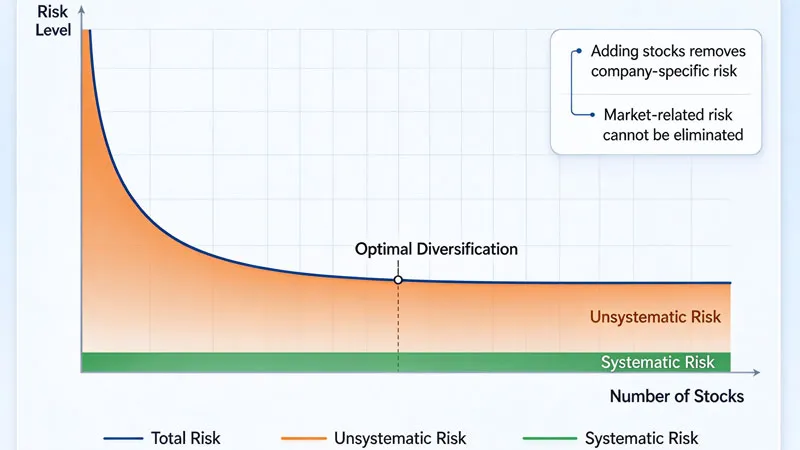
How Much Diversification Do You Actually Need?
Academic research on portfolio construction generally points to somewhere around 20 to 30 stocks across different sectors to substantially cut unsystematic risk. [research on optimal portfolio diversification]backs this range, though the number shifts depending on sector overlap.
Here’s the catch nobody mentions: owning 30 stocks in the same sector doesn’t diversify away much of anything. If you hold 25 tech names, a sector-wide correction hits your whole portfolio at once. Real diversification means spreading across sectors, not just multiplying tickers.
How to Reduce Unsystematic Risk in Your Portfolio
Diversify Across, Not Just Within, Asset Classes
Stocks, bonds, real estate, and cash all react differently to the same event. Spreading across asset classes cuts unsystematic risk faster than adding more stocks alone.
Use Index Funds & ETFs to Instantly Diversify
A single broad-market ETF can hold hundreds of companies. This is the fastest, cheapest way to reduce single-company exposure without picking individual winners.
Best index funds for diversification
Watch Your Employer Stock
This one hits close to home for a lot of readers in their 30s and 40s. RSUs and ESPP shares can quietly build a dangerously concentrated position — your paycheck and your portfolio tied to one company’s fate. Cap employer stock at a fixed percentage of your net worth and sell down regularly.
Rebalance on a Schedule, Not Emotion
Set a calendar reminder — quarterly or annually — to rebalance back to your target allocation. Reacting to headlines instead of a schedule is how concentration risk creeps back in.
When Professional Guidance Makes Sense
If your portfolio has grown complex — multiple accounts, equity compensation, real estate — a fee-only financial advisor can spot concentration risk you might miss on your own.
How to choose a financial advisor
A Related (and Often Confused) Term: Systemic Risk
Systemic risk is not the same as systematic or unsystematic risk. It describes the risk that one institution’s failure triggers a chain reaction across the entire financial system. The 2023 regional banking stress, where the failure of a handful of banks raised fears about deposit runs elsewhere, is a modern example. It’s a hybrid: it starts at a single institution but threatens the whole system — which is exactly why regulators watch it so closely.
Common Mistakes Investors Make with Unsystematic Risk
- Mistaking “owning many stocks” for real diversification when they’re all in one sector
- Ignoring correlation between holdings that move together during stress
- Dumping a diversification strategy after one bad headline
- Confusing short-term volatility with actual risk
Frequently Asked Questions
Is unsystematic risk good or bad?
Neither inherently. It’s simply avoidable risk — reducing it through diversification generally improves your risk-adjusted returns without giving up expected performance.
Can unsystematic risk be completely eliminated?
Not entirely, but it can be reduced close to zero with a well-diversified portfolio spread across sectors and asset classes.
Does beta measure unsystematic risk?
No. Beta measures sensitivity to overall market movement — that’s systematic risk. Unsystematic risk requires different tools, like R-squared.
How many stocks do I need to diversify away unsystematic risk?
Roughly 20 to 30 holdings across different sectors captures most of the benefit, though index funds achieve this instantly with far less effort.
Is unsystematic risk higher for small-cap or large-cap stocks?
Generally higher for small-caps. They’re more exposed to single-product lines, thinner management benches, and less financial cushion than large, diversified companies.
The Bottom Line
Systematic risk is the price of being in the market. Unsystematic risk is the price of not diversifying properly — and it’s the one part of the equation you actually control. Build a portfolio spread across sectors and asset classes, watch concentrated positions like employer stock, and rebalance on a schedule instead of a whim.
Disclaimer: This article is for educational purposes only and does not constitute investment, financial, or legal advice. Investing involves risk, including possible loss of principal. Consult a licensed financial advisor or tax professional before making investment decisions based on your individual circumstances.