
Asking the right mortgage loan questions before you sign can save you thousands of dollars — or cost you thousands if you skip them. Most buyers walk into their first lender meeting unprepared and pay for it later. This guide gives you the exact questions, the math behind them, and the red flags your lender won’t volunteer.
Why Interviewing Your Mortgage Lender Matters More Than You Think
Buyers treat lender selection like a formality. It isn’t. Two lenders can quote the same rate and still leave you paying different amounts over the life of the loan, once fees, points, and service quality enter the picture.
Mortgage rate shopping savings data
Comparing offers from at least two lenders is one of the few actions a buyer fully controls in a process otherwise driven by rates and underwriting rules outside their hands.
When to Start Asking These Questions
Timing matters. Ask these questions during prequalification, not after you’ve fallen in love with a house. Prequalification gives you a rough number. Preapproval — which requires documentation and a credit pull — gives you a real one. Underwriting follows, then closing.
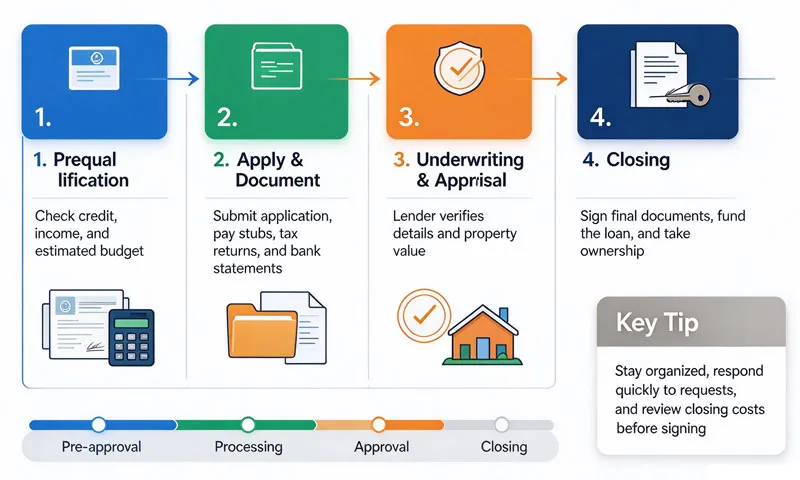
Most buyers only learn the difference between prequalification and preapproval after losing a bidding war to someone who had the stronger paperwork.
Understanding Your Mortgage Options: The Foundation Questions
“What Types of Mortgage Loans Do I Qualify For?”
Not every buyer qualifies for every loan type, and not every loan type serves every buyer well. Here’s how the main options stack up:
| Loan Type | Min. Down Payment | Min. Credit Score | Mortgage Insurance? | Best For |
|---|---|---|---|---|
| Conventional | 3–20% | 620+ | Only if <20% down | Strong credit, stable income |
| FHA | 3.5% | 580 | Yes, most of loan term | First-time buyers, lower credit |
| VA | 0% | No federal minimum | No | Veterans, active military |
| USDA | 0% | ~640 typical | Yes, guarantee fee | Rural/suburban eligible areas |
| Jumbo | 10–20% | 700+ | Varies by lender | High-value properties |
FHA and VA loan eligibility requirements
Self-employed buyers and gig workers face extra scrutiny here. Ask your lender directly how they document non-W-2 income — some require two years of tax returns, others accept bank statement programs. That answer alone can determine which loan type actually works for you.
Fixed-Rate vs. Adjustable-Rate: Which Fits Your Timeline?
A fixed rate never changes. An adjustable-rate mortgage (ARM) locks a rate for an initial period — commonly 5, 7, or 10 years — then adjusts annually.
The decision comes down to one question: how long do you plan to stay? If you’ll sell or refinance within seven years, an ARM’s lower starting rate can save real money. If you’re planting roots for the long haul, the predictability of a fixed rate usually wins.
The Money Questions: Down Payment, Rates & Hidden Costs
“How Much Down Payment Do I Actually Need?”
The honest answer: it depends on the loan, your credit, and your local market. But most buyers don’t know down payment assistance programs exist in nearly every state, often covering $5,000–$15,000 in costs for eligible buyers.
Case in point: Sarah earns $75,000 a year and has $15,000 saved. With an FHA loan, her 3.5% down payment on a $350,000 home is $12,250 — leaving room for closing costs. With a conventional loan at 5% down, she’d need $17,500, pushing her past her savings. The “better” loan depends entirely on her cash position, not just her credit score.
First-time home buyer down payment assistance
Interest Rate vs. APR: What’s the Real Difference?
Your interest rate determines your monthly payment. Your APR tells you the true cost of borrowing.
APR = Interest Rate + Fees (Origination + Points + Mortgage Insurance) ÷ Loan Term
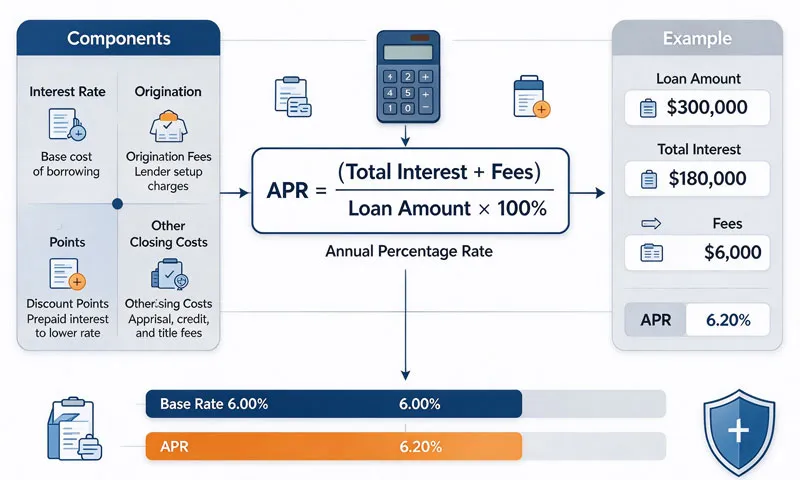
Watch for this trick: a lender quotes a rate slightly below competitors, then buries origination fees and junk charges that push the real APR higher. Always compare APR, not just the headline rate.
Are Discount Points Worth It?
One discount point costs 1% of your loan amount and typically lowers your rate by about 0.25%. On a $400,000 loan, one point costs $4,000. If that point saves you $60 a month, your breakeven is roughly 67 months — just over five and a half years.
If you plan to stay in the home longer than your breakeven point, points make sense. If you might sell or refinance sooner, skip them.
What Should You Expect in Closing Costs?
Closing costs typically run 2–6% of your loan amount. Break them down by category so nothing surprises you:
Lender fees:
- Loan origination fee
- Discount points
- Credit reporting fee
Third-party fees:
- Home inspection
- Appraisal
- Title search and title insurance
Prepaid items:
- Homeowner’s insurance (first year)
- Property tax escrow
- Recording and transfer taxes
Ask your lender and agent whether a “seller assist” is on the table — sellers can sometimes cover part of these costs as a negotiation point.
Qualification Questions: Credit, Income & Debt-to-Income Ratio
What Credit Score Do You Need — and What If Yours Isn’t There Yet?
| Credit Score Range | Realistic Next Step |
|---|---|
| 580–619 | FHA loan likely available now; focus on paying down revolving balances |
| 620–679 | Conventional loans open up; shop rates aggressively, rates vary widely here |
| 680+ | Strong position; negotiate rate and points confidently |
If you’re below 580, don’t wait passively. Dispute credit report errors immediately — they’re more common than people assume — and pay down credit card balances below 30% utilization. Most buyers see measurable score improvement within 60–90 days of consistent action.
How Is Debt-to-Income Ratio Calculated?
Add up your monthly debt payments, divide by your gross monthly income, multiply by 100. Lenders generally want this at or below 43%, though some programs allow higher.
If you’re over the limit, you have options: pay down the smallest debts first to free up ratio room fast, or bring in a co-borrower to strengthen the application. Don’t assume a high DTI is a dead end — ask your lender which specific debts, if paid down, would move the needle most.
What Documents Will You Need?
- W-2 employees: pay stubs (30 days), W-2s (2 years), tax returns (2 years)
- Self-employed: business tax returns, profit and loss statements, 1099s
- Everyone: bank statements (2 months), investment account statements, proof of down payment funds
Process & Timeline Questions
How Long Does Closing Actually Take?
Average mortgage closing time data
Most closings take 30–45 days from accepted offer to keys in hand. Complex files — self-employment income, jumbo loans, or appraisal disputes — can push that timeline further.
What Happens If Your Rate Lock Expires Before Closing?
This question trips up more buyers than any other on this list. Rate locks typically run 30–90 days. If your closing gets delayed past that window, you may face an extension fee or lose your locked rate entirely. Ask upfront: what does a rate lock extension cost, and does your lender offer a float-down option if rates drop after you lock?
Can You Reapply After Being Denied?
Yes, and it happens more often than buyers admit. Lenders must send an adverse action notice explaining the specific denial reason — insufficient income, high DTI, credit issues. Fix that specific issue, wait the recommended period (often 30–60 days for a re-pull), and reapply. A denial isn’t permanent; it’s a diagnostic.
Red Flags: Questions That Reveal a Lender’s Trustworthiness
How Do You Verify a Lender Is Licensed?
Verify mortgage lender license status
Every legitimate loan officer has an NMLS number. Search it before you sign anything.
Warning Signs During the Loan Process
- Pressure to sign documents same-day without review time
- Refusal to put rate quotes in writing
- Unexplained fee increases between quote and closing disclosure
- Vague answers to direct questions about APR or points
A good loan officer answers these questions without hesitation. Hesitation itself is information.
How to Compare Multiple Lenders Side-by-Side
mortgage lender comparison worksheet
Build a simple grid: list each lender across the top, then rows for rate, APR, points, closing costs, and rate lock period. Fill it out during the same week so quotes stay comparable — rates shift daily, and comparing a Monday quote to a Friday quote skews your decision.
Frequently Asked Questions
Should I get quotes from multiple lenders or just one?
Get at least two to three quotes within the same week. Rate shopping within a short window typically counts as a single credit inquiry for scoring purposes.
Does checking mortgage rates hurt my credit score?
Rate shopping done within a focused period — usually 14 to 45 days depending on the scoring model — is treated as one inquiry, not several.
Can I negotiate closing costs with my lender?
Yes. Origination fees, in particular, are often negotiable, especially if you have competing offers in hand.
Is a bigger down payment always better?
Not always. A larger down payment lowers your monthly payment and can remove mortgage insurance, but tying up all your savings leaves no cushion for repairs or emergencies after closing.
What’s the difference between a loan officer and a mortgage broker?
A loan officer works for one lender and offers that lender’s products. A broker works with multiple lenders and shops your application across them.
Your Print-and-Bring Question List
Before your next lender meeting, bring these:
- What loan types do I qualify for?
- What’s my estimated APR, not just the rate?
- What are all my closing costs, itemized?
- How much down payment do I actually need?
- What’s my debt-to-income ratio, and how can I improve it?
- How long is my rate lock, and what happens if it expires?
- Can you put this quote in writing?
Disclaimer: This article is for educational purposes only and does not constitute financial, legal, or investment advice. Mortgage rates, terms, and eligibility requirements vary by lender and change over time. Consult a licensed mortgage loan originator or financial advisor before making decisions about your specific situation.