

Your award letter came back thousands of dollars short. Before you panic or write a check you can’t afford, know this: colleges expect some families to ask for more. Here’s exactly how to do it, what to say, and what to do if the answer is no.
Financial Aid vs. Merit Aid: What You’re Actually Appealing
You can’t ask a college for more money the right way until you know which pot you’re pulling from. These aren’t the same conversation, and confusing them is the fastest way to send your appeal to the wrong office.
Need-Based Aid: Built on Your Family’s Finances
Need-based aid runs through the FAFSA, and sometimes the CSS Profile for schools that want a deeper look at assets. For 2025-26, the metric colleges use isn’t the old EFC (Expected Family Contribution) anymore — it’s the SAI (Student Aid Index). [Student Aid Index methodology]
The switch matters more than it sounds. Under SAI, a family’s number can go negative, which can unlock more aid than the old system allowed. But SAI no longer discounts for having multiple kids in college at once — a real gap if you’ve got two students on campus simultaneously. If your family situation doesn’t fit neatly into either formula, that’s exactly what an appeal is for.
Merit Aid: The School’s Marketing Budget
Merit aid isn’t about need. It’s a discount colleges offer to make themselves look attractive to students they want. Two students with identical financial profiles can get wildly different merit offers based purely on how much the school wants them enrolled.
This is why merit appeals go to admissions, not financial aid. You’re not proving hardship — you’re proving you’re worth the discount.
Need-Based vs. Merit Aid Appeals: Quick Comparison
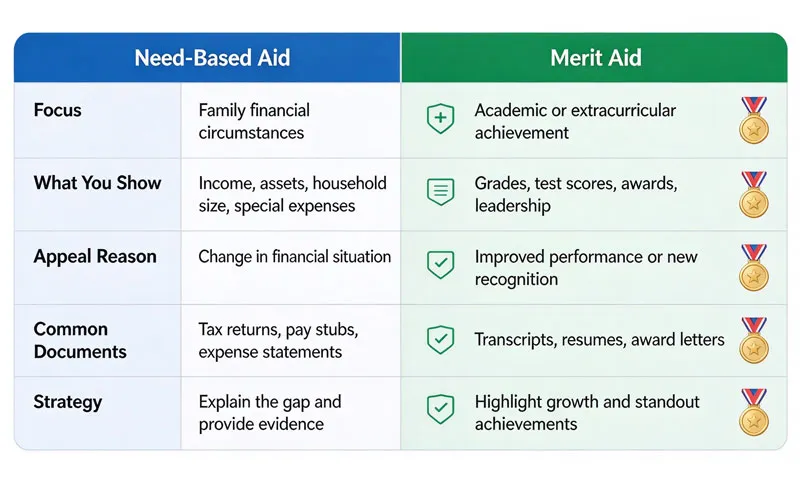
| Need-Based Appeal | Merit Appeal | |
|---|---|---|
| Contact | Financial aid office | Admissions office |
| Who leads | Parent or guardian | Student |
| Key evidence | Tax documents, job loss letters, medical bills | Competing offers, updated grades/scores |
| Official term | Professional judgment review | Merit reconsideration |
| Typical turnaround | 2-6 weeks | 1-4 weeks |
| Repeatable | Yes, annually | Usually one-time per enrollment cycle |
Should You Even Appeal? A 4-Point Self-Check
Not every award is worth appealing. Before you draft anything, answer these four questions honestly.
Where Do You Rank in the Admitted Class?
If your test scores and GPA sit in the school’s top 25%, you have real leverage. If you’re near the bottom of the range that got you in, the school has less incentive to sweeten the deal — you were already a reach for them.
What’s the School’s Yield Rate?
Yield rate is the percentage of admitted students who actually enroll. A low-yield school fights harder to convert admits into enrolled students, which means more room to negotiate. You can find yield data on a school’s Common Data Set, usually posted on its institutional research webpage.
Does the School Meet Full Need?
Some colleges pledge to meet 100% of demonstrated need. Others don’t. If your school claims full-need coverage and the numbers don’t add up, point directly at that gap — it’s the strongest card you can play.
Do You Have Competing Offers?
An offer from a comparable school is the single most persuasive piece of evidence you can bring to either office. No offer in hand? You can still appeal — you’re just relying on the school’s general interest in converting you, rather than a direct comparison.
How to Ask a College for More Money: The 8-Step Process
This is the actual mechanics — who to contact, what to send, and in what order.
Step 1: Find the Right Contact
Admissions counselors are usually assigned by region or high school — check the admissions staff page. Financial aid officers are often assigned alphabetically by last name. Can’t find either? Call the general office line and ask.
Step 2: Gather Your Evidence
For need-based appeals: recent tax returns, pay stubs, unemployment documentation, medical bills, anything that shows your situation has shifted since you filed the FAFSA or CSS Profile.
For merit appeals: written offers from comparable schools, updated GPA or test scores, new honors or awards earned since you applied.
Step 3: Choose Your Angle
There are three real levers: a competing offer, a special circumstance (job loss, medical costs, divorce, a sibling starting college), or both together. Special circumstances carry more weight than people assume — financial aid officers have real authority, officially called professional judgment, to adjust your numbers when your FAFSA doesn’t reflect your actual situation.
Step 4: Draft Your Appeal Email
Keep it short, specific, and enthusiastic. Two templates below — copy, adapt, send.
Need-Based Appeal Template
Subject: Financial Aid Reconsideration Request – [Student Full Name], [Applicant ID]
Dear [Financial Aid Officer Name],
My [child] was thrilled to be admitted to [School Name] — it’s genuinely at the top of our list because of [specific reason: program, faculty, campus fit].
Since submitting our FAFSA, our family’s financial circumstances have changed: [brief, factual explanation — job loss, medical expense, reduced income]. Our current award leaves a gap of [$ amount] between what we can pay and what the school has offered.
Could your office review our file under professional judgment and reconsider our aid package? I’m happy to provide tax documents, pay stubs, or any other records that would help.
Thank you for your time and consideration.
[Parent/Guardian Name]
[Phone] | [Email]
Merit Appeal Template
Subject: Merit Scholarship Reconsideration – [Student Full Name]
Dear [Admissions Counselor Name],
I’m excited to have been admitted to [School Name] — it’s my first choice because of [specific reason].
The cost is still a real stretch for my family. I’ve received offers from [School A] and [School B] that bring my family’s contribution to [$ amount], compared to [$ amount] at [School Name]. Is there any room to bring your offer closer to that level?
Since submitting my application, I’ve also [raised my GPA to X / earned Y honor], which I wanted to share.
[School Name] is where I want to be. I’d love to make it work.
[Student Name]
[Phone] | [Email]
Step 5: Ask for a Specific Number, Not “More”
Vague requests get vague responses. Calculate the exact gap between what you can pay and what you’ve been offered, and state that number. A $30,000 award that still leaves you at a $60,000 contribution is worse than a $20,000 award that drops you to $40,000 — ask for the contribution level, not the sticker discount.
Step 6: Submit Through the Correct Channel
Check the school’s website for a formal appeal form before you email cold — some schools require one and will bounce an email straight back if you skip it.
⚠️ Compliance note: Appeal policies, deadlines, and required documentation vary by school. Always verify the exact process on your school’s official financial aid or admissions page before submitting anything.
Step 7: Follow Up — Once, Politely
Give it 7-10 business days. Then send a brief, friendly check-in. Financial aid offices are swamped every March and April; a single polite nudge reads as genuine interest, not pressure.
Step 8: What to Do If You’re Denied
This is where most guides stop. Yours shouldn’t.
- Ask what changed the decision would require. Some offices will tell you directly.
- Reapply next year. Aid is recalculated annually — a denial this year doesn’t lock you out forever.
- Look at work-study or on-campus jobs the financial aid office can point you toward.
- Check in-state residency reclassification if you’re at a public school and have a path to it.
- Consider a gap year to strengthen your application and reapply with a stronger profile.
- Compare private student loan options as a last-resort gap-filler — [private student loan comparison guide] — after you’ve exhausted grants, scholarships, and federal loans first.
The Appeal Timeline: What to Expect
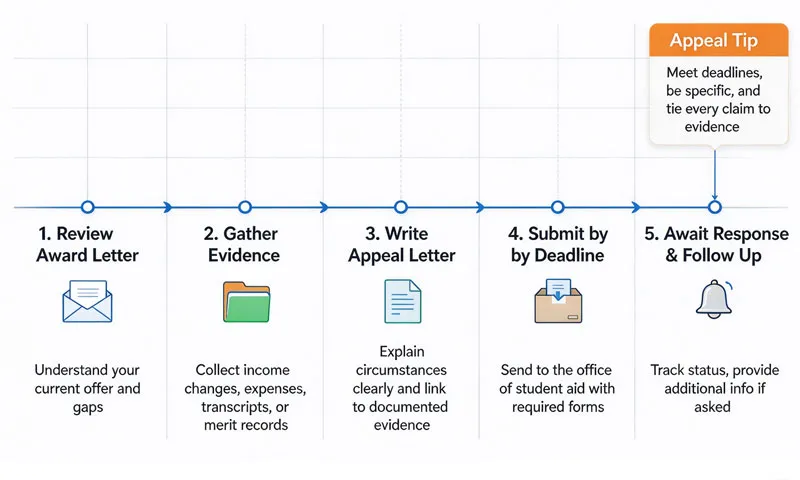
Award letter arrives → Evaluate within 1-2 weeks → Submit appeal with documentation → School reviews (2-6 weeks, longer in peak March-April season) → Decision issued → All of this needs to wrap before your enrollment deposit deadline.
Miss the deposit deadline while waiting on an appeal, and you lose your spot. Always confirm with admissions whether they’ll extend your deposit date while your appeal is pending — many will, but only if you ask.
Situations Most Guides Skip
Appealing as an International Student
No FAFSA access means no SAI, no federal aid, and often no need-based appeal path at all. Your leverage is almost entirely merit-based and institutional — lean on competing offers and any private scholarships you’ve secured.
Appealing as a Transfer Student
Transfer merit aid pools are typically smaller than freshman pools. Ask directly whether transfer students are eligible for the same merit programs as first-year admits — at many schools, they aren’t.
In-State Residency Reclassification
If you’re attending a public university out-of-state, reclassifying as a resident can cut your tuition dramatically — public four-year out-of-state tuition averaged $31,880 in 2025-26, nearly triple the in-state rate of $11,950. Requirements vary by state, but usually involve a minimum residency period and proof of intent (lease, driver’s license, voter registration).
When Your Income Changes After You File
A job loss in April, after your FAFSA is locked in from January tax data, is exactly what professional judgment exists for. Document it and send it — don’t wait for next year’s FAFSA cycle.
Common Mistakes That Get Appeals Rejected
- Using the word “negotiate” instead of “appeal” or “reconsider”
- Asking for “more money” without a specific dollar figure
- Sending no supporting documentation
- Writing with an entitled or frustrated tone
- Missing the school’s stated appeal deadline
- Appealing without any real intent to enroll if approved
FAQ: How to Ask a College for More Money
How much more financial aid can you realistically get by appealing?
Recent research from College Aid Pro found successful appeals typically add $3,000 to $5,000 per year, though some cases — particularly at high-cost private schools — have exceeded $50,000.
What’s the success rate for financial aid appeals?
It varies widely by source and school type. Some data puts successful appeals around 75% at private colleges and 25% at public colleges, while older NASFAA/College Board surveys found far lower adjustment rates industry-wide. The gap reflects how differently individual schools handle appeals — always research your specific target school’s track record where possible.
Does appealing hurt your admission or enrollment status?
No. A school will not rescind your admission because you asked for more aid. Appealing is a normal, expected part of the process — not a red flag.
Can you appeal financial aid more than once?
Yes for need-based aid — it’s recalculated every year via a new FAFSA/CSS submission. Merit aid appeals are typically a one-time conversation during your admission cycle.
Is there a deadline to appeal?
Always, and it’s usually tied to your enrollment deposit date. Submit your appeal as early as possible — appealing after you’ve already sent your deposit eliminates almost all your leverage.
What’s the difference between an appeal and a professional judgment review?
They’re often the same thing. “Professional judgment” is the official federal term for a financial aid administrator’s authority to adjust your FAFSA-based aid using their own discretion. “Appeal” is the everyday term families use for the same process.
Final Thoughts
An appeal that goes nowhere costs you an email and ten minutes. An appeal you never send costs you the money outright. Do the math, gather your documents, and ask — professionally, specifically, and before your deposit is due.
Disclaimer: This article is for general educational purposes only and does not constitute financial, legal, or tax advice. Financial aid appeal policies, deadlines, and outcomes vary by institution. Consult your school’s official financial aid office and, where appropriate, a licensed financial advisor before making decisions about college costs or student loans.