

Finding the best way to invest 50k in property means picking between seven very different paths — and most guides stop at “here are your options.” You need the numbers behind each one: real after-tax returns, real vacancy risk, real tax mechanics. This guide gives you all three.
Before You Invest $50K: A Readiness Checklist
Don’t skip this step. $50K feels like a lot until you factor in closing costs, reserves, and the mortgage math.
- Emergency fund first. Keep 3-6 months of expenses in cash, separate from your investment capital.
- High-interest debt goes before real estate. Credit card balances at 20%+ APR beat almost any property return.
- Know your actual deployable amount. After a buffer for repairs and vacancy, expect to work with roughly 85-90% of your $50K.
What’s Your Actual Goal — Cash Flow, Appreciation, or Tax Shelter?
This single question eliminates half your options. Someone chasing monthly income shouldn’t buy a growth-market rental with thin cash flow. Someone building long-term wealth shouldn’t chase 12% private loans with no appreciation upside.
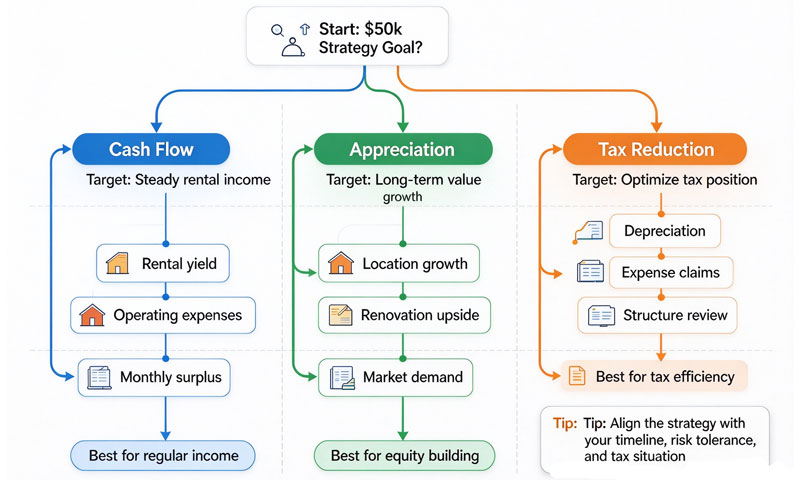
7 Ways to Invest $50,000 in Property
Each option below follows the same format: minimum entry, expected annual return, liquidity, and who it fits.
1. Buy a Rental Property Directly
$50K covers a 20-25% down payment on a home priced around $200,000-$250,000 — realistic in much of the Midwest and parts of the Sun Belt. regional home affordability data shows these markets still offer positive cash flow after mortgage, taxes, and insurance.
Best for: Investors who want full control and are comfortable with landlord duties (or hiring a property manager).
2. House Hacking or ADU Conversion
Turn $50K into a converted garage, basement unit, or attached ADU on your existing property. Many cities relaxed ADU zoning rules through 2025, so check local ordinances before you commit a dollar.
Best for: Homeowners with unused space and a tolerance for construction logistics.
3. Short-Term Rental in a Secondary Market
Nightly rates beat long-term leases, but so does the workload. Check local STR licensing rules first — several cities tightened restrictions in 2025, and a property that cash-flows under old rules may not under new ones.
4. REITs (Public or Private)
Buy shares in a company that owns income real estate. Public REITs trade like stocks; private REITs require accreditation and lock up your capital longer.
Best for: Investors who want real estate exposure with stock-market liquidity.
5. Real Estate Crowdfunding
Pool your $50K with other investors into a single project or spread it across several for instant diversification. Minimums often start under $10K, so you can split capital across 3-5 deals.
6. Real Estate Syndication
Similar to crowdfunding, but you become a limited partner with an actual equity stake — not just a share of profits. Most syndications require accredited investor status and lock your money up for 3-7 years.
7. Private Lending or Real Estate Notes
Lend your $50K to another investor, secured by the property itself. You collect interest, typically 8-14% annualized, over a 6-24 month term. No appreciation, no tax depreciation — just cash flow.
Real estate crowdfunding vs syndication
$50K Investment Comparison: Returns, Liquidity, and Effort
| Strategy | Min. Investment | Est. Annual Return | Liquidity | Effort |
|---|---|---|---|---|
| Direct rental | $50K | 6-10% + appreciation | Low | High |
| House hacking | $10-50K | Varies widely | Very low | High |
| Short-term rental | $50K | 8-15% | Low | Very high |
| Public REIT | $500+ | 4-10% dividend | High | Very low |
| Crowdfunding | $5-25K | 8-12% | Low-medium | Low |
| Syndication | $25-50K | 12-18% | Very low | Very low |
| Private notes | $25-50K | 8-14% | Very low | Low |
No single row wins. A retiree wanting monthly checks and low stress leans toward notes or REITs. A hands-on investor building equity leans toward direct ownership.
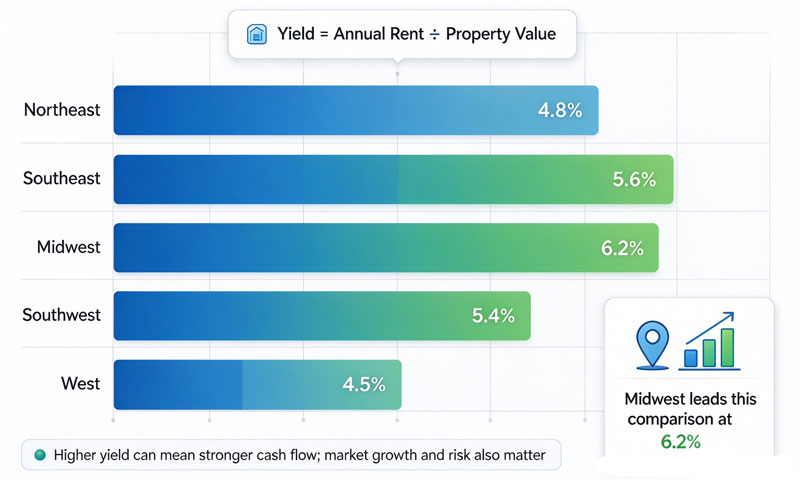
Where You Buy Changes Your Return More Than What You Buy
A $50K down payment in a high-cost metro buys almost nothing. The same $50K in an emerging secondary market can fund a full turnkey rental. regional rental yield data consistently shows secondary Midwest and Sun Belt cities outperforming coastal metros on cap rate, even as coastal markets win on appreciation.
The Tax Playbook Most Guides Skip
This is where direct ownership quietly wins — and where most $50K guides stop short.
Depreciation Offsets More Income Than You Think
A $208,000 rental property (excluding land value) depreciates over 27.5 years. That’s roughly $6,000-$7,000 a year in paper losses you can use to offset rental income — even in years the property cash-flows positive.
REIT Dividends vs. Direct Ownership, After Tax
REIT dividends are usually taxed as ordinary income, not the lower capital gains rate. Direct ownership income gets reduced by depreciation before it’s ever taxed. On paper, a REIT’s 8% yield and a rental’s 8% cash-on-cash return are not the same after-tax number — the rental typically wins.
Inherited or Windfall Money Gets a Tax Reset
If your $50K came from an inheritance, you likely received a step-up in basis on any prior asset — worth understanding before you reinvest, since it can change your capital gains exposure entirely. [1031 exchange explained]
A licensed CPA should run these numbers against your actual tax bracket before you commit.
Risk Reality Check: What Could Actually Go Wrong
Vacancy Stress Test
A single month of vacancy on a property cash-flowing $300/month can wipe out 25-30% of your annual net return. Two months can push you negative for the year. Model this before you buy, not after.
Rate Sensitivity
A 1% rate increase on a $150K mortgage adds roughly $100-$150 to your monthly payment — enough to flip a marginal deal into a losing one. Stress-test your numbers at rates a full point above today’s.
Build a Real Contingency Buffer
Set aside 10-15% of your $50K, not just “some,” for repairs, vacancy, and rate shocks. Investors who skip this step are the ones forced to sell at the worst possible time.
Diversify or Go All-In?
Most experienced investors don’t pick one strategy. A common split: 60% into a direct rental for appreciation and tax benefits, 40% into notes or a REIT for passive cash flow while the rental stabilizes. Spreading $50K across two vehicles reduces your exposure to any single market or tenant.
Frequently Asked Questions
What is the safest way to invest $50,000 in real estate?
REITs and real estate notes carry lower volatility than direct ownership, since you’re not exposed to a single property’s vacancy or repair risk. Neither is risk-free.
Can I use $50K as a down payment on an investment property?
Yes — $50K typically covers 20-25% down on a property priced around $200K-$250K, plus closing costs, depending on your lender and location.
Is $50K enough for real estate syndication?
In most cases, yes. Minimums often start at $25K-$50K, though your capital will be locked up for several years.
How much passive income can $50K generate monthly?
Depending on the vehicle, expect roughly $150-$400/month from notes or REIT dividends, or $200-$600/month net from a directly owned rental after expenses.
Should I pay off debt before investing $50K in property?
Pay off anything above 7-8% interest first. Real estate rarely outperforms high-interest debt on a risk-adjusted basis.
Final Thoughts
There’s no single best way to invest $50K in property — only the best fit for your goal, your timeline, and how hands-on you want to be. Run the after-tax numbers, stress-test the vacancy scenario, and pick the strategy you can actually stick with for the next five years.
Disclaimer: This article is for informational purposes only and does not constitute financial, tax, or legal advice. Real estate investing carries risk, including loss of principal. Consult a licensed financial advisor, CPA, or attorney before making any investment decision.