
Can I buy a house making 50k a year? Yes — and the honest range right now is roughly $135,000 to $185,000, depending on your debt, down payment, and where you’re shopping. Rates moved this year, so the math is different than it was last spring. Here’s exactly how the numbers break down.
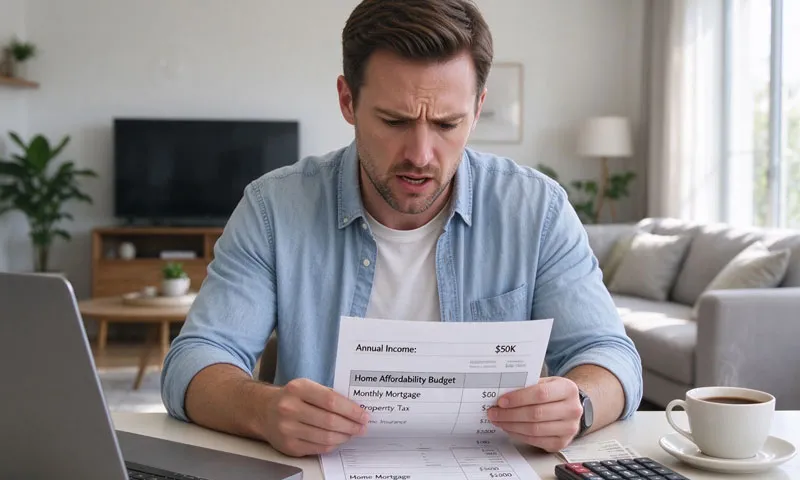
What $50K a Year Actually Buys You Right Now
A $50,000 salary works out to $4,167 a month before taxes. Freddie Mac’s Primary Mortgage Market Survey put the average 30-year fixed rate at 6.71% as of September 3, 2026 — up from 6.66% the prior week. That’s the actual national average right now, not a rate someone quoted you six months ago. gcs-web
Freddie Mac 30-year fixed mortgage rate data
Higher rates mean less loan for the same monthly payment. Here’s where that leaves you:
| Buyer Profile | Down Payment | Est. Home Price | Monthly P&I |
|---|---|---|---|
| No debt, 20% down (conventional) | $35,000+ | $175,000–$185,000 | ~$920 |
| No debt, 3.5% down (FHA) | $5,000–$7,000 | $135,000–$145,000 | ~$850 |
| $500/mo existing debt, 10% down | $15,000 | $105,000–$115,000 | ~$650 |
These numbers assume the 28% housing rule and roughly $250/month set aside for taxes and insurance. Your actual number moves with your credit score and local tax rate — no calculator can nail that down without your specific inputs.
The 28/36 Rule, and Why It’s Only Half the Story
Front-End vs. Back-End DTI, in Plain English
Lenders use two ratios. Front-end DTI is your housing payment divided by gross income — cap it at 28%. Back-end DTI adds every other debt payment — cap it at 36%. On $4,167/month, that’s a $1,167 housing ceiling and a $1,500 total-debt ceiling.
Do the math before you fall for a house. If you’re carrying a $400 car payment and $200 in student loan payments, you’ve already used $600 of your $1,500 back-end allowance. That leaves $900 for housing — well under the $1,167 front-end cap.
When Lenders Go Above 36%
FHA loans allow back-end DTI up to 43-50% with manual underwriting, especially if you have strong “compensating factors” — a higher credit score, cash reserves after closing, or a history of paying rent on time and on budget. This is the part most guides skip: a 45% DTI with $10,000 in reserves gets approved far more often than a 45% DTI with nothing in the bank. Ask your loan officer directly whether you qualify for an exception before assuming you’re capped at 36%.
Real Scenarios: What $50K Buys in Different Situations
Single buyer, no debt, 20% down. At 6.71%, a $142,000 loan runs about $920/month in principal and interest. Add taxes and insurance, and you land close to your $1,167 ceiling on a home priced around $177,000.
FHA buyer, 3.5% down. FHA loans require mortgage insurance premiums that eat into your budget — roughly $65/month on a $132,000 loan. That drops your realistic price to the $135,000–$145,000 range, but you only need $5,000–$7,000 down instead of $35,000.
Two incomes, one household. This is the scenario most articles skip entirely. If you’re buying with a partner or co-borrower who adds another $30,000 in income, your combined $80,000 salary changes the math completely — your maximum housing payment jumps to roughly $1,867/month, opening up homes in the $260,000–$290,000 range. If you have a co-borrower option, use it before assuming $50K is your ceiling.
Same salary, different metro. $50,000 in rural Ohio and $50,000 in San Diego are not the same buying power. Median home prices can differ by $300,000+ between metros — location does more to your budget than almost any other single factor.
Mortgage affordability calculator by location
Beyond Salary: What Actually Decides Your Approval
Credit Score Tiers and What They Cost You
| Credit Score | Typical Rate Impact | Extra Cost Over 30 Years |
|---|---|---|
| 760+ | Best available rate | Baseline |
| 700–759 | +0.15–0.25% | ~$8,000–$14,000 |
| 660–699 | +0.35–0.5% | ~$18,000–$25,000 |
| 620–659 | +0.5–0.75% | ~$28,000+ |
| Below 620 | FHA required, higher MIP | $35,000+ |
A 100-point credit score gap can cost more over the life of a loan than your entire annual salary. If you have six months before you plan to buy, fixing your score is the single highest-leverage move available to you.
The 20% Down Payment Myth
You do not need 20% down. FHA loans require 3.5% with a 580 credit score. Conventional programs like HomeReady and Home Possible go as low as 3%. The 20% figure only matters because it lets you skip mortgage insurance — it was never a requirement to get a loan in the first place.
Rate Sensitivity: Why Half a Percent Matters
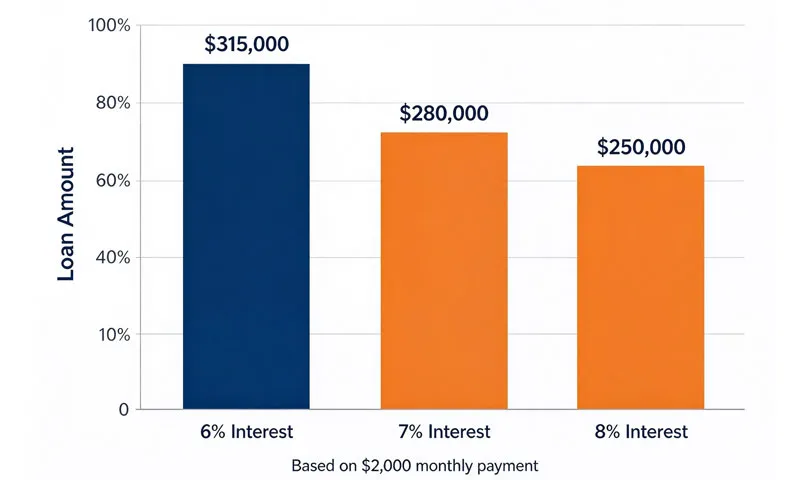
At 6.71%, a $900/month payment buys roughly $140,000 in loan. Push that rate to 7.5%, and the same payment only buys about $129,000 — an $11,000 swing from one percentage point. Shop at least three lenders. Rate quotes on the same day, same credit profile, routinely differ by 0.25% or more between lenders.
Loan Programs Built for a $50K Income
| Loan Type | Min. Down | Min. Credit Score | Mortgage Insurance | Best For |
|---|---|---|---|---|
| FHA | 3.5% | 580 | Required (MIP) | Lower credit, limited savings |
| VA | 0% | No official minimum | None | Veterans, active military |
| USDA | 0% | ~640 typical | Reduced guarantee fee | Rural/suburban buyers |
| Conventional (HomeReady/Home Possible) | 3% | 620 | Required until 20% equity | Strong credit, some savings |
FHA’s national loan limit floor sits at $541,287 for 2026 in most counties — far above what a $50K salary would ever borrow, so the limit itself won’t hold you back. FHA loan limits vary by location, generally running between $541,287 and $1,249,125 for single-family homes this year. kyoutv
VA loans deserve a specific mention: zero down, no ongoing mortgage insurance, and no official minimum credit score set by the VA itself (individual lenders still set their own floor). If you’ve served, this is almost always your best option.
Down Payment Help Most Buyers Never Look Into
State and local Down Payment Assistance (DPA) programs offer grants or forgivable loans, often specifically targeting incomes in the $45,000–$60,000 range. Search your state housing finance agency directly — don’t rely on a lender to volunteer this information, since not every loan officer tracks every local program.
A less-known option: Mortgage Credit Certificates (MCCs), available through many state housing agencies, let you claim a percentage of your annual mortgage interest as a direct federal tax credit — not just a deduction. On a $140,000 loan, that can mean $1,000+ back at tax time, every year you hold the mortgage.
Costs Nobody Warns You About
Your mortgage payment is the beginning, not the whole picture:
- Closing costs: 2–5% of purchase price, due at signing
- PMI/MIP: 0.3–1.5% of loan amount annually if you put down less than 20%
- Maintenance: budget 1% of home value per year
- Property taxes and insurance: varies wildly by state — verify local rates before you fall in love with a listing
Student Loans and Your DTI: What Changed Recently
Federal student loan repayment plans have shifted more than once in the past two years, and how a lender counts your student loan payment in your DTI depends on which repayment plan you’re on. If your loan is in an income-driven repayment plan showing a $0 or low monthly payment, some lenders still use a calculated percentage of your balance instead of your actual payment. Ask your loan officer directly how they’ll count it — this single detail has quietly disqualified buyers who assumed their $0 payment meant $0 impact.
Should You Buy Now or Keep Renting?
If your rent is climbing faster than your savings rate, buying often wins even at today’s rates — you’re building equity instead of paying down someone else’s mortgage. But if you don’t have three to six months of reserves after closing, or you expect to relocate within three years, renting a bit longer and improving your credit score first usually pays off more than rushing into a purchase.
5 Ways to Increase Your Buying Power
- Pay down one debt before applying — even $200/month freed up increases your qualifying loan amount noticeably.
- Add a co-borrower if you have one — combined income changes your bracket entirely.
- Raise your credit score 40–60 points before you shop — this alone can outweigh a bigger down payment.
- Apply for DPA and MCC programs in your state before you assume you can’t afford closing costs.
- Get pre-approved, not just pre-qualified — pre-approval verifies your documents upfront and shows sellers you’re serious.
get pre-approved for a mortgage
FAQ
Is $50,000 a good salary to buy a house?
It’s workable, not automatic. With low debt and a decent credit score, most buyers on $50K qualify for a starter home in the $135,000–$185,000 range, more with a co-borrower or in a lower-cost market.
How much house can I afford with $50K salary and no debt?
Roughly $175,000–$185,000 with 20% down, or $135,000–$145,000 with an FHA loan and 3.5% down, at current rates near 6.71%.
Can I buy a house with a 580 credit score on $50K income?
Yes, through an FHA loan, which allows a 580 score with 3.5% down. Below 580, you’ll typically need at least 10% down.
Can two people combine $50K incomes to qualify for more?
Yes. Combined income raises your qualifying housing payment directly — two $50K incomes together can roughly double your buying power, assuming debt stays low.
How much do I need saved before buying a house on $50K?
Beyond your down payment, budget 2–5% of the purchase price for closing costs and at least one month of mortgage payments in reserve. On a $150,000 home, that’s realistically $8,000–$15,000 total.
Disclaimer: This article is for general informational purposes only and does not constitute financial, legal, or investment advice. Mortgage rates, loan limits, and program eligibility change frequently. Consult a licensed mortgage loan originator or financial advisor for guidance specific to your situation.