

Smart money management for high school students starts with one uncomfortable fact: most teens graduate without ever balancing a budget. A 2024 national survey found fewer than half of U.S. teens feel confident managing their own money.[1] This guide skips the vague advice and gives you real numbers, real rules, and a plan you can start this week.

Why Financial Literacy Matters More Than a Part-Time Job
Money habits form early. Students who learn budgeting basics before 18 carry those habits into adulthood — the ones who don’t often spend their twenties catching up. That’s not opinion; it’s what happens when the first real budget you build is also the first time you’re managing rent.
The Financial Literacy Gap, By the Numbers
Only 25 states currently require a standalone personal finance course to graduate high school.[2] If your school isn’t one of them, this article is your course.
Start Earning: Jobs, Side Hustles, and Legal Age Limits
Before you chase a paycheck, know the rules. Under the Fair Labor Standards Act, 14- and 15-year-olds face strict hour limits during the school year — generally capped at 3 hours on school days. Workers 16 and older face no federal hour restrictions, though state laws vary. [verify state-specific youth employment rules]
Part-Time Job vs. Side Hustle: Which Fits Your Schedule?
| Factor | Part-Time Job | Side Hustle |
|---|---|---|
| Schedule | Fixed shifts | Flexible, self-set |
| Income stability | Steady, predictable | Variable |
| Examples | Retail, lifeguarding | Tutoring, freelance design |
| Tax handling | W-2, employer withholds | 1099, self-report |
Pick the format that fits your GPA and your energy, not just the paycheck.
Handling Peer Pressure Spending
Before any purchase, ask one question: would I buy this if nobody saw it? If the answer is no, you’re paying for approval, not the product.
Opening Your First Bank Account
A checking account handles daily spending. A savings account holds money you’re not touching for months. Most teens need both, and most banks let you open them jointly with a parent starting at 13.
Custodial Accounts: UTMA vs. UGMA
If you’re saving larger amounts — gift money, earnings from a side business — a custodial account (UTMA or UGMA) may fit better than a standard teen checking account. The account is legally yours, but a parent controls it until you hit the transfer age your state sets, typically 18 or 21. Rules differ by state, so this is one to confirm directly.
What to Ask Before You Choose a Bank
- Is there a monthly minimum balance?
- What’s the overdraft fee, and can it be turned off?
- Is there a mobile app with spending alerts?
Budgeting That Actually Sticks
Skip the 50-page spreadsheet. Start with a simple split: 50% needs, 30% wants, 20% savings. On a $200 monthly allowance, that’s $100 for essentials, $60 for fun, $40 saved automatically.
Best Budgeting Tools for Teens in 2026
| Tool Type | Cost | Needs Parent Link? | Best For |
|---|---|---|---|
| Banking app built-in tracker | Free | Sometimes | Beginners |
| Dedicated budgeting app | Free–$5/mo | Usually no | Category tracking |
| Spreadsheet template | Free | No | Full manual control |
Setting Goals That Don’t Fizzle Out
Short-term goals (1 month–1 year): concert tickets, a phone upgrade, holiday gifts.
Long-term goals (1–5 years): a car, college costs, a graduation trip.
Write the dollar amount and the date next to each goal. Goals without deadlines rarely get funded.
Compound Interest: The One Concept Worth Understanding Early
Here’s the math most articles skip. Save $50 a month starting at 16, earning 7% average annual return, and by 65 you’d have roughly $195,000 — from contributions of about $29,400. Start the same habit at 26 instead, and the total drops to around $95,000. Same monthly amount. Ten years of delay costs you half the outcome.
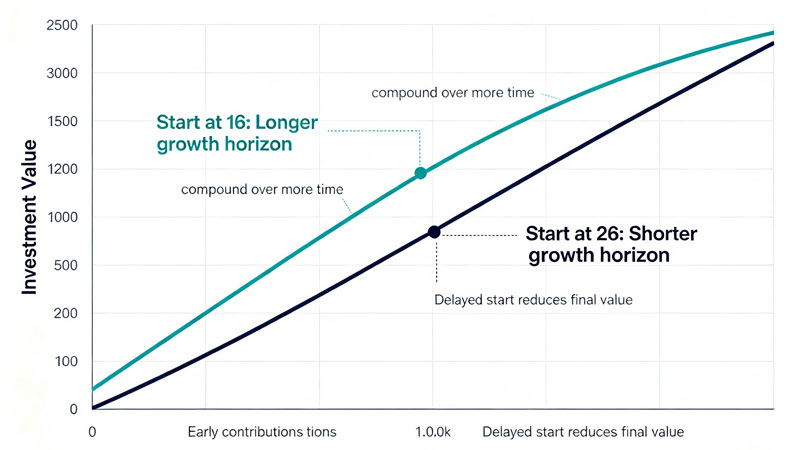
That gap isn’t about how much you save — it’s about when you start.
Saving Smart: Emergency Funds and College Costs
Even $200 set aside covers a broken phone screen or a bus pass emergency without derailing your budget. For college, the average cost of tuition, fees, room and board now runs well over $38,000 a year at four-year institutions.[3] Every dollar saved now is a dollar you won’t borrow later.
Everyday Ways to Cut Spending
- Use your student ID for discounts — streaming, retail, transit
- Wait 48 hours before non-essential purchases over $30
- Split subscriptions with friends or family
Taxes and Credit: What Nobody Tells Teens
Do You Have to File Taxes on Part-Time Income?
If your earned income exceeds the IRS standard deduction threshold for dependents (adjusted annually), you’re required to file. Even below that threshold, filing can get withheld taxes refunded. [check current filing thresholds for dependents]
Building Credit Before You’re 18
You can’t open a credit card alone as a minor, but becoming an authorized user on a parent’s card — with low balances and on-time payments — starts building your credit history years before you’d otherwise qualify.
Mistakes That Cost Teens the Most
- Falling for “get rich quick” trends on social media. If a stranger online promises guaranteed returns, that’s the red flag, not the opportunity.
- Not knowing part-time income can affect financial aid. Earnings above certain thresholds can reduce FAFSA eligibility — worth checking before you take on extra shifts senior year.
FAQ: What Students Actually Ask
What age can I open a bank account without a parent?
Most banks require a joint account with a parent or guardian until you’re 18. Some credit unions allow independent accounts at 16.
Do I need to pay taxes on babysitting or freelance income?
Yes, if your total earnings exceed the annual filing threshold for dependents. Track your income year-round so filing isn’t a scramble in April.
How much should a high schooler save each month?
Aim for 20% of whatever you earn. On irregular income, save a fixed dollar amount instead of a percentage — it’s easier to stick with.
Can I start investing before I turn 18?
Yes, through a custodial brokerage account opened by a parent. You can begin learning the mechanics — index funds, risk, time horizon — well before you can trade independently.
Your Next Step
Pick one habit from this list — open the account, set the budget split, or start the emergency fund — and do it this week. Small, consistent moves beat a perfect plan you never start.
Disclaimer: This article is for general educational purposes only and does not constitute financial, tax, investment, or legal advice. Rules on banking, taxes, and custodial accounts vary by state and change over time. Consult a licensed financial advisor, tax professional, or your bank directly for guidance specific to your situation.