

Most NYC co-op buyers don’t think about insurance until their closing attorney asks for proof of coverage — with 10 days to go. That’s the wrong time to start. Co-op insurance costs between $350 and $2,800+ per year depending on your unit’s size, renovations, and location. This guide breaks down every pricing tier, the factors that drive your premium up or down, and the coverage gaps that leave most buyers exposed.
What Is Co-Op Insurance — And Why Is It Not Optional?
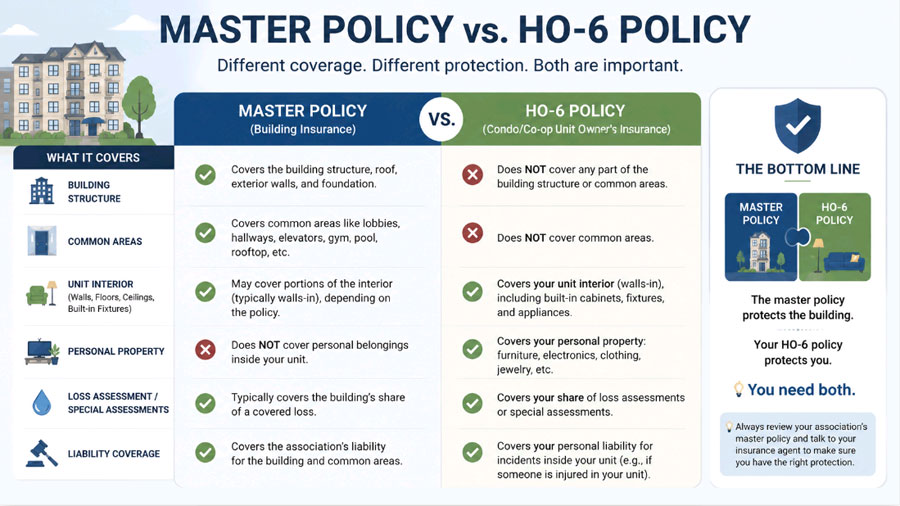
Your co-op building carries a master insurance policy. It covers the building’s structure, common areas, and the board’s liability. What it does not cover: anything inside your unit.
If a pipe bursts and floods your hardwood floors and custom kitchen, the building’s insurer will hand you back a white box. Your renovations, furniture, and personal property? That’s on you.
Beyond your board’s requirements, your mortgage lender will almost certainly require coverage too — often mandating that walls-in coverage equals at least 20% of the loan amount. Skipping insurance isn’t a money-saving move. It’s a financial gamble with a Manhattan-sized downside.
New York State’s official guidance on residential insurance requirements
The 4 Core Coverage Areas
- Personal property — furniture, electronics, clothing, artwork
- Dwelling / walls-in — your floors, walls, built-in cabinetry, and any renovations you paid for
- Personal liability — covers injury to a guest in your home, or damage your unit causes to a neighbor’s (think: overflowing bathtub, burst pipe)
- Loss of use — pays for a hotel or temporary rental if your unit becomes uninhabitable after a covered loss
The Coverage Most Buyers Miss: Loss Assessment
Here’s the scenario nobody talks about at closing: your building suffers $2 million in water damage. The master policy covers $1.5 million. The remaining $500,000 gets split among all shareholders based on their ownership percentage.
Loss Assessment Coverage protects you from that bill. It’s often available as a policy add-on for under $50/year — and it’s one of the most overlooked protections in NYC co-op ownership.
understanding loss assessment coverage for NYC co-op owners
What Co-Op Insurance Does NOT Cover
| Not Covered | What to Do Instead |
|---|---|
| Flood damage | Purchase separate NFIP or private flood policy |
| Earthquake damage | Add earthquake rider if applicable |
| Jewelry over policy limit | Schedule a separate jewelry floater |
| Professional equipment | Requires separate commercial policy |
| Fine art (high-value pieces) | Standalone art insurance or scheduled rider |
How Much Does Co-Op Insurance Cost in NYC? (2026 Breakdown)
Premiums vary widely — and the cheapest policy is rarely the right one. Here’s what each tier actually gets you.
NYC Co-Op Insurance Cost by Coverage Tier
| Tier | Annual Premium | Contents | Walls-In | Liability |
|---|---|---|---|---|
| Basic | $350 – $450 | $25,000 | $20,000 | $100,000 |
| Standard | $580 – $770 | $50,000 | $50,000 | $300,000 |
| Enhanced | $1,400 – $2,800 | $100,000 | $300,000 | $1,000,000 |
| High-Value | $5,000+ | Custom | Custom | $2,000,000+ |
Source: NerdWallet (2024), Insurance.com, and Gotham Brokerage industry estimates. Premiums reflect NYC market conditions and will vary by zip code, building type, and insurer.
The basic tier is a trap for most buyers. Rebuilding an average Manhattan apartment costs $300 or more per square foot — meaning a 600-square-foot one-bedroom carries a rebuild cost of at least $180,000. A $20,000 walls-in policy won’t get you past the architect’s invoice.
A Real-World Example
Say you own a 750-square-foot one-bedroom on the Upper West Side. You renovated the kitchen ($45,000) and have roughly $35,000 in furniture and personal belongings. Your walls-in rebuild exposure alone is around $225,000 at current NYC construction rates.
A Standard policy won’t cover it. You need Enhanced coverage — which runs $1,400 to $2,800 per year, or roughly $120 to $230 per month. For most buyers in that price bracket, that’s a manageable cost compared to the asset being protected.
Why Premiums Have Risen Since 2020
NYC co-op insurance premiums have climbed 3% to 40% depending on building and location. The drivers:
- Construction cost inflation — labor and materials are significantly more expensive than pre-pandemic levels
- Aging infrastructure — water claims tied to old pipes are among the most common in NYC
- Reinsurance market pressure — global insurance losses from natural disasters have pushed carriers to raise rates across the board
Expect annual increases of 3–5% in stable buildings, and up to 12–15% if your building has had recent water damage claims.
Co-Op vs. Condo Insurance: Key Differences
The premiums are similar. The underlying structure is not.
| Co-Op | Condo | |
|---|---|---|
| What you own | Shares in a corporation | Fee-simple real property |
| Policy type | Modified HO-6 | Standard HO-6 |
| Master policy type | Set by board (often bare walls) | Set by condo association |
| Lender requirements | Vary by cooperative | Typically 20% of loan for walls-in |
| Loss assessment risk | Common | Less common but possible |
Bare Walls vs. All-In Master Policies
This distinction directly affects how much personal insurance you need.
- Bare walls: The building insures only the structure. You’re responsible for everything from the drywall in — including flooring, built-ins, fixtures, and all renovations.
- All-in: The building’s policy covers original fixtures and finishes. Your personal policy fills gaps on renovations and upgrades only.
Before you buy a policy, get the master policy declaration page from your managing agent. Ask specifically: Is this bare walls or all-in? What’s the per-incident deductible? The answers change your coverage math significantly.
7 Factors That Determine Your Premium
| Factor | Impact on Premium |
|---|---|
| Unit size & rebuild cost | Higher sq footage = higher exposure |
| Zip code & location | Waterfront buildings often face surcharges or limited carriers |
| Building age & construction | Pre-war buildings may cost more to rebuild |
| Insurance score | Your credit history + prior claim history |
| Building amenities | Doorman, sprinklers, Nest/alarm systems = discounts |
| Prior claims history | Both yours and the building’s matter |
| Deductible choice | Higher deductible = lower annual premium |
One factor worth underscoring: your proximity to water. Shoreline properties often can’t get standard coverage. A specialty carrier may be required, and premiums reflect the added risk. This applies even if you’re not in a designated flood zone — wind damage from coastal storms is the main concern.
How to Get the Right Co-Op Insurance Policy
Step 1: Calculate Your Actual Replacement Cost
Before you request a quote, run these numbers:
- Contents: Walk through your apartment. Furniture + electronics + clothing + anything you’d replace = your contents figure
- Walls-in rebuild: Multiply your square footage × $300 (conservative NYC average). Add renovation costs you’ve invested
- Liability: $500,000 is the practical minimum for most NYC owners. Upgrading from $300,000 to $500,000 often costs less than $20/year
Step 2: Get Quotes With the Right Information Ready
To get an accurate quote, have this on hand:
- Building address and year of construction
- Unit square footage
- Estimated renovation value
- Your mortgage lender’s minimum coverage requirements
- Any high-value items (jewelry, art, professional equipment) that need scheduling
Compare at least three insurers. Rates for identical coverage can vary by 20–30%.
Step 3: Don’t Make These Common Mistakes
- Underinsuring contents. Most people underestimate by 30–40%.
- Skipping Loss Assessment Coverage. Add it. It’s cheap.
- Forgetting scheduled items. Standard policies cap jewelry at $1,000–$2,500. If you own more than that, add a floater.
- Ignoring Loss of Use. If your unit is damaged and uninhabitable, where will you live? Make sure your policy covers it.
Submitting Proof of Insurance to Your Board
Most co-op boards require a Certificate of Insurance (ACORD 27 form) before closing. Key details:
- Timing: Request the certificate from your insurer 2–3 weeks before closing
- Named insured: Must match your name exactly as it appears on the proprietary lease
- Additional insured: The co-op corporation is typically listed as an additional interested party
- Minimum limits: Check your board’s house rules — many specify minimum liability amounts (commonly $300,000 or $500,000)
Frequently Asked Questions
Q: Is co-op insurance the same as renters insurance?
No. Renters insurance covers personal property and liability but not the unit’s walls or fixtures. Co-op owners typically need walls-in coverage too, since they’re responsible for the interior structure — especially after renovations.
Q: How much Loss Assessment Coverage do I actually need?
A minimum of $25,000 is a starting point, but $50,000–$100,000 is more realistic for larger NYC buildings where a single water or fire event can generate significant shared assessments. Check your building’s master policy deductible — that figure often sets your minimum exposure.
Q: Can I get co-op insurance if my building is near the water?
Yes, but your options may be limited. Standard carriers sometimes decline waterfront properties. A specialty broker with access to non-standard markets can usually find coverage, though premiums will be higher.
Q: Does co-op insurance cover my partner or roommate?
Only if they’re listed on the policy. A domestic partner or spouse can typically be added at no cost. Roommates are a separate matter — they generally need their own renters or co-op policy.
Q: What happens if I skip co-op insurance and something goes wrong?
You absorb the full cost of any loss — repairs, legal liability, and temporary housing. If your lender required coverage and you let it lapse, you may be in breach of your mortgage terms as well.
The Bottom Line
For most NYC co-op buyers, a well-structured Enhanced policy runs $1,400 to $2,800 per year. That’s $120–$230/month to protect an asset worth hundreds of thousands of dollars and insulate yourself from liability claims that can reach seven figures.
The basic $400 policy looks attractive on paper. In practice, it leaves you dangerously underinsured. Get the coverage that matches what you’ve actually built — and add Loss Assessment while you’re at it.
Disclaimer: The information in this article is for educational purposes only and does not constitute financial, legal, or insurance advice. Premium estimates reflect general market conditions and may vary based on individual circumstances. Always consult a licensed insurance broker or advisor before purchasing a policy.