

Trying to figure out how to get out of a cosigned car loan usually means something else already went wrong — a breakup, a credit crunch, or a cosigner who’s tired of the risk. This guide skips the theory. You’ll get five real exit paths, the hidden costs nobody mentions, and a framework to pick the right one fast.

Cosigner vs. Co-Borrower: The Difference That Decides Your Options
Before you touch any paperwork, figure out which one you are. The terms get used interchangeably, but they unlock completely different exit strategies.
A cosigner backs the loan but has no ownership claim on the car. Their name sits on the credit obligation, not the title. If the primary borrower misses payments, the cosigner’s credit takes the hit — but they can’t sell or reclaim the vehicle.
A co-borrower is different. You’re equally responsible for the debt, and your name is on the title. That joint ownership means you can’t refinance, sell, or retitle the car without the other person’s signature. Full stop.
| Factor | Cosigner | Co-Borrower |
|---|---|---|
| Credit liability | Shared | Shared |
| Title ownership | No | Yes |
| Can request lender release | Often, yes | Rarely |
| Needs other party’s consent to sell | No | Yes |
Check your loan documents now. This one distinction determines every option below.
check your credit score for free
Before You Start: 3 Questions That Change Your Strategy
Is the Other Person Cooperating?
Family law attorneys who handle these disputes consistently flag the same issue: without cooperation from the other party, options shrink fast, especially for co-borrowers who need a joint signature to sell or retitle.
Is There a Legal Agreement Already in Place?
Divorce decrees, prenups, or even a signed one-page agreement override informal assumptions. A decree might award you the car, but if you can’t qualify to refinance alone, the other person stays financially tied to a vehicle they no longer legally own. Courts don’t fix that — lenders do.
Does Your Credit Support a Solo Loan?
Most refinance approvals cluster around a 660+ score for competitive rates, though subprime lenders will work with scores in the high 500s at a steeper rate. Know your number before you apply anywhere.
The Decision Framework: Which Exit Path Fits You
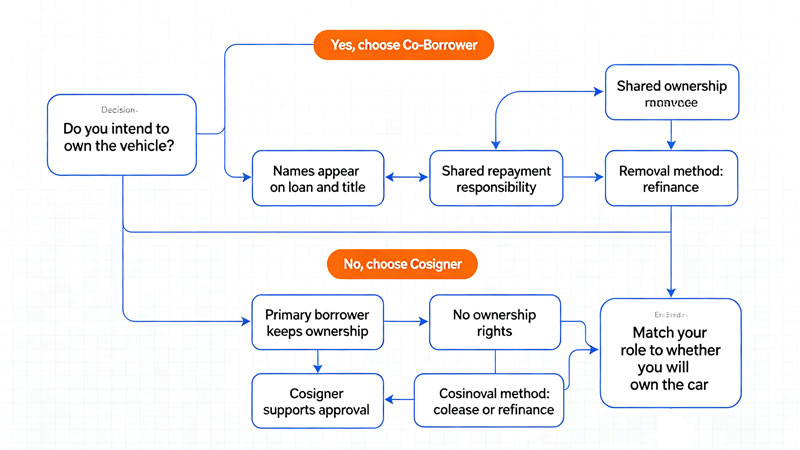
Run through this quickly:
- Cosigner + good credit + lender offers release → Request a cosigner release
- Co-borrower + cooperative party → Refinance or sell together
- Either role + can’t qualify alone → Pay off the loan or sell the car
- Uncooperative party + no legal agreement → Legal consultation before anything else
5 Ways to Remove a Cosigner From a Car Loan
Option 1: Request a Cosigner Release
Call your lender and ask directly if they offer this. Not all do. Most require 12 to 24 months of on-time payments before they’ll consider it, plus proof of income and a fresh credit pull.
Steps:
- Contact your lender’s servicing department and ask for their cosigner release policy in writing.
- Submit pay stubs, bank statements, and any requested documents.
- Wait for approval or denial — keep every document afterward.
sample cosigner release request letter
Option 2: Refinance the Auto Loan
Refinancing replaces the old loan with a new one in your name only. It’s the most flexible option and the only one that lets you renegotiate your rate.
Expect an application fee from the new lender and possibly an early termination fee from the old one. Some lenders also charge a prepayment penalty near 2% of your remaining balance — factor that into whether refinancing actually saves you money.
Option 3: Pay Off the Loan in Full
The cleanest exit, if you have the cash. Paying off the balance releases everyone tied to the loan immediately, no lender approval needed.
One side effect: closing an installment account can shrink your credit mix and cause a small, temporary score dip. It typically recovers within a couple of months.
Option 4: Sell or Trade In the Car
If the payoff amount exceeds what you can cover, selling the vehicle solves two problems at once. A dealer trade-in pays off the loan directly; a private sale means you handle payoff yourself, then split any remaining equity per your agreement.
Co-borrowers: your partner’s signature is required either way. There’s no workaround if their name is on the title.
Option 5: Loan Assumption
Rarely advertised, but some lenders will let a qualified party take over the existing loan without a full refinance — same terms, new sole borrower. Ask specifically; it won’t show up on the standard menu of options.
What If the Other Person Won’t Cooperate?
This is where most guides stop. It’s also where most people actually get stuck.
If communication has broken down entirely, a family law attorney or consumer credit counselor can outline your legal standing, especially around divorce decrees that don’t match loan reality. Credit counseling agencies can also help negotiate a structured payoff plan if neither party can afford to refinance alone. Small claims court becomes a last resort — expensive and slow, but sometimes the only path when one party refuses to engage.
learn about auto loan consumer protections
The Hidden Costs Nobody Mentions
Car insurance: If the departing cosigner was also listed on the insurance policy, update it immediately. A mismatch between your lienholder and policyholder can delay claims.
Retitling fees: Check your title for “and” versus “or” between names. An “or” lets one person retitle solo at the DMV. An “and” requires both signatures, plus state retitling fees that vary widely.
Community property states: In these states, a car bought during marriage may be treated as joint property regardless of whose name is on the loan — a wrinkle that catches people off guard during divorce.
How This Affects Your Credit Score
Refinancing triggers a hard inquiry, typically knocking off a small number of points that recover within a couple of months of on-time payments. Paying off the loan entirely can cause a slightly longer dip due to reduced credit mix and shorter average account age — again, usually temporary. The cosigner being removed will see the account drop off their report entirely, which can help or hurt their score depending on their overall credit mix.
Comparison Table: Which Option Wins?
| Method | Time Needed | Cost | Credit Impact | Best For |
|---|---|---|---|---|
| Cosigner release | 12-24 months history | Low | Minimal | Improved credit, cooperative lender |
| Refinance | Days to weeks | Fees + possible penalty | Small, short-term dip | Better rate + full independence |
| Payoff | Immediate | Full balance | Small, short-term dip | Available cash |
| Sell/trade-in | Days to weeks | Possible shortfall payment | Neutral to positive | Underwater or unwanted vehicle |
Prevent This Next Time
Before cosigning or co-borrowing again, put terms in writing: who pays, what happens on missed payments, and how the title gets resolved if the relationship ends. A one-page agreement signed by both parties can save months of conflict later.
Frequently Asked Questions
Can you switch cosigners on a car loan?
Not directly. Most lenders require a full refinance to swap out a cosigner rather than a simple substitution.
How long does a cosigner release actually take?
Once you qualify, approval usually takes a few weeks, but reaching eligibility often requires 12-24 months of on-time payments first.
Does removing a cosigner hurt your credit score?
Only slightly, and usually temporarily — mainly from a hard inquiry if you refinance or a shift in credit mix if you pay off the loan.
What happens to a cosigned car loan in a divorce?
The divorce decree can assign the car to one spouse, but the loan itself doesn’t change until you refinance, get a release, or pay it off — the lender isn’t bound by the decree.
Disclaimer: This article is for informational purposes only and does not constitute financial, legal, or credit advice. Loan terms, credit requirements, and state laws vary. Consult a licensed financial advisor or attorney before making decisions about your auto loan.