

Most car buyers ask about price. Few ask about the loan structure hiding behind that price. Questions to ask a dealership aren’t just a checklist — they’re your leverage. Ask the wrong ones, and you’ll walk out with a payment you can afford but a deal that costs you thousands more than it should.

Quick-Reference Checklist: Every Question, Sorted by Stage
Print this. Bring it. Don’t skip steps because the salesperson seems friendly — friendliness and fairness aren’t the same thing.
Before you walk in:
- Get pre-approved financing from a bank or credit union
- Research the car’s market value and current incentives
- Pull the vehicle history report (used cars only)
During negotiation:
- What’s the total out-the-door price?
- Can every fee be itemized?
- What’s the real APR, not the advertised one?
Before signing:
- Is there an arbitration clause?
- What’s the return or cancellation policy?
- Are any add-ons rolled into my loan principal?
If a salesperson hesitates on any of these, that hesitation is information.
Why the Questions You Ask Matter More Than the Answers You Expect
The Psychology Behind “What’s Your Monthly Budget?”
Dealers ask about monthly budget first because it’s easier to hide costs inside a longer loan term than inside a single price tag. Stretch a loan from 48 to 72 months, and the monthly number drops — while total interest paid climbs. It’s not dishonest, exactly. It’s a framing trick, and it works because most buyers never do the math.
What the Data Actually Shows
Average new-vehicle transaction prices and loan terms have both crept upward over the past several years, with more buyers now financing for 72 months or longer. Longer terms lower monthly payments but increase total interest paid and raise the risk of being underwater on the loan. [average auto loan terms data]
Questions to Ask a Dealership About Pricing and the Out-the-Door Number
What Is the Total Out-the-Door Price?
Not the sticker. Not the monthly payment. The full number — car, taxes, fees, everything — before financing enters the conversation.
Scenario comparison:
| Deal A | Deal B | |
|---|---|---|
| Monthly payment | $300 | $275 |
| Loan term | 36 months | 48 months |
| Total paid | $10,800 | $13,200 |
Deal B looks better on the showroom floor. It costs $2,400 more over the life of the loan.
Can You Itemize Every Fee on This Quote?
Ask for documentation fees, prep fees, and destination charges broken out line by line. Many states cap documentation fees by law — worth checking before you accept whatever number appears on the worksheet. [state dealer fee limits]
What Incentives or Rebates Do I Qualify For Right Now?
Manufacturer cashback and loyalty rebates shift monthly. Ask directly — don’t assume the advertised rate applies to your trim or credit tier.
Questions to Ask a Dealership Before Signing a Loan
What’s the Exact APR — Not the Advertised One?
Advertised rates usually require top-tier credit. Ask for your actual approved APR in writing, and compare it against your pre-approval from a bank or credit union before agreeing to anything.
Is Any Add-On Being Rolled Into My Loan Principal?
This is the question almost nobody asks, and it’s the one that costs buyers the most. GAP insurance, extended warranties, and paint protection can get folded into your loan amount instead of paid upfront. That means you’re paying interest on the insurance, not just the car.
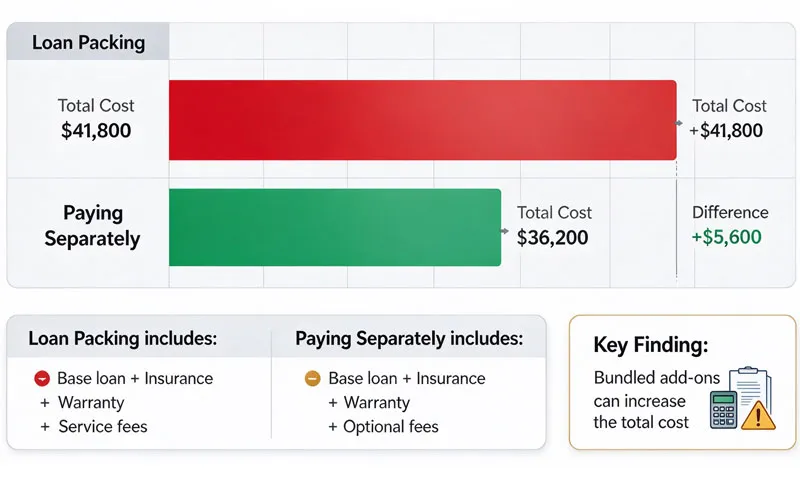
A $2,000 add-on financed at 7% over 60 months adds roughly $375 in extra interest. Paid in cash upfront, it costs exactly $2,000. Ask for a breakdown showing what’s financed versus what’s optional.
What Happens If I Pay This Loan Off Early?
Some contracts include prepayment penalties. Most don’t — but confirm it before you sign, especially if you plan to refinance later.
Questions to Ask a Dealership About the Vehicle Itself
For Used Cars: History, Title, and Inspection
Pull the vehicle history and confirm the VIN matches. Beyond Carfax, the federal NMVTIS database can flag title issues that commercial reports sometimes miss. [NMVTIS title check]
Get an independent mechanic’s inspection before you buy — not after.
For New Cars: Warranty and Recalls
Ask what’s covered under bumper-to-bumper versus powertrain warranty, and whether it transfers if you sell the car. Then check the VIN for open recalls directly through NHTSA before you leave the lot.
If You’re Considering an Electric Vehicle
EV buyers face a different set of questions: battery warranty length and mileage, current federal tax credit eligibility for that specific model, and realistic home charging installation costs. None of this shows up on the sticker.
Questions to Ask a Dealership When Leasing a Car
What’s the Money Factor?
Leasing hides its interest rate behind a “money factor” — a small decimal like 0.00125. Multiply it by 2,400 to get the approximate APR equivalent. Dealers rarely volunteer this conversion.
What’s the Mileage Allowance and Overage Cost?
A low monthly lease payment often comes with a mileage cap around 10,000–12,000 miles a year. Go over, and overage charges run 15–30 cents per mile at lease-end — an easy $1,000+ surprise if your commute changed since you signed.
What Are My Options at Lease-End?
Ask about buyout price, return condition standards, and whether you can trade the lease into a different dealership entirely.
Questions to Ask Before You Sign Anything
Is There an Arbitration Clause in This Contract?
Most buyers never read this far. An arbitration clause can limit your right to sue if a dispute comes up later, pushing you into private arbitration instead. Ask directly whether one exists, and whether it can be struck from the contract.
What’s the Return or Cooling-Off Policy?
In-person purchases usually don’t come with automatic cancellation rights the way online or phone sales sometimes do. Confirm this before you drive off.
Special Situations: First-Time Buyers and Negative Equity
No credit history? Ask whether the dealer works with credit unions offering first-time-buyer programs, and what down payment reduces your rate meaningfully.
Trading in a car you still owe money on? Ask the dealer to show your negative equity as a separate line item — not folded silently into the new loan, where it quietly increases what you owe on the new car from day one.
Dealership Red Flags: When to Walk Away
- Refusal to give a written out-the-door price
- Pressure to sign same-day with no time to review paperwork
- “Payment packing” — add-ons appearing on the contract you never agreed to
- Vague answers about APR or loan term
- No willingness to let you take the car to an independent mechanic
Any one of these is a reason to pause. Two or more, and it’s time to leave.
New vs. Used vs. Lease: Key Questions Side-by-Side
| New Car | Used Car | Lease | |
|---|---|---|---|
| Price focus | Out-the-door price, incentives | Vehicle history, title status | Money factor, mileage cap |
| Warranty | Full manufacturer coverage | Remaining coverage, if any | Manufacturer coverage during term |
| Financing | Standard APR loan | Standard APR loan | Money factor, not APR |
| Biggest risk | Depreciation | Hidden mechanical issues | Overage fees at lease-end |
New car vs used car cost comparison
FAQ: Common Dealership Questions
What’s the single most important question to ask at a dealership?
“What’s the total out-the-door price?” It forces the conversation away from monthly payments and onto the real number.
Should I tell the dealer my budget?
Share a monthly comfort range only if asked, but always negotiate the total price first. Never let budget become the opening number.
Can I negotiate price with bad credit?
Yes. Vehicle price and interest rate are separate negotiations. A lower credit score affects your rate — it doesn’t mean you overpay on the car itself.
Is it rude to ask for the out-the-door price upfront?
No. It’s standard practice. A dealer unwilling to provide it isn’t being discreet — they’re avoiding transparency.
Do dealership add-ons ever make sense?
Sometimes — GAP insurance can help if you’re financing with little down. The problem isn’t the product; it’s paying interest on it without knowing.
Disclaimer: This article is for general informational purposes only and does not constitute financial, legal, or investment advice. Loan terms, fees, and consumer protection laws vary by state and lender. Consult a licensed financial advisor or attorney before making a purchase decision.