
Should I take out student loans? It’s the question every 18-year-old stares at right before signing a FAFSA form. The honest answer isn’t yes or no — it’s a formula. Here’s how to run it before you borrow a dollar.
Why “Should I Take Out Student Loans” Doesn’t Have a One-Size-Fits-All Answer
Borrowing $15,000 for a nursing degree and borrowing $80,000 for an undeclared major aren’t the same decision wearing different price tags. One is a calculated bet with a clear payoff. The other is a coin flip with your twenties on the line.
Most articles on this topic pick a side. They either scare you off loans entirely or wave them through as “an investment in yourself.” Neither approach helps you, because your situation isn’t generic. What you study, where you study, and what that field pays after graduation change the math completely.
So instead of a verdict, you need a framework. Below is exactly that — the real numbers for 2025-26, the actual rules financial planners use with clients, and what to do if you’ve already borrowed more than you should have.
Reviewed for accuracy against 2025-26 Department of Education data. Last updated: September 2026.
What College Actually Costs Right Now
Before you can decide whether to borrow, you need real numbers — not the vague “college is expensive” line every article opens with.
For the 2025-26 academic year, average published tuition and fees run:
| School Type | Tuition & Fees | Room & Board | Total (Annual) |
|---|---|---|---|
| Public four-year, in-state | ~$11,950 | ~$13,000 | ~$24,950 |
| Public four-year, out-of-state | ~$29,000 | ~$13,000 | ~$42,000 |
| Private nonprofit four-year | ~$45,000 | ~$15,000 | ~$60,000 |
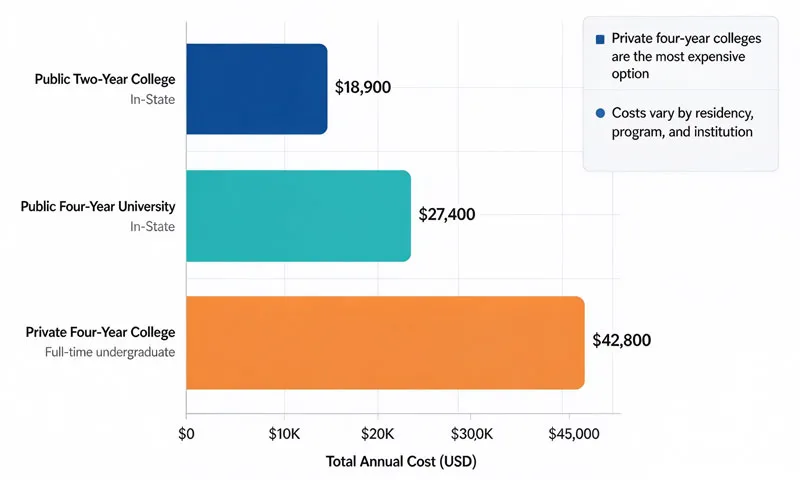
College Board 2025-26 tuition data
Here’s the part most articles skip: your sticker price isn’t your real price. Financial aid, need-based grants, and merit scholarships routinely cut 20-40% off the published number at private schools. Never rule out a school based on the listed tuition alone — always wait for your actual aid offer.
How Fast Student Loan Interest Actually Compounds
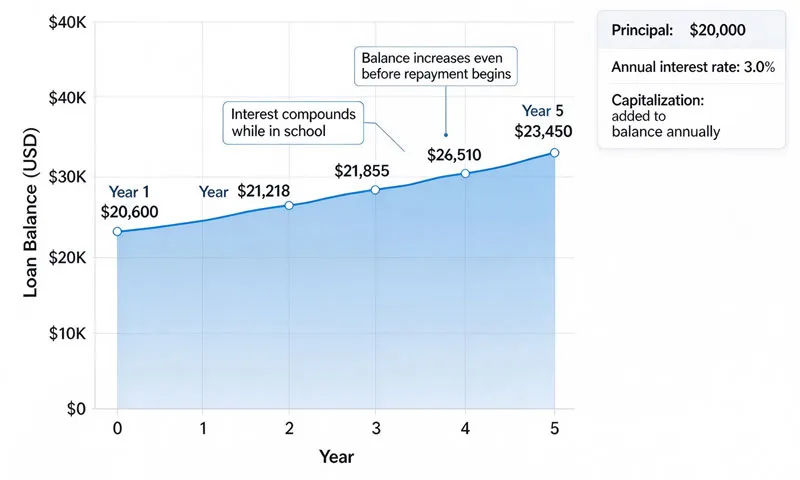
For the 2025-26 school year, federal direct undergraduate loans carry a fixed rate of 6.39%, down slightly from 6.53% the year before. Graduate unsubsidized loans sit at 7.94%, and PLUS loans at 8.94%.
Federal student loan interest rates
Here’s what that rate does in practice. Borrow $30,000 at 6.39%, and interest starts accruing the moment the loan disburses (unless it’s subsidized). Left untouched through a standard 4-year program plus a 6-month grace period, that $30,000 balance grows to roughly $32,700 before you make a single payment. You haven’t spent a dime of that extra $2,700 — it’s pure cost for the privilege of paying later.
How Long Repayment Actually Takes
The standard federal plan is built around 10 years. In practice, most borrowers take longer, because minimum payments on income-driven plans stretch the timeline in exchange for lower monthly bills. Under the plans launching in 2026 (more on that below), some borrowers won’t finish paying until year 30.
The takeaway: “10-year loan” is a starting assumption, not a guarantee.
Should I Take Out Student Loans? Use This 3-Question Framework
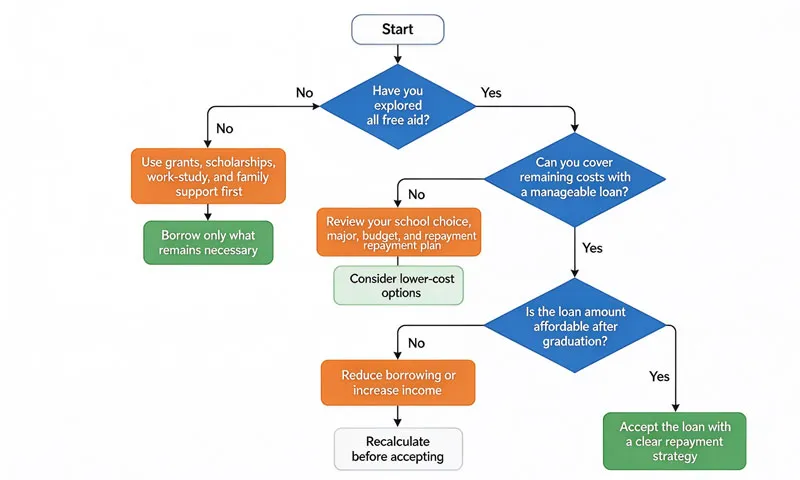
This is the core of the decision. Answer these three questions honestly before you sign anything.
Rule 1: Don’t Borrow More Than Your Expected Starting Salary
If your total debt at graduation is lower than what you’ll earn in year one, you can realistically pay it off within a standard 10-year window. Borrow more than that, and the math gets tight fast.
This rule forces you to research your field before you commit to a loan amount, not after. A quick way to check: search “[your intended major] starting salary” alongside data from the Bureau of Labor Statistics.
Bureau of Labor Statistics occupational data
Rule 2: Keep Monthly Payments Under 10% of Gross Income
Take your expected first-year salary, divide by 12, and multiply by 10%. That’s your monthly payment ceiling. Example: a $50,000 salary gives you roughly $417 a month to work with.
At 6.39% over a 10-year term, $417 a month supports a loan of about $36,000. Borrow more than that against a $50,000 salary, and you’re either stretching your budget or stretching your repayment term — both cost you.
Student loan affordability calculator
Rule 3: Have You Actually Exhausted Free Money First?
This is the step most students skip. Before you accept a single dollar in loans, confirm you’ve applied for every grant, scholarship, and work-study option available to you. We cover exactly where to look in the alternatives section below — read that before you sign your loan paperwork, not after.
Federal vs. Private Student Loans: Which Should You Choose?
This isn’t a philosophical question — it’s a checklist. Here’s how the two actually compare for 2025-26.
| Feature | Federal Loans | Private Loans |
|---|---|---|
| Interest rate type | Fixed, set annually by Congress | Fixed or variable, based on credit |
| 2025-26 undergrad rate | 6.39% | Typically 4%–15%, credit-dependent |
| Credit check required | No (except PLUS) | Yes, plus usually a cosigner |
| Income-driven repayment | Yes | No |
| Deferment/forbearance | Yes, built in | Varies by lender |
| Forgiveness programs | Yes (PSLF, IDR forgiveness) | No |
| Borrowing limits | Capped annually | Up to full cost of attendance |
The practical rule: exhaust federal loans first. They’re not underwritten on credit, they come with real safety nets, and they’re eligible for forgiveness programs private lenders will never offer. Private loans exist to fill the gap between your federal limit and your actual cost — not to replace federal borrowing.
Grad PLUS and Parent PLUS Loans
Graduate students and parents borrowing on a child’s behalf have a separate loan type: PLUS loans, currently at 8.94% for 2025-26. One detail almost nobody explains clearly: Parent PLUS borrowers are not eligible for the new Repayment Assistance Plan launching in 2026, even after consolidation. If your parents are cosigning or borrowing PLUS loans, that’s a critical fact to know before you sign — it changes their repayment options for the life of the loan.
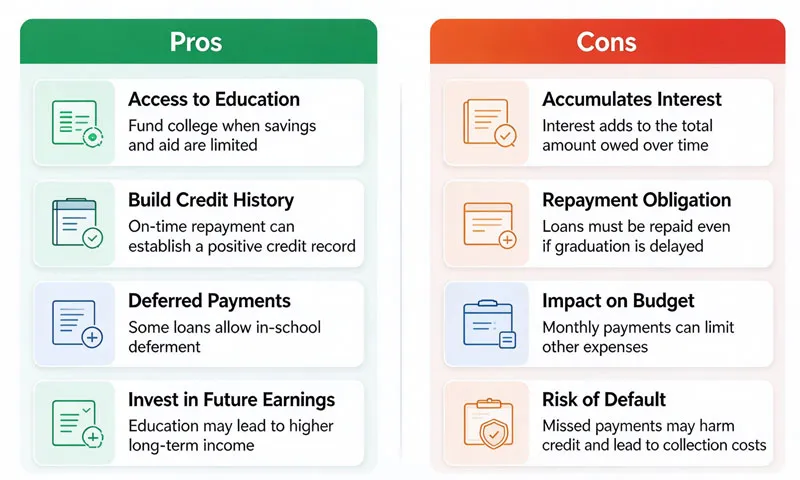
The Honest Pros and Cons of Student Loans
The Case For Borrowing
A four-year degree still correlates with meaningfully higher lifetime earnings than a high school diploma alone, and for fields with licensing requirements — nursing, engineering, accounting — there’s often no path to the career without it. Used deliberately, a loan that funds a credential with predictable, above-average earning power isn’t reckless. It’s financing an asset, similar to a mortgage.
The Case Against Borrowing
The risk isn’t the loan itself — it’s the mismatch between what you borrow and what you’ll actually earn. Roughly 40% of students who start a four-year degree don’t finish it within six years, and unfinished degrees still come with full repayment obligations. Debt without a diploma is the worst outcome in this entire framework, and it happens more often than people assume.
The Hidden Risks Nobody Tells You About Student Loans
Credit Score Impact
A single missed student loan payment can drop your credit score by 90+ points and stay on your credit report for up to seven years. That follows you into your first apartment application, your first car loan, and your first mortgage rate quote.
What Co-Signing Actually Means for Your Parents
If a parent cosigns a private loan, they’re not offering moral support — they’re legally on the hook for the full balance if you can’t pay. Missed payments hit their credit too, not just yours.
The Financial Stress Is Real, and It’s Measurable
Studies on financial stress consistently link high debt loads to disrupted sleep, elevated anxiety, and delayed major life decisions — buying a home, getting married, having kids. This isn’t a scare tactic; it’s a reason to borrow only what the math above actually supports.
Unfinished Degrees Still Require Full Repayment
Your lender doesn’t care whether you graduated. Every dollar borrowed is owed back, degree or no degree — which loops back to why Rule 3 (exhaust free money first) matters so much before you take on debt for a program you’re not fully committed to finishing.
How Much Student Loan Debt Is Too Much?
A rough industry benchmark: total debt above $70,000–$100,000 is considered heavy for an undergraduate. Above $100,000 is generally only sustainable for graduate programs — law, medicine, dentistry — where post-graduation salaries are high and predictable enough to support it.
Safe Debt Levels by Career Path
| Field | Typical Starting Salary | Reasonable Max Borrowing |
|---|---|---|
| Nursing (BSN) | ~$60,000–70,000 | ~$60,000 |
| Engineering | ~$70,000–80,000 | ~$70,000 |
| Education | ~$40,000–45,000 | ~$35,000 |
| Business/Marketing | ~$50,000–55,000 | ~$50,000 |
| Liberal Arts (general) | ~$40,000–45,000 | ~$35,000 |
| Law (JD) | ~$85,000–160,000 | Up to $150,000 (case-dependent) |
Use this table as a starting reference, not gospel — regional pay differences matter. Check current numbers for your specific target industry before committing.
Alternatives to Student Loans You Should Try First
- Scholarships and grants — free money, and not just for top students. Local scholarships tied to hobbies, employers, or community organizations get far fewer applicants than national ones.
- 529 college savings plans — tax-advantaged growth if your family started saving early.
- Work-study and part-time work — reduces how much you need to borrow in the first place.
- Starting at community college — transferring after two years can cut total tuition significantly while keeping the same final degree.
- Employer tuition assistance — many companies offer this for part-time employees, and it’s routinely overlooked by students who assume it’s only for full-time staff.
- Income Share Agreements (ISAs) — a newer, less common option where you repay a percentage of future income instead of a fixed loan amount. Worth researching for specific bootcamp and vocational programs, but read the terms carefully — they’re not regulated the same way federal loans are.
Already Borrowed Too Much? Here’s What Actually Helps
The Repayment Assistance Plan (RAP) Is Changing Everything in 2026
Starting July 1, 2026, a new plan called RAP becomes available and will be the only income-driven option for anyone taking out new federal loans after that date. Payments are calculated as a percentage of your adjusted gross income — from a $10/month minimum up to 10% of AGI for higher earners — with forgiveness after 30 years. It replaces SAVE, PAYE, and ICR, which are being phased out by mid-2028.
If you’re currently repaying loans, compare your existing plan against RAP using the Department of Education’s official loan simulator before switching — for some borrowers, RAP means a longer timeline than their current plan.
Income-driven repayment comparison
Refinancing: When It Helps
Refinancing federal loans into a private loan can lower your rate if your credit has improved significantly — but it also permanently forfeits federal protections like income-driven repayment and forgiveness eligibility. Only refinance if you’re confident you won’t need those safety nets.
Public Service Loan Forgiveness
If you work for a qualifying government or nonprofit employer and make 120 qualifying payments, remaining federal loan balances can be forgiven. The requirements are specific — the employer, the loan type, and the repayment plan all have to match, so confirm eligibility directly through your servicer rather than assuming.
Frequently Asked Questions
Should I take out student loans for college?
Only if your total borrowing stays below your expected starting salary and you’ve already applied for scholarships, grants, and work-study. Beyond that threshold, the math gets risky fast.
Is it bad to take out student loans?
Not inherently — it depends on the ratio between what you borrow and what your degree is likely to pay. A calculated, modest loan for a marketable degree is very different from open-ended borrowing for an undecided major.
What’s the difference between federal and private student loans?
Federal loans don’t require a credit check, offer fixed rates, and come with income-driven repayment and forgiveness options. Private loans are credit-based, often need a cosigner, and skip those safety nets entirely.
How much student loan debt is too much?
As a general benchmark, anything above $70,000–$100,000 for an undergraduate degree is considered heavy. The safer number is whatever’s below your realistic starting salary in your chosen field.
Can I get out of student loan debt if I can’t pay?
Bankruptcy rarely discharges student loans. Your realistic options are income-driven repayment (including RAP starting mid-2026), deferment, forbearance, or forgiveness programs like PSLF if you qualify.
Disclaimer: This article is for informational purposes only and does not constitute financial, legal, or investment advice. Student loan terms, interest rates, and repayment programs change over time and may vary by lender or individual circumstances. Consult a licensed financial advisor or your loan servicer before making borrowing decisions.