
Yes, you can use student loans for books — but the money doesn’t land in your bank account on day one. Between disbursement delays and interest that piles up quietly, borrowing for textbooks costs more than the sticker price suggests. This guide breaks down exactly how it works, what it really costs, and when a loan isn’t your best move.
Can You Use Student Loans for Books? The Official Rule
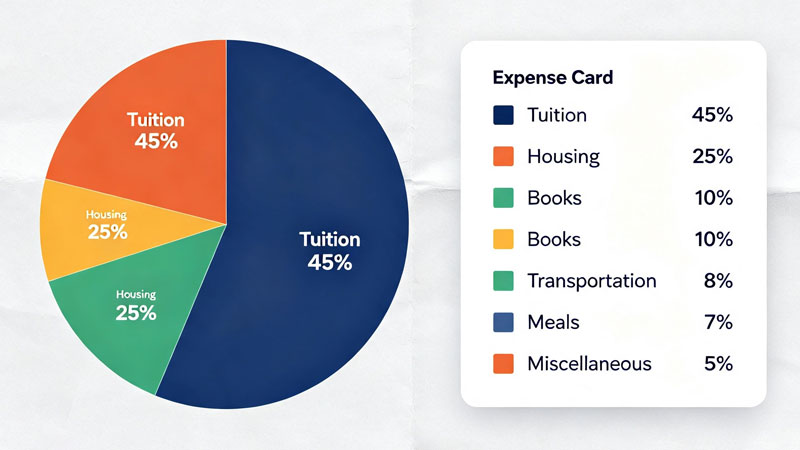
Federal Student Aid doesn’t limit your loan to tuition. It’s built around your school’s Cost of Attendance (COA) — a budget that includes tuition, housing, transportation, and yes, books and supplies. Once your school certifies your COA, any loan money left after tuition and housing gets released to you for these other costs.
What Cost of Attendance Actually Covers
Most students assume COA only means tuition. It doesn’t. A typical COA budget includes:
- Tuition and mandatory fees
- Room and board (on or off campus)
- Books, supplies, and course materials
- Transportation
- Personal expenses and, in some cases, a laptop
Federal Student Aid’s official Cost of Attendance policy
Federal vs. Private Loans for Book Funding
Not all loans work the same way once you’re standing at the bookstore counter.
| Feature | Federal Subsidized/Unsubsidized | Federal PLUS | Private Student Loan |
|---|---|---|---|
| Credit check required | No (except PLUS) | Yes | Yes |
| Covers up to 100% of COA | Often capped below COA | Yes | Yes |
| Interest starts accruing | Varies (Subsidized delays it) | Immediately | Immediately |
| Best for | Most undergrads | Grad students, parents | Gap funding after federal aid |
If you’ve maxed out federal aid and still can’t cover books, private student loans for textbooks can fill that gap — but they come with market-rate interest and no income-driven repayment safety net.
Federal vs. private student loans compared
How Student Loan Disbursement Works for Books and Supplies
This is where most students get blindsided. Your loan doesn’t skip straight to your wallet.
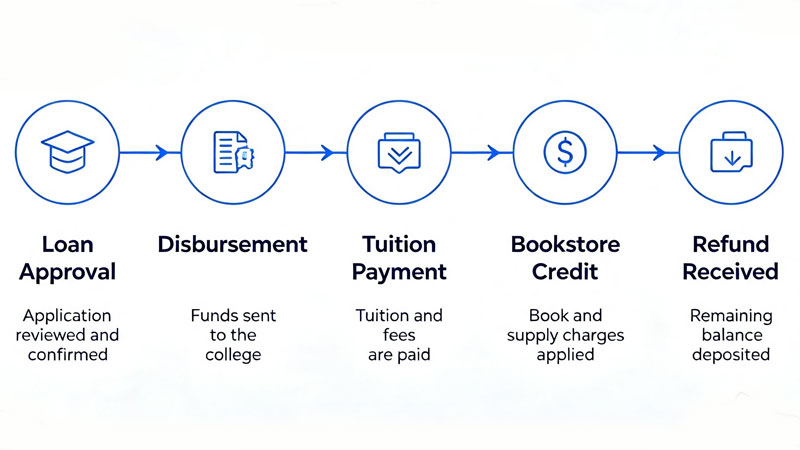
The Disbursement Timeline, Step by Step
- Your school receives the loan funds from your lender.
- Tuition and mandatory fees get paid first.
- Room and board (if billed through the school) comes next.
- Whatever’s left gets refunded to you — usually within 14 days.
First-year borrowers often wait 30 days into the term before that first disbursement arrives at all. That’s a real problem if classes start on day one and your textbook is due reading by day three.
What to Do If Your Refund Hasn’t Arrived Yet
Federal rules require schools to give you a way to get books and supplies within the first seven days of the term — even if your refund hasn’t posted. Most students never ask for this. Call your financial aid office directly and ask about a “book voucher” or “bookstore charge” option. Bring your class schedule; it speeds up the conversation.
The Real Cost of Borrowing for Books
Here’s what gets left out of most guides: borrowing $1,000 for books isn’t a $1,000 decision. At a 6.5% federal rate over a standard 10-year term, that $1,000 turns into roughly $1,370 by the time it’s paid off — just from interest. Multiply that across four years of book purchases, and you’re financing a debt that outlives your degree by a decade.
Borrow for books only after you’ve checked every free and low-cost option below. A loan should be your fallback, not your first move.
Private Student Loans for Textbooks: When They Make Sense
Private loans aren’t the villain here — they’re a tool for a specific gap. Use one when:
- You’ve hit your federal borrowing limit for the year
- You’re not a U.S. citizen or eligible non-resident
- Your federal aid package leaves a documented shortfall after tuition and housing
How to Apply for a Private Student Loan for Books
- Confirm your remaining COA gap with your financial aid office first.
- Compare APR, not just the advertised rate — fixed vs. variable matters over a 10-year term.
- Decide if you need a cosigner (most undergrads without credit history do).
- Apply directly with the lender and review the total repayment estimate before accepting.
Free and Low-Cost Alternatives Before You Borrow
Legitimate Free Textbook Resources
Not every free textbook site is safe or legal. Stick to verified open educational resource (OER) platforms:
- OpenStax — peer-reviewed, free, and legal
- OERCommons — vetted academic resources
- Your school library’s digital reserve system
Avoid random PDF links from forums promising a free copy of an expensive title — many of these violate copyright and can carry malware risk. If a site isn’t a recognized OER platform or your library’s own database, treat it as unverified.
Directory of verified open educational resources
Renting, Buying Used, and Reselling
Run this cycle every semester: buy used or rent first, keep receipts, then resell at term’s end. Students who resell consistently recover 20–40% of what they spent — money that funds next semester’s books without touching a loan.
Textbook Scholarships Worth Applying For
Scholarships like the BookScouter Quarterly Scholarship and similar $500 book-specific awards exist, but eligibility and deadlines shift constantly. Verify current amounts and deadlines directly with the sponsoring organization before applying — award details change without notice.
Which Payment Method Fits Your Situation?
| Method | Speed | Repayment Required? | Best For |
|---|---|---|---|
| Free (OER, library) | Immediate | No | Any budget |
| Scholarships | 2–8 weeks | No | Students who apply early |
| Federal loan disbursement | Up to 30 days | Yes | Standard aid gap |
| Private loan | 1–3 weeks | Yes | Leftover gap after federal aid |
Special Situations: International and Community College Students
International students typically can’t access federal loans and need to rely on school emergency funds, private loans with a U.S. cosigner, or department-specific grants. Community college students often have lower COA budgets, which can mean smaller book allowances — check with your aid office before assuming a private loan is necessary.
FAQ: Student Loans for Books
Can you use student loans for textbooks bought outside the campus bookstore?
Yes. Once disbursed to you, loan refund money isn’t restricted to the campus bookstore — spend it wherever you find the best price.
Do I have to repay loan money used for books if I drop the class?
Generally yes. The loan is tied to your enrollment period, not the specific class, so dropping a course doesn’t cancel the repayment obligation.
Can international students get loans for textbooks?
Not through federal aid. International students typically need a private loan with a creditworthy U.S. cosigner or a school-specific emergency fund.
What happens if my book costs exceed my loan disbursement?
Talk to your financial aid office about a supplemental private loan or a short-term bookstore payment plan before your refund arrives.
Can I use a 529 plan for textbooks alongside a student loan?
Yes. 529 withdrawals for books and required supplies are considered a qualified education expense and can be used alongside loan funds, as long as you don’t double-count the same expense for a tax credit.
Disclaimer: This article is for informational purposes only and does not constitute financial, legal, or tax advice. Loan terms, scholarship amounts, and eligibility rules change frequently — consult your school’s financial aid office or a licensed financial advisor before making borrowing decisions.