


Introduction
Wondering what age you can start real estate? You’re not alone — and the answer matters more than most people think.
In the majority of states, 18 is the minimum age to hold a real estate salesperson license. A handful of states require 19. And two states have no stated age requirement at all — though that doesn’t mean a 15-year-old can sign up.
This guide breaks down every state’s rules, explains what you can do before you’re eligible, and gives you a clear action plan — whether you’re 17, 22, or 40.
All state requirements verified as of Q2 2025, sourced from individual state Real Estate Commission websites and [ARELLO (Association of Real Estate License Law Officials)].
Key Takeaways
- 18 is the minimum age in 47 states
- Alabama, Alaska, and Nebraska require age 19
- Oklahoma and Rhode Island have no explicit age requirement — but practical limits still apply
- Georgia lets 17-year-olds sit for the salesperson exam (license activation requires 18)
- Broker licenses typically require 18–19 plus 2–3 years of experience — making 21 the realistic floor
- Pre-licensing coursework can be started before you hit the age cutoff in most states
Why 18? The Legal Reason Behind the Age Floor
The 18-year standard isn’t arbitrary. Real estate agents execute legally binding contracts — purchase agreements, listing contracts, buyer representation agreements. Under U.S. contract law, minors generally cannot be held to these agreements.
That’s the core issue: it’s not about maturity. It’s about legal enforceability.
A 17-year-old can understand the market. But if they sign a contract on behalf of a client, that contract may be voidable — exposing the client and the brokerage to serious legal risk. The 18-year age floor protects everyone in the transaction.
This also explains why some states set 19 as the minimum. Those states apply a slightly higher bar for full contractual capacity in professional licensing contexts.
Minimum Age for a Real Estate License by State
The table below covers the salesperson (entry-level) license. Broker requirements follow in the next section.
| State | Min Age (Salesperson) | Can Study Before Age? | Notable Detail |
|---|---|---|---|
| Alabama | 19 | Yes | Higher than national standard |
| Alaska | 19 | Yes | Higher than national standard |
| Arizona | 18 | Yes | — |
| Arkansas | 18 | Yes | — |
| California | 18 | Yes | 135-hour pre-license requirement |
| Colorado | 18 | Yes | Issues broker license directly (no salesperson tier) |
| Connecticut | 18 | Yes | — |
| Delaware | 18 | Yes | — |
| Florida | 18 | Yes | Only 63 hours required — one of the lowest |
| Georgia | 18 | Yes | Exam allowed at 17; license activates at 18 |
| Hawaii | 18 | Yes | Must be 18 by exam date |
| Idaho | 18 | Yes | — |
| Illinois | 18 | Yes | — |
| Indiana | 18 | Yes | — |
| Iowa | 18 | Yes | Must be 18 within 6 months of exam |
| Kansas | 18 | Yes | — |
| Kentucky | 18 | Yes | 96 hours required |
| Louisiana | 18 | Yes | — |
| Maine | 18 | Yes | — |
| Maryland | 18 | Yes | — |
| Massachusetts | 18 | Yes | — |
| Michigan | 18 | Yes | Per MCL §339.2502a(1) |
| Minnesota | 18 | Yes | No age requirement to start coursework |
| Mississippi | 18 | Yes | — |
| Missouri | 18 | Yes | Age verified at fingerprinting per MO Statute 330.040.3 |
| Montana | 18 | Yes | — |
| Nebraska | 19 | Yes | Higher than national standard |
| Nevada | 18 | Yes | — |
| New Hampshire | 18 | Yes | — |
| New Jersey | 18 | Yes | — |
| New Mexico | 18 | Yes | Defined as “age of majority” |
| New York | 18 | Yes | Per NYS Real Estate License Law §440-a |
| North Carolina | 18 | Yes | No diploma required |
| North Dakota | 18 | Yes | — |
| Ohio | 18 | Yes | Application submitted after education; exam follows |
| Oklahoma | None stated | Yes | Practical minimum remains 18 (see note below) |
| Oregon | 18 | Yes | — |
| Pennsylvania | 18 | Yes | Per PA Real Estate Licensing and Registration Act §521 |
| Rhode Island | None stated | Yes | Practical minimum remains 18 (see note below) |
| South Carolina | 18 | Yes | Age required at time of application |
| South Dakota | 18 | Yes | — |
| Tennessee | 18 | Yes | — |
| Texas | 18 | Yes | 180-hour pre-license requirement |
| Utah | 18 | Yes | — |
| Vermont | 18 | Yes | — |
| Virginia | 18 | Yes | Per 18 VAC 135-20-30 |
| Washington | 18 | Yes | — |
| West Virginia | 18 | Yes | — |
| Wisconsin | 18 | Yes | — |
| Wyoming | 18 | Yes | Defined as “age of majority” |
Always verify directly with your state’s Real Estate Commission before enrolling or applying. Requirements change.
Oklahoma and Rhode Island: “No Stated Age” Doesn’t Mean Anything Goes
Both states have no explicit age statute — but that’s not a loophole. Here’s why 18 remains the practical floor:
- Contract law still applies. Brokerages won’t sponsor a minor because the liability exposure is real.
- E&O insurance (Errors and Omissions) providers typically won’t cover agents under 18.
- Background checks are run through adult-system databases in most cases.
If you’re in either state and under 18: start your coursework, but wait until 18 to apply.
Real Estate Broker License Age Requirements: The Next Level
Most guides stop at the salesperson license. Here’s what they miss: the broker license is where income and independence scale significantly.
Salesperson vs. Broker: What Actually Changes
| Factor | Salesperson License | Broker License |
|---|---|---|
| Minimum age (typical) | 18–19 | 18–19 + experience |
| Experience required | None | 2–3 years (varies by state) |
| Can work independently? | No — must work under a broker | Yes |
| Can open own brokerage? | No | Yes |
| Median annual income (BLS, 2024) | ~$52,000 | ~$79,000 |
The realistic minimum age for a broker license is 21–22 — because experience requirements (typically 24–36 months as an active salesperson) stack on top of the age floor.
Broker Age + Experience Requirements in Key States
- California: 18 + 2 years full-time experience as a salesperson
- Texas: 18 + 4 years active experience (at least 3,600 points of qualifying experience)
- Florida: 18 + 24 months of real estate experience within the past 5 years
- New York: 19 + 2 years of experience as a licensed salesperson
- Georgia: 21 to hold broker license (can sit for exam at 20)
Step-by-step guide to upgrading from salesperson to broker license
If You’re Under 18: What You Can Do Right Now
Being under the age cutoff doesn’t mean you’re sitting on your hands. The agents who move fastest after turning 18 are the ones who started before they were eligible.
Start Pre-Licensing Coursework Early
Most states allow minors to enroll in pre-licensing education. This is significant. If your state requires 150 hours of coursework, completing it at 17 means you’re exam-ready the day you turn 18 — not four months later.
States that explicitly allow pre-18 enrollment include Georgia, Minnesota, and most others (check your state commission’s enrollment age policy, which is separate from the licensing age policy).
The Georgia Exception: Exam at 17
Georgia is the only state with a formal early-exam provision. You can:
- Sit for the salesperson state exam at age 17
- Activate your license once you turn 18
Per the Georgia Real Estate Commission, this applies to the broker exam as well — allowed at 20, activated at 21.
If you’re 17 and serious about real estate, Georgia’s rules are worth knowing even if you don’t plan to work there immediately.
Build Practical Experience Now
Formal apprenticeships are rare in real estate, but real experience is available:
- Administrative or marketing roles at local brokerages — these exist, and good brokers hire for them
- Transaction coordinator shadowing — learn the contract-to-close process from the inside
- Real estate investing content — understanding market analysis and property valuation has no age requirement
- Notary Public certification — available at 18 in most states (16 in some), useful in real estate transactions
A Note for Parents
If your teenager is serious about this path, here’s what you can actually do:
- Help them enroll in a state-approved pre-licensing course — many are online and self-paced
- Connect with local brokerages about part-time administrative roles
- Understand the background check implications: minor adjudications are typically sealed, but some serious offenses may surface. If there’s any history, consult an attorney before submitting an application — not after.
How Long Does It Take to Get a Real Estate License?
From decision to active license, expect 3 to 6 months in most states. Here’s the typical path:
[Week 1]      Research your state's requirements
[Weeks 2–16]  Complete pre-licensing coursework (40–180 hrs, varies by state)
[Week 16–18]  Pass the course final exam
[Week 18–19]  Submit license application
[Week 20–22]  Schedule and pass the state licensing exam
[Concurrent]  Identify and secure a sponsoring broker
[Week 22–24]  License issued and activated ✓

Total: approximately 3–6 months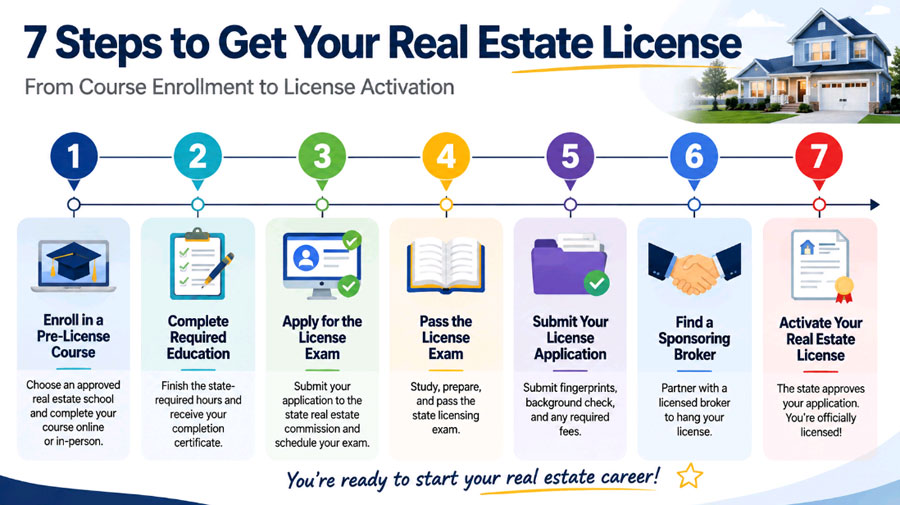
States With the Lowest Hour Requirements
- Florida: 63 hours
- Virginia: 60 hours
- Kentucky: 96 hours
These states are popular starting points for career-changers who want to get licensed efficiently.
States With the Highest Requirements
- Texas: 180 hours (six mandatory courses)
- California: 135 hours (three required courses)
- Colorado: 168 hours
If you’re targeting a high-volume market, build the extra study time into your timeline.
Real Estate License Requirements Beyond Age
Age is the entry point. These are the other boxes you need to check.
High School Diploma or GED
Most states require one. A handful — including North Carolina — do not. Check your state’s commission website for the exact wording.
Background Checks
Every state runs one. A criminal record doesn’t automatically disqualify you — but it requires attention.
- Felonies involving fraud, dishonesty, or financial crimes are the most commonly disqualifying
- Misdemeanors are reviewed case-by-case in most states
- Juvenile records are typically sealed and do not appear on standard background checks — but verify this with your state’s commission and an attorney if you’re uncertain
The smart move: Request an eligibility determination (also called a “fitness determination” or “declaratory ruling”) from your state’s Real Estate Commission before you invest time and money in coursework. Most states offer this.
This is not legal advice. If you have a criminal history, consult a licensed attorney before applying.
Sponsoring Broker Requirement
You cannot activate your license without a sponsoring broker. This isn’t a formality — it’s a professional relationship that shapes your first years in the business.
Start identifying potential brokers while you’re still in coursework. Attend open houses. Reach out on LinkedIn. The brokers who agree to mentor new agents are not the ones you cold-email the week before your exam.
Real Estate License Age Requirements in California, Texas, and Florida
These three states account for a disproportionate share of real estate activity — and real estate license searches.
California
- Minimum age: 18
- Pre-licensing: 135 hours across three courses (Real Estate Principles, Real Estate Practice, one elective)
- Exam pass rate: Approximately 50% on first attempt, per the California Department of Real Estate
- Governing body: California Department of Real Estate (DRE)
Texas
- Minimum age: 18
- Pre-licensing: 180 hours across six required courses
- Key detail: TREC (Texas Real Estate Commission) requires fingerprinting and background check before you can sit for the exam
- Timeline note: Texas has one of the longest processes — budget 5–6 months
Florida
- Minimum age: 18
- Pre-licensing: 63 hours — one of the lowest in the country
- Why it matters for career changers: The lower hour requirement makes Florida one of the most accessible entry points for 28–45-year-olds considering a transition. The market is also consistently one of the most active in the U.S.
Florida real estate market activity data
Starting a Real Estate Career at 28–45: Your Actual Advantages
Most content on this topic is written for 18-year-olds. But the data tells a different story.
According to the NAR 2024 Member Profile, the median age of a REALTOR® in the United States is 55. The average member has 10 years of experience. First-time agents who enter the business in their 30s and 40s bring something most 18-year-olds can’t replicate:
- An existing network. Your former colleagues, neighbors, and professional contacts are potential clients. A recent college graduate starts from zero.
- Financial stability. Real estate income is commission-based and irregular, especially in year one. Adults who’ve managed finances and weathered income variability adapt faster.
- Negotiation experience. Buying a car, closing a business deal, navigating a difficult workplace — these translate directly.
- Domain expertise. A former healthcare professional understands what physician relocation looks like. A former tech worker knows what a remote-work buyer needs. That’s a niche.
The question for this group isn’t “am I old enough?” It’s “can I survive the first 12 months while building a client base?” — which is a financial planning question more than a licensing question.
Frequently Asked Questions
Can a 17-year-old get a real estate license?
No state will issue an active real estate license to a 17-year-old. Georgia is the only exception — allowing 17-year-olds to sit for the exam, with license activation held until age 18.
What is the youngest age you can get a real estate license in the U.S.?
18, in 47 states. Alabama, Alaska, and Nebraska require 19. Georgia technically allows exam-sitting at 17, making 18 the youngest age to hold a license anywhere in the country.
Does a criminal record disqualify you from getting a real estate license?
Not automatically. Most states review records case-by-case, with fraud-related felonies being the most common disqualifier. Request a pre-application eligibility determination from your state commission before enrolling in coursework.
Can I get a real estate license if I’m not a U.S. citizen?
Yes, in most states. Legal residency status (green card, valid work visa) is typically sufficient. A few states have additional requirements. Check with your specific state commission.
How long does it take to get a real estate license at 18?
Typically 3–6 months from enrollment to activation, depending on your state’s hour requirements and exam scheduling availability.
What’s the difference in age requirements between a salesperson and broker license?
The minimum age is the same (18–19), but broker licenses require 2–4 years of active experience as a salesperson first. The realistic minimum age to hold a broker license is 21–22 in most states.
Your Next Step
The age requirement is the starting line — not the finish line.
If you’re under 18: enroll in pre-licensing coursework now if your state allows it. Use the waiting period to build industry knowledge and find a brokerage where you can shadow or work part-time.
If you just turned 18: start your coursework this week. The sooner you’re licensed, the sooner your experience clock starts.
If you’re 28–45 considering a career change: the barrier to entry is lower than you think, and your life experience is a competitive advantage most new agents lack. The investment is a few months of study and a few hundred dollars in licensing fees. The ceiling is substantially higher.
Disclaimer: This article is for informational purposes only and does not constitute legal, financial, or career advice. Real estate licensing requirements vary by state and are subject to change. Always verify current requirements directly with your state’s Real Estate Commission or a licensed professional before making decisions.