

Wondering what are the requirements to join a credit union? The short answer: you need a “common bond,” not a minimum balance. Most people qualify through their job, family, or zip code — they just never check. This guide breaks down every eligibility path, what to do if you’re rejected, and the exact documents you’ll need. No fluff, just what gets your application approved.
What Makes Credit Union Eligibility Different From a Bank Account
Banks sell you a product. Credit unions require you to join an ownership group. That’s the legal difference, and it changes how membership works.
Federal law requires every federal credit union to define a “field of membership” — a specific group of people it’s allowed to serve. You can’t just walk in and open an account the way you would at a bank. You have to belong to the group first.
This rule exists because credit unions are nonprofit cooperatives. Members are owners, not customers. That structure is also why rates tend to run better — there are no outside shareholders demanding a cut.
National Credit Union Administration (NCUA)
What Are the Requirements to Join a Credit Union? 5 Common Paths
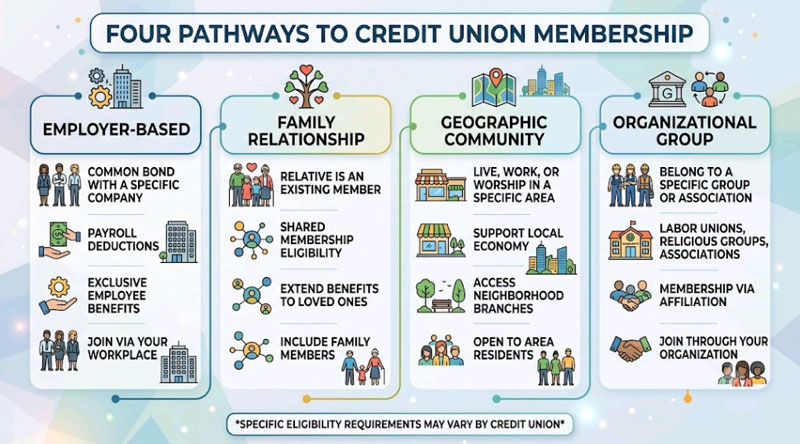
Most credit unions accept members through one or more of these routes. Check all five before assuming you don’t qualify.
Employer-Based Membership
Many companies partner with a specific credit union. If your employer offers this, joining usually takes minutes — HR can confirm eligibility on the spot.
Geographic or Community-Based Membership
Community charters cover a defined city, county, or region. If you live, work, worship, or attend school in that area, you likely qualify. This is the broadest and most common path for people with no employer connection.
Family and Household Membership
Most credit unions extend eligibility to immediate family members of existing members — spouses, children, parents, and sometimes grandparents. Some also include anyone living in the same household.
Association or Organizational Membership
Alumni groups, labor unions, professional associations, and even certain homeowners’ associations can open the door to membership. It’s worth checking if any group you already belong to has a credit union partnership.
Donation-Based Membership
Some credit unions let you qualify by donating a small amount to a partner nonprofit — often between $10 and $25. This path exists specifically for people who don’t fit the other four categories, and it’s rarely advertised. Ask directly; don’t assume it’s unavailable.
| Eligibility Path | Typical Requirement | Approval Speed |
|---|---|---|
| Employer-based | Proof of employment | Same day |
| Geographic | Proof of address/work | Same day |
| Family | Relationship documentation | Same day |
| Organizational | Membership card or ID | 1-2 days |
| Donation-based | $10-$25 donation | Same day |
What Happens If You Don’t Qualify for a Credit Union
This is the part most guides skip. Rejection happens, and it’s rarely about the eligibility path itself.
Common Reasons Applications Get Denied
The most frequent cause isn’t the “common bond” — it’s ChexSystems. This consumer reporting agency tracks closed accounts with unpaid overdrafts or suspected fraud. A flagged file can stall your application even if you meet every other requirement.
Other rejection triggers include mismatched address documentation, incomplete identity verification, or applying under an organizational tie that’s already expired (like an old employer).
Fixing a ChexSystems Issue Before You Reapply
You have a legal right to see what’s on your file. Request your ChexSystems report, dispute inaccurate entries, and resolve any outstanding balance with the original institution. Understand consumers’ rights to dispute ChexSystems records
If your record still shows an issue, look into second-chance checking programs. Several credit unions specifically design accounts for people rebuilding after a ChexSystems flag
How to Join a Credit Union: The Application Process
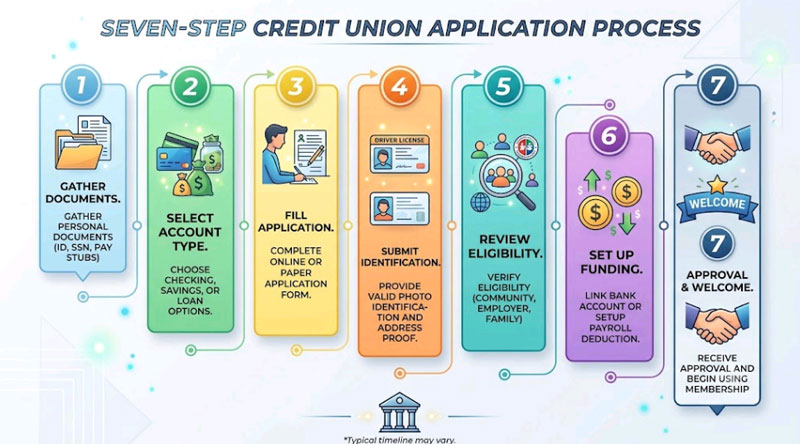
- Shortlist eligible credit unions. Compare fees, rates, and branch or app access before applying anywhere.
- Confirm your eligibility path. Check the “Membership” page or call directly — don’t guess.
- Gather your documents (full list below).
- Submit the application. Online takes 10-15 minutes; in-branch is often approved same-day.
- Complete identity verification. This includes a soft credit check, which does not affect your credit score, plus a ChexSystems review.
- Fund your share account. This small deposit establishes your ownership stake.
- Activate online and mobile access so your account is usable immediately.
Documents Needed to Join a Credit Union
Have these ready before you start the application — it cuts approval time significantly.
- Government-issued photo ID (license, passport, or state ID)
- Social Security number
- Proof of eligibility (utility bill, employee badge, or membership card)
- Initial deposit, typically $5-$25
Credit Union vs. Bank: How Eligibility and Costs Compare
Eligibility isn’t the only difference worth weighing. Here’s how the two stack up on the numbers that actually affect your wallet.
| Factor | Credit Union | Traditional Bank |
|---|---|---|
| Membership required | Yes, one eligibility path | No, open to public |
| Deposit insurance | NCUA, up to $250,000 | FDIC, up to $250,000 |
| Average savings APY | Generally higher | Generally lower |
| Average loan rates | Generally lower | Generally higher |
| Branch density | Lower, community-based | Higher, national footprint |
| ATM network | Shared networks (e.g., CO-OP) | Proprietary, often larger |
Worth noting: credit unions trade some convenience — fewer branches, smaller ATM networks — for better rates and lower fees. If you travel constantly or need a physical branch in every city, factor that in before switching.
Keeping Your Membership After You Join
Once you’re in, membership is usually permanent — even if you move, retire, or leave the employer that qualified you originally. The only common way to lose it is falling into serious bad standing, like unpaid overdrafts or account fraud.
FAQ: What Are the Requirements to Join a Credit Union
Can I join a credit union if I don’t live in its service area?
Sometimes. Family, employer, or organizational ties can qualify you even outside the geographic footprint. Check each path individually rather than assuming geography is the only option.
Do credit unions check ChexSystems before approving membership?
Most do, as part of standard identity and account verification. A minor issue won’t always block approval, but unresolved debt with a prior institution often will.
Can I belong to more than one credit union at once?
Yes. There’s no rule limiting you to a single credit union, as long as you meet each one’s eligibility requirements separately.
How much does it cost to join a credit union?
Typically $5-$25 for your share deposit. This isn’t a fee — it represents your ownership stake and is usually refundable if you close the account in good standing.
Disclaimer: This article is for informational purposes only and does not constitute financial, legal, or investment advice. Membership requirements, rates, and fees vary by institution and change over time. Consult a licensed financial advisor or contact the credit union directly before making a decision.