

Learning how to build credit without debt sounds like a contradiction. Most advice tells you to borrow more so lenders can watch you repay it. But a credit score needs reported on-time payments, not interest charges or a balance you carry. This guide covers six ways to build credit without debt, from credit-builder loans to rent reporting. Written for working adults who want a stronger score without paying interest to get it. You’ll see costs, timelines, and risks side by side, plus a 90-day plan. Every figure comes from a named source. Pick the method that fits your situation, then start with your free credit reports.

What Does It Mean to Build Credit Without Debt?
You build a record of on-time payments. You do not pay interest or carry a balance you can’t clear. You still need at least one account or payment that reaches the credit bureaus.
Debt, credit accounts, and carrying a balance
People mix up three terms.
- Debt is money you owe.
- A credit account is a card or loan that shows up on your report. It can have a $0 balance.
- Carrying a balance means you don’t pay in full each month, so interest builds on cards.
You can hold a credit account without being in debt. A card you pay in full every month builds history and costs no interest.
Which parts of your score you control
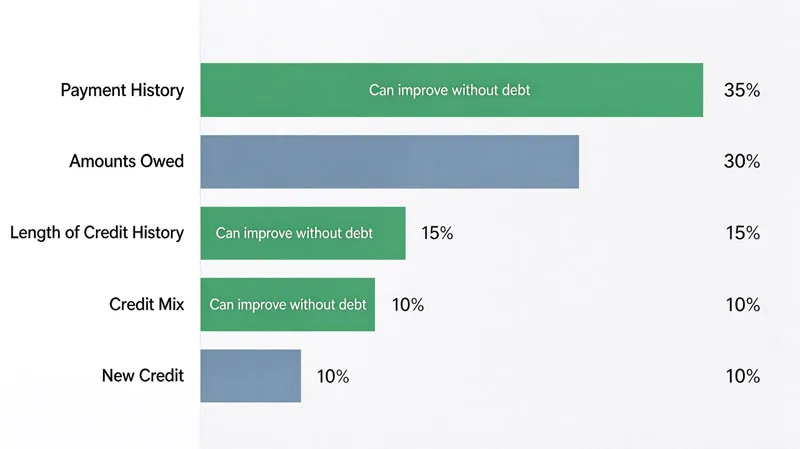
FICO scores weigh five factors, according to myFICO: payment history (35%), amounts owed (30%), length of credit history (15%), new credit (10%), and credit mix (10%). Without borrowing, you can move the first three. Pay on time. Keep balances near zero. Keep your oldest accounts open.
Step One: Check Your Credit Reports Before You Build
Pull your free reports and fix errors
Equifax, Experian, and TransUnion now offer free weekly reports at AnnualCreditReport.com. The FTC says the bureaus made that program permanent. Use that site only. Look-alike sites may charge you or steal your data.
Check your name, address, and account statuses. Look for late payments you actually made on time. If you find an error, dispute it with the bureau and with the company that reported it. Our guide on how to read your credit report walks through each section.
Know your starting point
- No file: no accounts report to the bureaus.
- Thin file: one or two accounts, or very little history.
- Damaged file: late payments, collections, or charge-offs.
Free score apps may not match what a lender sees. Experian notes there are as many as 40 versions of the FICO Score, and lenders choose which one to use. Treat app scores as a trend line, not a verdict.
6 Ways to Build Credit Without Debt
Each method below lists how it works and what to watch for.
1. Credit-builder loans
A lender places a small amount, typically $300 to $1,000, in a locked account. You pay it back in installments over 6 to 24 months. The lender reports your payments, then releases the money at the end, minus interest and fees. That is how the CFPB describes it.
Here is an example. You borrow $600 over 12 months and pay $52.75 a month. You pay $633 in total and get $600 back. Your net cost is $33, before any fees.
Technically, this is a loan. But because the lender holds the funds, you never owe a balance you can’t clear. The CFPB says borrowers can’t end up with a lasting outstanding balance.
Watch out: Confirm the lender reports to all three bureaus. Ask about origination and administration fees. Remember that your cash is locked up, and a missed payment still hurts. The CFPB also notes that people with existing debt may want to pay it down first. Read more on how credit-builder loans work before you apply.
Credit-builder loans explained
2. A secured card used like a debit card
You put down a refundable deposit, which becomes your limit. Charge one small bill, such as a $15 subscription. Set autopay for the full statement balance. Interest never applies.
Watch out: This is still a credit card account. If you want to avoid cards entirely, skip it. Check for annual fees, deposit refund terms, and whether the issuer reports to all three bureaus.
3. Authorized user status
Ask a trusted family member with a long, clean history to add you to their card. If the issuer reports authorized users, their on-time record can appear on your file. It usually costs nothing.
Watch out: Their late payments and high balances can hurt you. They also carry the legal responsibility for the account. Agree on spending rules before you swipe.
4. Rent reporting
On-time rent does nothing for your score unless someone reports it. Many landlords don’t. Ask yours to start, or use a rent-reporting service. Some services also add up to 24 months of past rent, though fees and coverage vary. Compare a few rent reporting services before you pay for one.
Scoring models matter here. FICO Score 8, which many lenders still use, ignores rent. FICO Score 9 and 10, and VantageScore 3.0 and 4.0, count it. On April 22, 2026, government officials announced that mortgage lenders can now use VantageScore 4.0, with FICO 10T expected later, according to CNBC. Both models can consider rent and utility data when it is reported. Ask any lender which score it pulls.
5. Utility, phone, and streaming payments
Experian Boost is free. You link your bank account, and Experian adds on-time utility, phone, streaming, and online rent payments to your Experian file.
Experian says users whose scores improved gained 13 points on average on FICO Score 8. Not everyone gains. Boost only touches your Experian report, so a lender that checks Equifax or TransUnion won’t see it. Thin-file users tend to benefit most.
6. Paying down what you owe and staying current
If you already have accounts, they are your fastest lever. Payment history is 35% of your FICO score, and amounts owed is 30%.
- Bring any late account current first.
- Keep card utilization under 30%. Lower is better.
- Leave your oldest account open.
- Set autopay for at least the minimum, then pay the full balance by the due date.
Which Way to Build Credit Without Debt Fits You?
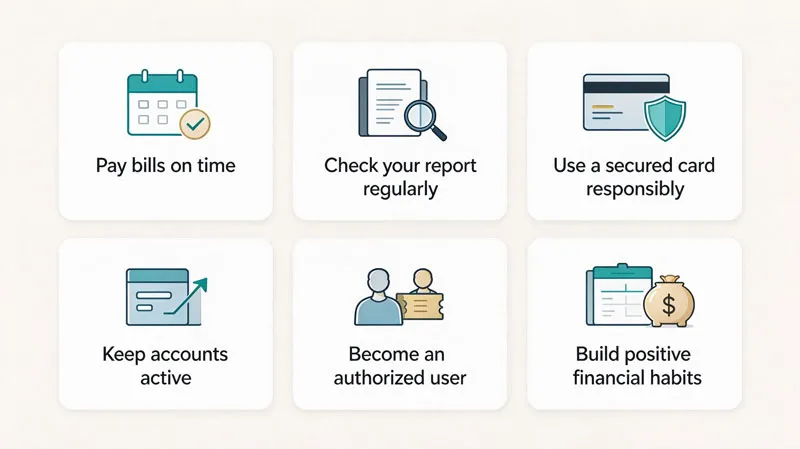
| Method | Typical cost | Reports to | Best for | Main risk |
|---|---|---|---|---|
| Credit-builder loan | Interest plus possible fees; cash locked 6-24 months | Varies by lender; confirm | No file, thin file | Fees; a missed payment hurts |
| Secured card, paid in full | Refundable deposit; maybe an annual fee | Usually all three; confirm | No file, rebuilding | Overspending; fees |
| Authorized user | Usually free | Depends on issuer | No file, thin file | Primary holder’s mistakes |
| Rent reporting | Free through a landlord, or a service fee | Varies by service | Renters with thin files | Not every score counts it |
| Experian Boost | Free | Experian only | Thin file, fair scores | No guaranteed gain |
| Pay down and stay current | Free | All three | Anyone with accounts | Slow; adds no new history |
If you have no credit history
Start with a credit-builder loan or authorized-user status. Add rent and bill reporting once those are running.
If you have a thin file
Add rent and bill data first, since it’s free. Then add one installment account if you want a better credit mix.
If you are rebuilding after late payments
Bring every account current first. Then add a secured card you pay in full, or a credit-builder loan. Recent on-time payments count for more as old marks age.
Pick one or two methods. You don’t need all six.
How Long Does It Take to Build Credit Without Debt?
When will you get your first score?
Most FICO scores generally need an account that has been open about six months, plus recent activity. Some VantageScore models can score a file sooner. Until then, your report still shows payments.
What to expect at 3, 6, and 12 months
- Months 1-3: Accounts open and start reporting. Check each bureau to confirm.
- Month 6: A first FICO score becomes possible. Keep utilization low.
- Month 12: You have a year of on-time history. Review your reports and decide what to add next.
No method guarantees a point gain. Results depend on your starting file.
How long do negative marks last?
According to the CFPB, most negative information can stay on your report for up to seven years. Bankruptcies can stay up to 10. The seven-year clock generally starts at the first missed payment, not when you pay off the debt. On-time payments and time both help.
What Are the Risks of Building Credit Without Debt?
Fees and locked cash
Credit-builder loans can charge interest and fees. Rent-reporting services may charge setup or monthly fees. Add up the total cost before you commit.
Reporting gaps
A payment only helps if it is reported and if the score a lender uses counts it. Ask each provider which bureaus it reports to. Ask each lender which scoring model it uses.
Too many new accounts at once
Each credit application can trigger a hard inquiry, and those can stay on your report for two years. Opening several accounts in one month can also shorten your average account age. Ask whether a product needs a hard check before you apply.
How Do You Avoid Credit Repair Scams?
Federal rules bar credit repair telemarketers from collecting fees before they deliver services, according to the FTC. Watch for these red flags:
- Upfront fees for “fixing” your score
- Promises to erase accurate negative items
- Guaranteed point jumps in 30 or 40 days
- Advice to stop talking to the bureaus or to create a “new credit identity”
You can dispute errors yourself for free. If a company breaks these rules, report it to the CFPB or the FTC.
Your 90-Day Plan to Build Credit Without Debt
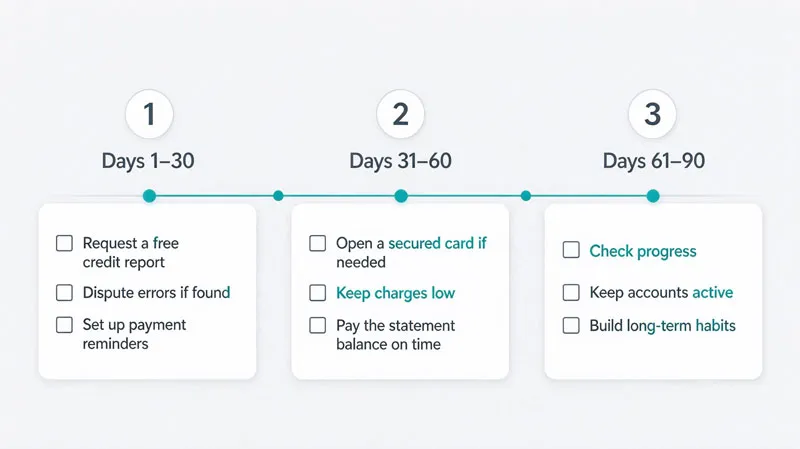
- Days 1-14: Pull your reports. Dispute errors. Identify your file type.
- Days 15-45: Choose one or two methods. Open them. Set autopay.
- Days 46-90: Confirm each bureau shows the new data. Keep utilization under 30%. Re-check your reports.
The Bottom Line on Building Credit Without Debt
You don’t need to borrow to build credit. You need reported, on-time payments. Check your reports this week, pick one method that fits your file, and automate the payment. Then let time do the rest.
Frequently Asked Questions About Building Credit Without Debt
Can you build credit with no debt at all?
Yes. Reported on-time payments, such as rent, utilities, or a card paid in full, create history without interest. You do need at least one source that reports to the bureaus.
Is a credit-builder loan considered debt?
It is an installment loan, but the lender holds the funds while you pay. You still owe the payments, and missing them hurts your credit.
Does checking my own credit hurt my score?
No. Checking your own reports is a soft inquiry and does not affect your score. A hard inquiry from a lender can.
How can I build credit without a credit card?
Use a credit-builder loan, rent reporting, or bill reporting through Experian Boost. These add payment history without a card account.
Is Experian Boost worth it?
It is free, and Experian says users whose scores rose gained 13 points on average. It only affects your Experian file, and some users see no change.
Disclaimer: This article is for general educational purposes only. It is not investment, financial, or legal advice. Credit products, fees, and scoring rules change. Consult a licensed financial professional or attorney before you make decisions about your credit.