

Introduction
You want to know how to protect your debit card from being hacked before a stranger drains your checking account. Fraud doesn’t wait for a good time. It hits during payday, before rent, at 2 a.m. This guide covers the exact steps that stop most attacks, plus your legal rights if one gets through anyway.
How Debit Cards Actually Get Hacked
Most people focus on solutions before understanding the threat. That’s backwards. Know the method, and the defense becomes obvious.
Card Skimming and Shimming
Skimmers sit inside ATM card slots. Shimmers go even deeper, reading chip data directly. Both copy your card the second you insert it.
Phishing and Text Scams
A message claims your account is locked. You click, you type your login, you’re done. Simple, and still one of the most effective attacks banks report.
Data Breaches
Sometimes you do everything right and get hacked anyway, because a retailer’s database got hit. [identity theft resource center data breach report]
Public Wi-Fi Interception
Free Wi-Fi at a coffee shop can be spoofed. A hacker names their hotspot almost identically to the real one, and you connect without noticing the difference.
12 Proven Ways to Protect Your Debit Card From Being Hacked
1. Use Virtual Card Numbers for Online Purchases
A virtual card number is a temporary, disposable stand-in for your real card. Use it once, and even if the retailer gets breached, your actual account stays untouched. Several major banks now offer this free.
2. Turn On Multi-Factor Authentication
A password alone isn’t enough anymore. Add a second layer — a code, a fingerprint, a face scan — and you cut off most remote takeover attempts before they start.
3. Set Real-Time Transaction Alerts
Get a text the second your card is charged. Fraud caught in minutes is fraud that costs you nothing. Fraud caught in weeks is a different story.
4. Use ATMs Inside Bank Branches
Outdoor, standalone ATMs get targeted more because they’re checked less often. A machine bolted inside a lobby, under constant camera coverage, is a harder target.
Quick skimmer check: Wiggle the card slot. Loose or oddly bulky? Walk away. Cover the keypad every time, regardless.
5. Avoid Public Wi-Fi for Banking
If you must check your balance from a café, use your phone’s cellular data instead, or a personal VPN. Never log into your bank on a network you don’t control.
6. Use Contactless and Mobile Wallet Payments
Tap-to-pay and mobile wallets generate a one-time code per transaction. Your actual card number never touches the terminal, which means there’s nothing for a skimmer to steal.
7. Build a PIN That Isn’t Guessable
Skip birthdays, skip 1234, skip repeating digits. [password cracking time statistics] shows how fast weak codes fall. A random four digits takes seconds longer to guess than a birth year, and that gap matters.
8. Keep a Spending Buffer, Not Your Full Balance
Move most of your money into savings and keep a working buffer in checking. If your debit card is compromised, the exposure is smaller by design.
9. Monitor Your Account on a Schedule
Don’t wait for a gut feeling. Check transactions two or three times a week, on a set day, the same way you’d check the mail.
10. Recognize Phishing Before You Click
Real banks don’t ask for your PIN by text. They don’t create urgency with countdown timers. If a message pushes you to act fast, that pressure is the tell.
11. Protect Elderly Parents and Kids With Their Own Cards
Older adults and teenagers get targeted specifically because scammers assume less familiarity with these tactics. A short conversation about common scams does more than any app setting.
12. Watch for Zelle and P2P-Linked Scams
Peer-to-peer transfers tied to your debit card move fast and rarely get reversed. Treat any unexpected P2P request, even from a “friend,” as suspicious until verified by phone.
Debit Card vs. Credit Card: Which One Protects You Better?
This is the question competitors gloss over, and it matters more than any single tip above.
Debit cards fall under [Regulation E consumer protections], not the same law that covers credit cards. The difference changes how much money you can lose.
| Factor | Debit Card | Credit Card |
|---|---|---|
| Governing law | Regulation E | Fair Credit Billing Act |
| Reported within 2 business days | Up to $50 | $0 (Zero Liability, typical) |
| Reported within 60 days | Up to $500 | $0 (Zero Liability, typical) |
| Reported after 60 days | Unlimited | $50 max |
| Where funds come from during dispute | Your checking account, immediately | Not yet paid by you |
The practical takeaway: for online purchases from unfamiliar sites, a credit card gives you a buffer a debit card doesn’t. For everyday spending you track closely, debit is fine.
Credit card vs debit card fraud protection guide
What to Do the Moment Your Debit Card Is Hacked
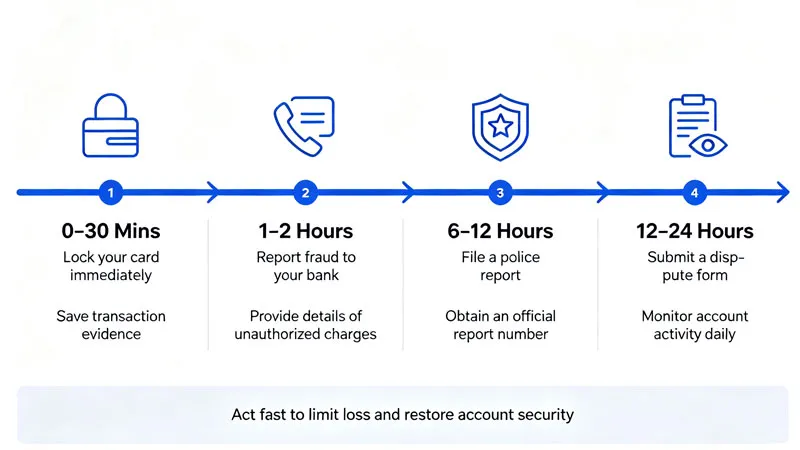
Speed decides how much you lose. Move through these steps in order.
- Lock the card immediately through your banking app, not a phone call queue.
- Report it in writing, not just verbally. Written reports create a paper trail your bank needs to process a claim.
- Request a replacement card and update every subscription tied to the old number.
- Pull your credit report to rule out broader identity theft. [identity theft recovery checklist]
- Change your online banking password and enable MFA if you haven’t already.
- File a report with the FTC at IdentityTheft.gov if the fraud extends beyond one transaction.
Warning Signs Fraud Is Already Happening
Small, odd charges often come before big ones. A $1.00 test transaction isn’t a mistake. It’s a fraudster checking whether your card still works before they max it out. Declined transactions you didn’t attempt, or a statement that never arrives, deserve a call to your bank the same day.
Key Takeaways
- Use virtual card numbers online whenever your bank offers them.
- Enable MFA and real-time alerts on every account tied to your card.
- Know your Regulation E timeline — reporting within 2 days caps your loss at $50.
- Lock your card first, ask questions second, if fraud hits.
- Small “test” charges are an early warning sign, not a billing error.
Frequently Asked Questions
Can someone hack my debit card with just the number?
Yes, for online purchases where a PIN isn’t required. This is exactly why virtual card numbers exist.
Will my bank refund me if my debit card is hacked?
Usually, yes, but the amount depends on how fast you report it under Regulation E. Faster reporting means a lower liability cap.
Is it safer to use a debit card or credit card for online shopping?
Credit cards generally offer stronger built-in protection for online purchases, since fraudulent charges don’t touch your bank account while disputed.
How long does a bank have to resolve a debit card fraud claim?
Banks typically must investigate within 10 business days, though this can extend for new accounts or larger claims.
Should I get a new card number after a data breach, even without confirmed fraud?
Yes. Waiting for confirmed fraud means waiting for damage. Requesting a new number after a breach notice is a low-cost precaution.
Disclaimer: This article is for general informational purposes only and does not constitute financial, legal, or investment advice. Fraud liability rules and bank policies vary. Consult a licensed financial advisor or your bank directly for guidance specific to your situation.