

What is a credit hold? It’s a restriction that blocks you from spending on credit, or stops a supplier from shipping on credit, until a problem gets fixed. You might meet it as a declined card at a hotel desk, a paused business account, or available credit that mysteriously shrank overnight. The cause differs each time, and so does the fix. This guide covers all three types of credit holds, explains why they happen, and walks you through getting each one lifted quickly. You’ll also learn whether a hold hurts your credit score and how to keep one from happening again.
Key Takeaways
- A credit hold limits spending or ordering on credit. It is not a credit freeze.
- There are three common versions: a supplier hold, a card account restriction, and an authorization hold.
- Most holds clear once you pay what’s due, verify your identity, or the merchant releases the charge.
- The hold itself rarely shows on your credit report. The unpaid debt behind it can.

What Is a Credit Hold? The Short Answer
A credit hold is a temporary block on credit activity. A lender, card issuer, or supplier pauses your ability to charge, borrow, or order on credit until a specific problem is resolved. The problem is usually a past-due balance, suspected fraud, or a limit you’ve exceeded.
Why “Credit Hold” Means Three Different Things
The phrase gets used in three settings:
- Supplier credit hold (business). A vendor stops filling orders on credit terms because your invoices are overdue.
- Card account restriction. Your issuer limits or suspends your card after spotting fraud risk, a missed payment, or a failed identity check.
- Authorization hold. A merchant reserves part of your available credit for a purchase that hasn’t settled. Hotels, gas stations, and car rental counters do this all the time.
Card issuers rarely use the exact words “credit hold.” You’ll see “account restricted,” “fraud block,” or “temporary suspension” instead. They all mean the same thing.
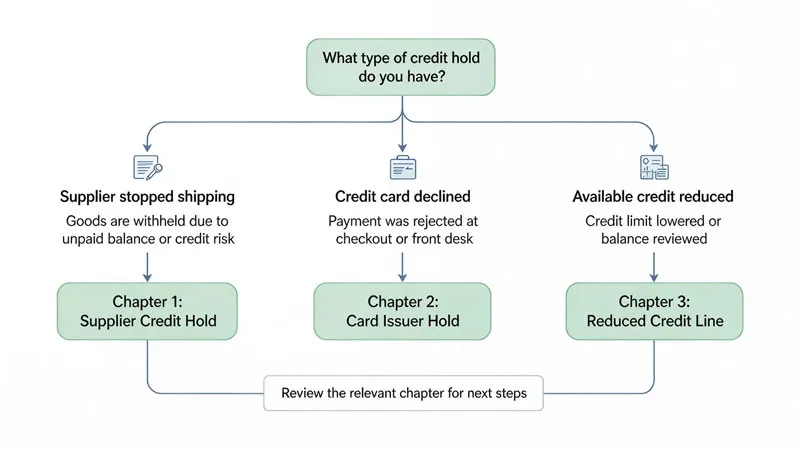
Which Credit Hold Do You Have?
Run this quick test:
- A vendor stopped shipping to your business? Go to the business account section.
- Your card is declined everywhere, or your issuer messaged you about a restriction? Go to the credit card section.
- Your card works, but available credit dropped after a hotel stay or rental? Go to the authorization hold section.
What Is a Credit Hold on a Business Account?
In accounts receivable, a credit hold pauses new orders for a customer who owes money or has hit their credit limit. The account stays open. The shipments stop.
Why Suppliers Place Accounts on Credit Hold
Suppliers carry the risk when they ship before they’re paid. A hold caps that risk. Common triggers include:
- Invoices that run past agreed terms, such as net 30 or net 60
- Orders that push you over your approved credit limit
- Bounced or returned payments
- Disputed invoices that haven’t been settled
- An outdated credit application, or a red flag on your business credit profile
Many holds are automatic. The accounting system flags your account once an invoice passes a set number of days overdue. A person may not have looked at your file at all.
What Happens to Your Open Orders
Open orders usually stall at the warehouse. Some suppliers release goods already in transit. Many don’t. Ask for the status of each order in writing. Some vendors will ship against prepayment or cash on delivery while the hold stays in place.
How Long Does a Business Credit Hold Last?
Until you pay the overdue amount or agree to a plan the supplier accepts. Many suppliers release the hold the same day your payment clears. A wire transfer clears faster than a mailed check, so choose your payment method with that in mind.
What Is a Credit Hold on a Credit Card Account?
A card-level hold is your issuer’s way of saying “pause.” It protects them, and often you, while they sort out a concern.
Why a Card Issuer Might Restrict Your Account
- Suspected fraud: a purchase in an unusual location, a rapid string of charges, or a large first-time purchase
- Missed payments: especially when the account is already past due
- Going over your limit
- Failed identity verification: common after an address change or a login from a new device
- An internal account review
Here’s a typical scenario. A cardholder books a pricey flight from a hotel Wi-Fi network abroad. The issuer’s system sees an unfamiliar location and a large amount, then declines the charge and restricts the card. One call to verify identity usually fixes it.
What You Can and Can’t Do During a Restriction
In most cases you can still view your account and make payments. You usually can’t make new purchases, and cash advances or balance transfers are often blocked too. Terms vary by issuer, so check your cardholder agreement.
Will the Issuer Tell You Why?
Often yes, by text, email, or phone. If the issuer acted because of information in your credit report, the Fair Credit Reporting Act rights generally require it to tell you, name the credit bureau it used, and explain your right to a free copy of that report and to dispute errors.
Is an Authorization Hold the Same as a Credit Hold?
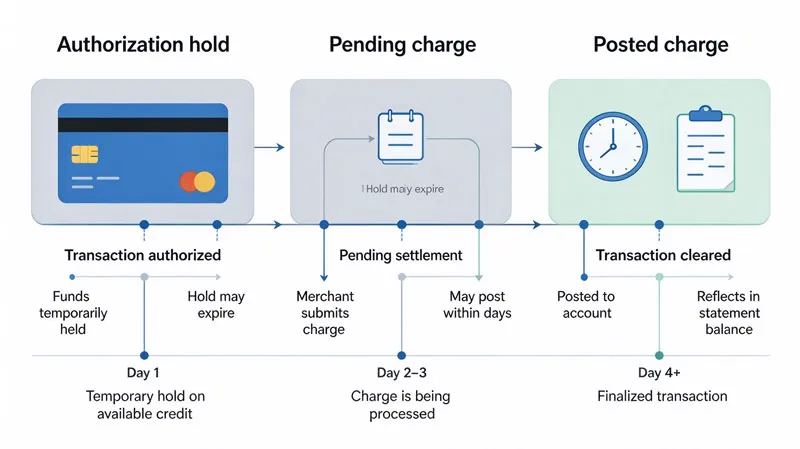
Not quite. An authorization hold is a temporary reservation placed by a merchant. It doesn’t signal a problem with you or your account.
Where Authorization Holds Show Up
- Hotels: your room cost plus an estimate for incidentals
- Gas stations: a pre-authorization before you pump
- Car rentals: the estimated rental cost plus a deposit
- Ride-share and food delivery apps: an estimate before the final fare or order total
How Long Does an Authorization Hold Last?
Until the merchant completes the final charge or cancels the hold. If the merchant never settles it, most holds drop off after a few days to a week. Timing depends on the issuer and the merchant, so confirm with yours.
Authorization Hold vs. Pending Charge vs. Posted Charge
| Authorization Hold | Pending Charge | Posted Charge | |
|---|---|---|---|
| What it is | A reservation of credit | A purchase awaiting final processing | A completed transaction |
| Amount | An estimate; may differ from the final bill | The final amount | The final amount |
| Reduces available credit? | Yes | Yes | Yes |
| Appears on your statement? | No | No | Yes |
| Goes away when | The merchant settles or the hold expires | It posts | Never; you pay it |
How to Get an Authorization Hold Released Faster
Ask the merchant first. Request that they void or release the pre-authorization, and keep your receipt. If the merchant has already voided it, your issuer can sometimes release it early. Don’t count on that.
Credit Hold vs. Credit Freeze vs. Fraud Alert vs. Card Lock
People mix these up constantly. The key difference is who starts the action and what it restricts.
| Credit Hold | Credit Freeze | Fraud Alert | Card Lock | |
|---|---|---|---|---|
| Who starts it | Issuer or supplier | You | You | You (or the issuer) |
| What it limits | Spending or shipping on your account | Access to your credit report | Nothing blocked; lenders must verify your identity | Charges on one card |
| Cost | No fee, but you may owe a balance | Free by federal law | Free | Free |
| How long | Until the issue is resolved | Until you lift it | 1 year; extended alerts last 7 years for identity theft victims | Until you unlock it |
| Where to fix it | Issuer or supplier | Each of the three bureaus | One bureau, which notifies the others | Your card app |
The Most Common Mix-Up: Credit Hold vs. Credit Freeze
A credit freeze is something you set to stop new lenders from viewing your credit report. A credit hold is something someone else sets on your account or credit line. Since a 2018 federal law, placing and lifting a freeze is free credit freezes at all three major bureaus.
If you’re worried about identity theft, read our credit freeze guide.
How to Get Off Credit Hold: Step by Step
If Your Credit Card Account Is Restricted
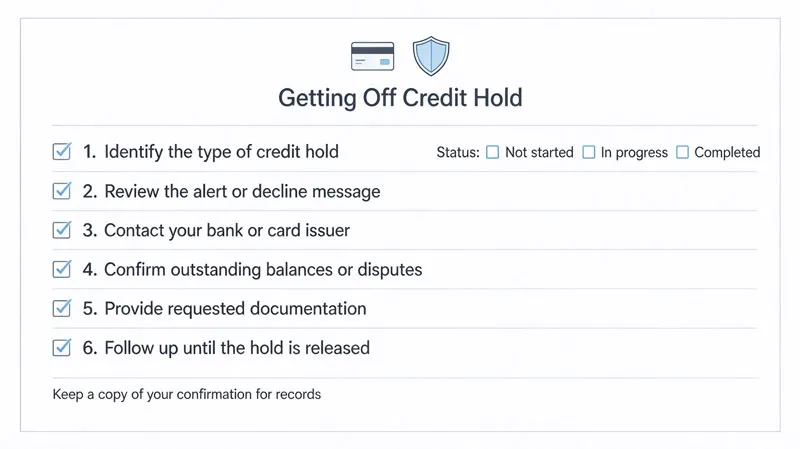
- Find out why. Check your app, email, and texts.
- Call the number on the back of your card. Don’t call numbers from unexpected texts or emails. Scammers fake fraud alerts.
- Verify your identity. Have your account details and ID information ready.
- Fix the cause. Confirm or deny flagged transactions. Pay any past-due amount.
- Get a timeline and a reference number. Write down the representative’s name and the time of the call.
- Test the card. After the promised release time, try a small purchase.
Script for the issuer: “I received an alert that my card is restricted. I’d like to verify my identity, review the recent transactions, and learn what’s needed to lift the restriction. Can you give me a reference number?”
If a Supplier Put Your Business on Hold
- Reconcile your invoices. Match each one against purchase orders and receipts. Find any disputes.
- Contact their accounts receivable team the same day. Call first, then confirm by email.
- Pay the undisputed portion. It shows good faith.
- Propose a written payment plan for the rest.
- Ask for a release date and a limit review in writing.
Script for the supplier: “Hi [Name], this is [You] at [Company]. I see invoice #[number] is [X] days past due. I’m sending $[amount] today and can pay the rest by [date]. Can you release the hold once the first payment posts, and confirm that in writing?”
If an Authorization Hold Is Tying Up Your Credit
Contact the merchant, not your issuer, and ask them to release the pre-authorization.
Does a Credit Hold Affect Your Credit Score?
The hold itself usually doesn’t. The problem behind it can.
When the Underlying Problem Hurts Your Score
Payment history is the largest factor in FICO scores, at roughly 35%. Amounts owed come next, at about 30%. Lenders typically report a late payment once it’s 30 days past due. Running over your limit pushes up your credit utilization too.
For businesses, unpaid trade invoices can reach commercial credit reports if the supplier reports them. They can also go to collections.
Do Holds Cause Hard Inquiries?
No. A hard inquiry happens when you apply for new credit. A hold doesn’t trigger one. Authorization holds don’t appear on your credit report either. They reduce your available credit for a short time, and issuers generally report your statement balance rather than pending holds.
Want to see what lenders see? Pull your free credit report and check for errors.
How to Prevent a Credit Hold
For Cardholders
- Turn on autopay for at least the minimum payment.
- Set balance and due-date alerts.
- Add a travel notice if your issuer offers one.
- Keep your phone number and email current so fraud teams can reach you.
- Leave a buffer. Before booking a hotel or rental car, keep your available credit well above the estimated total.
Strengthen your defenses further with our guide to credit card fraud protection.
For Business Owners
- Read your credit terms before your first order.
- Review your limit before placing a large order.
- Calendar every due date and pay early when cash allows.
- Raise disputes in writing as soon as you spot an error.
- Talk early. Suppliers tend to be more flexible before an invoice is 60 days overdue.
Know Your Rights If a Credit Hold Looks Wrong
Disputing a Hold You Believe Is a Mistake
Ask for the reason in writing. If the hold stems from an error in your credit report, dispute it with the credit bureau. You’re entitled to a free copy of the report when an adverse action is based on it. For billing errors, send a written dispute within 60 days of the statement that shows the problem.
Where to File a Complaint
Start with the company’s own complaints department. If that stalls, file a complaint with the Consumer Financial Protection Bureau (CFPB) or your state attorney general’s office.
When to Call a Professional
A supplier dispute that involves contract terms is a job for a business attorney. If a hold keeps recurring because of personal debt, a nonprofit credit counselor can help you build a plan.
What to Do Next If You’re on Credit Hold
Match your situation to the right type: supplier, card issuer, or merchant. Then act on the matching steps above. Call the issuer or supplier today, get a reference number, and put every promise in writing. Most holds end faster than people expect once the cause is addressed.
Credit Hold FAQs: Quick Answers to Common Questions
What does credit hold mean?
It means a lender, card issuer, or supplier has paused your ability to charge, borrow, or order on credit until a specific issue, such as an overdue balance or fraud concern, is resolved.
How long does a credit hold last?
It depends on the type. Supplier and card holds last until you resolve the cause, often within a day of payment or verification. Authorization holds usually clear within a few days to a week.
Can I still use my card during a credit hold?
Usually not for new purchases. You can typically still log in and make payments. Check your issuer’s terms.
Is a credit hold the same as a credit freeze?
No. You place a credit freeze to limit who can view your credit report. A credit hold is placed on your account or credit line by a lender or supplier.
Does a credit hold show up on my credit report?
The hold itself generally doesn’t. The late payments or collections that led to it can.
Can a supplier put me on credit hold without warning?
Yes, if your agreement allows it. Many suppliers hold accounts automatically once an invoice passes a set number of days overdue, so read your credit terms.
Disclaimer: This article is for educational purposes only and does not constitute investment, financial, or legal advice. Rules and policies vary by lender, issuer, and state. For guidance on your specific situation, consult a licensed financial professional or attorney.